


The 2026 racing season for the Emo Speedway is underway, with dozens of races taking place in multiple classes of racecar from now until the first week in October, the speed and noise can be a little overwhelming for the uninitiated. Here’s all you need to know about the point system, results, rules and regulations that Speedway racers follow throughout the season.
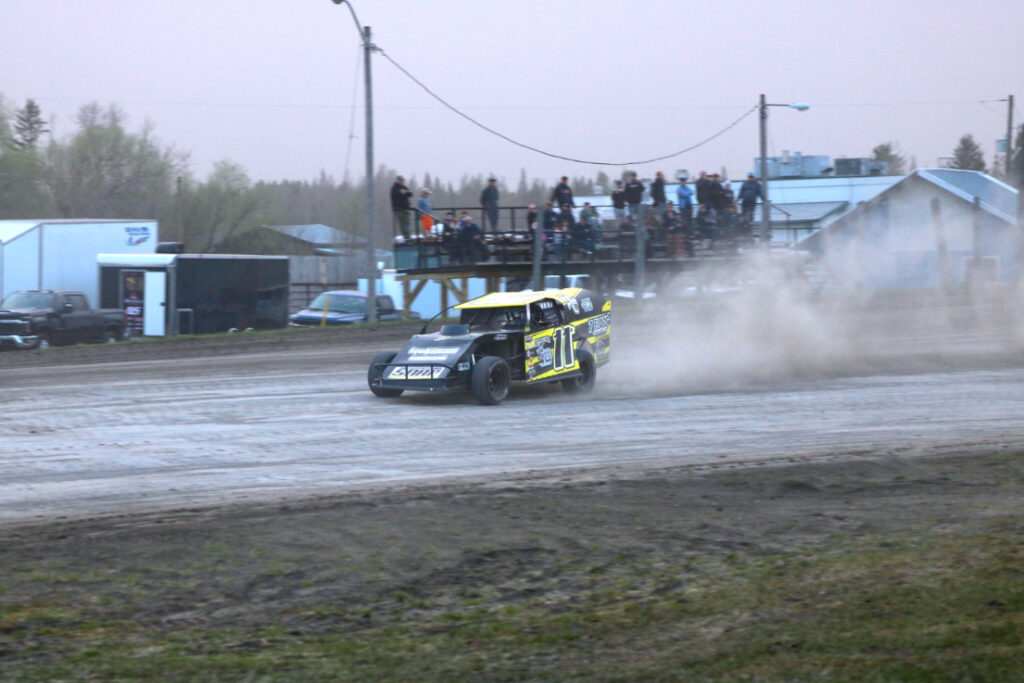
The speedway itself is a 3/8 of a mile clay oval track in Emo, Ont., operated by the Borderland Racing Association, a nonprofit that organizes races, maintains the track and staffs event nights.
The track races three classes from the WISSOTA (WISconsin and MinneSOTA Promoters Association) organization: street stock, Midwest mods and modifieds. WISSOTA, a nonprofit, member-driven organization, sanctions dirt track racing events in the Midwest U.S., Northwestern Ontario, Manitoba and Alberta. There are 45 tracks in Canada and the U.S., including the Emo Speedway.
New this year is the Junior Slingshot class for youth racers aged seven to 14. Races in the Junior Slingshot class are separate from WISSOTA and fall only on select weekends throughout the season.
What’s the racing point system?
Competitors in WISSOTA classes are ranked through a point system, with scores based on performances during two types of races—the heat race and the feature, according to A.J. Kellar, a regular competitor and three-time street stock champion at the Emo Speedway.
Heat races are short preliminary sets of races run right before the feature. They offer significantly fewer points to winners than a feature.
“To start off the night, you [the racer] draw a number out of 100, and that’s to randomize the starting spot of your heat race,” Kellar said. “If you win a heat race, you get 10 points, and then second place gets nine, and so on.”
Any racers finishing ninth or after receive two points in heat races.
Feature races are the main events of an afternoon on the track, with one run per day for each class.
“The system automatically redraws your starting number and then that determines your starting spot for the feature,” Kellar said. “If you win a feature, it’s 35 points. Then it drops to 33, 32 and so on as it goes back. Then they just accumulate throughout the year.”
There are two different point structures utilized in Emo: the track’s own local point system and the national point system. The local point system keeps a record of the races run only at the speedway, while national points accumulate for each race on every WISSOTA track over the season.
The final national score tallies points from 30 races during the season. A driver can race as often as they are free to do so, however, only the 30 best finishes are used to determine the final score.
Rules and regulations
As in any sport, there are plenty of rules that a competitor must follow—it isn’t as simple as driving in circles and getting ahead of the car in front of you.
Each WISSOTA class is bound by a set of general rules as well as class- and track-specific rules.
The general, across-the-board WISSOTA event rules pertain mainly to safety and driver conduct on and off the track. For example, there is a zero-tolerance policy for any impaired driving or consumption of alcohol or illicit substances in the pit area.
This is enforced with a mandatory fine of $500 and a 90-day suspension from participating in sanctioned events, and could result in police involvement, depending on the legality of the substance. These regulations also govern unsportsmanlike conduct and discrimination, ensuring fair treatment amongst all racers.
Then there are separate rules for each class that govern a range of technical specifications that must be met by each car in that class. These vary widely for each class and include frame, body and engine specifications. Full documentation of the WISSOTA event and class rules can be found by visiting its website at wissota.org/rules/.
“There’s a rule book for every class,” Kellar said. “They go into how a car needs to be built—what specs are allowed for motors, transmissions, differentials, shocks, everything.”
In addition to the general and class rules, because no two tracks are the same, each racer must follow the safety guidelines unique to whatever track they’re driving on that day.
This does not include Junior Slingshot rules, as it is not a class sanctioned by WISSOTA. Slingshot rules, regulations and vehicle specifications, along with track-specific rules, can be found on the Emo Speedway website at borderlandracing.com/rules/.
Sponsorships keep
Because the average person doesn’t have the financial means to continuously service and swap out parts that get dinged up and bent out of shape on the track—a majority of racers wouldn’t be able to stay in the game if they had to shoulder the entire financial burden of running a racecar—most seek sponsorships.
“Sponsors play a huge role in everyone’s racing program,” Kellar said. “Since it’s an expensive sport, it really helps out to have good sponsors. I’ve been really fortunate to have a good crew of sponsors on board my car for the last few years.”
Without a team of sponsors to help keep drivers on the track, the sport simply wouldn’t exist.
For their part, sponsors get brand association with the racer they fund, stamping highly visible logos across the car.
Armed with this information, spectators can enjoy the next speedway event on May 30, featuring races from the three above-mentioned WISSOTA classes. Gates open at 6 p.m.





