


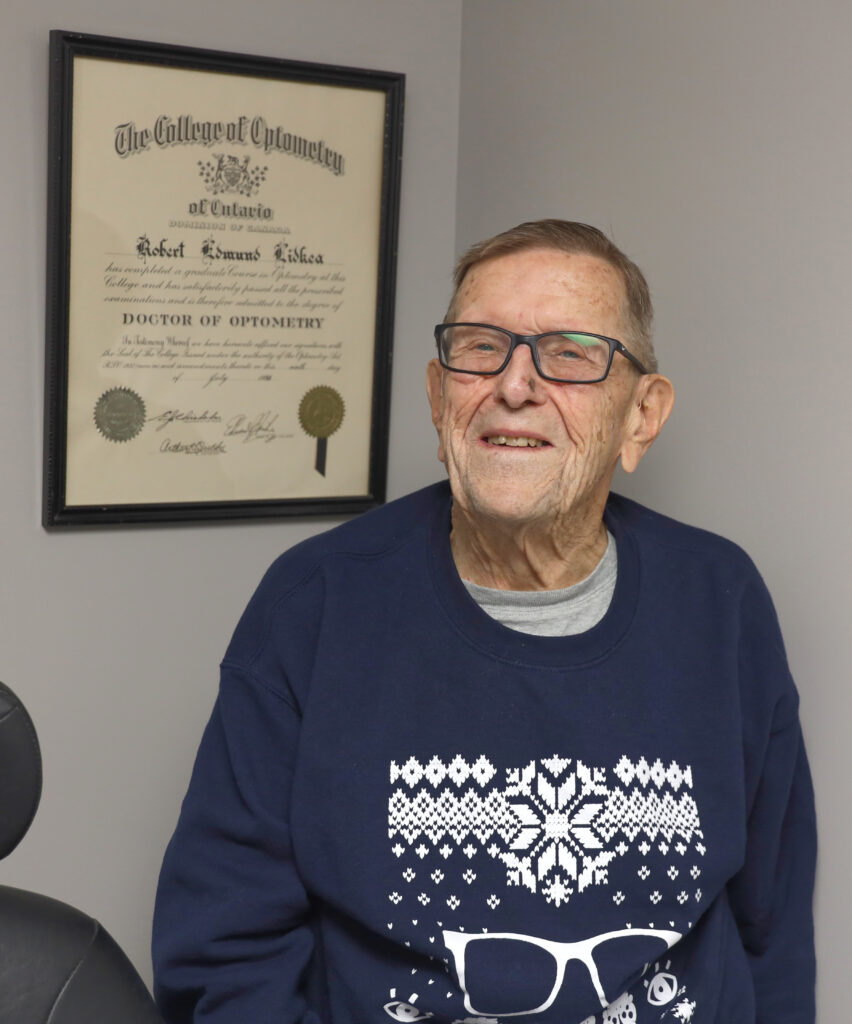
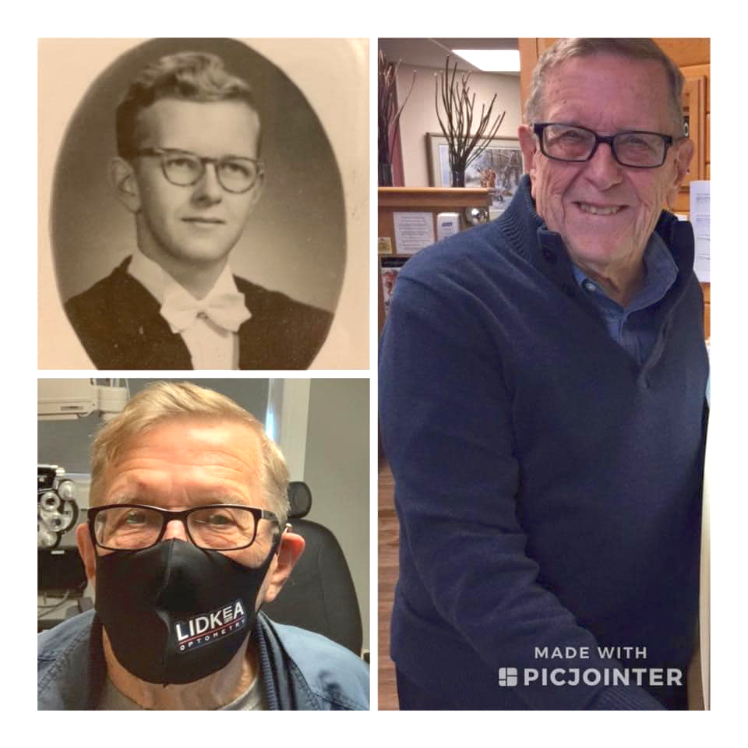
This year, Dr. Robert Lidkea celebrated his 93rd birthday with the gift of retirement. Known in 1952 as the youngest practicing optometrist in Ontario and in 2021 as the oldest practicing optometrist, Lidkea has made great strides in the optometry field and as an avid volunteer in his community.
At Lidkea Optometry in Fort Frances, Ontario, where he served as clinic founder and optometrist, Lidkea sat in the optical exam chair in his office and reflected on the significance of New Year’s Day.
January 1 happened to be Lidkea’s birthday and officially marked his retirement this year—a fitting milestone for a day that symbolises fresh starts across the world.
Lidkea recounted the day of his birth when the doctor, dressed in a tuxedo, congratulated Lidkea’s mother for having not only her fourth child but also the first baby of the year at North Bay Civic Hospital.
“My doctor was taken away from a New Year’s Eve party. It was after midnight, but he was in a tuxedo,” Lidkea said. “He was a little drunk, but the nurses took care of me… All the other doctors were still at the party.”
Since then, Lidkea carried the spirit of celebration with him every day to work.
“I’ve really, really enjoyed it. I was so happy and eager to come to work,” he said.
Lidkea attempted to retire once before. In 2021, he planned to officially retire on Jan. 1 and then went back to work on Jan. 21, saying that he could not stay home all day.
But lately, it has been getting more difficult for him to continue working. Lidkea said he was 100 per cent sure he would retire this year.
“First of all, I enjoy being an optometrist,” Lidkea said. “It’s getting to be harder to do. There’s so much technical work now and so much more education required now. And it just become not as much fun as it used to be. I enjoyed it before. It’s just getting harder to do. And plus the fact that I’m turning 93—time to slow down.”
“Maybe it is this year’s birthday present to me,” he said.
Lidkea graduated as a registered optometrist in 1952, and earned his doctor of optometry in 1958 from the College of Optometry of Ontario. Of 240 students in optometry school in all of Canada, except Quebec, only four were from Fort Frances, he said.
“So that’s a pretty high ratio. And through the years, there’s probably been 15 students from here that have gone on to become optometrists,” Lidkea said.
He came to Fort Frances in 1952 to become part of the Fort Frances Clinic, the same building where Lidkea Optometry’s office currently stands. At the time the clinic had only two M.D’s, a dentist, an optometrist, and a pharmacy. Lidkea took over for the former optometrist.
“It was a step forward. Before that, a lot of optometrists were in the back of jewelry stores,” Lidkea said. “It was not really an important profession at that time. And it was in 1975, when the Health Act was performed, optometry became one of the five professions recognized under the province of Ontario—so that would be medicine, nursing, dentistry, pharmacy, and optometry.”
“That was the first that we actually were ever recognized. And that happened to be the year I was president,” Lidkea said.
Lidkea served as president of the Ontario Association of Optometrists from 1975 to 1976.
“I was at a meeting in Halifax and had to fly to Toronto to have lunch with the Minister of Health, and back to Halifax that night,” Lidkea said, laughing. “A big step forward.”
Lidkea pointed to the phoropter, an instrument that helps measure eye prescriptions, and noted that it has probably changed the least throughout the years.
“P-H-O-R-O-P-T-E-R. Phoropter. It’s got all the lenses in there,” he said. “We didn’t take much of this school. But in the early 1960s, I bought one.”
In his office, an original case of lenses used before the invention of the phoropter was on display. It came with the optometry office and was probably older than he was, he said.
Furthermore, many progressions have been made in the field to extract more information about eyes, Lidkea noted that optometrist students now have license to do things that would have been illegal for him to do back when his career started.
“At that point, we weren’t allowed to use any medications or drugs on the eyes. And so it was around probably around the 1980s where we could use diagnostic drugs… and we could enlarge the pupil. It’s progressed so much from what it was. So many improvements in finding the information.”
Lidkea also noted that optometrists couldn’t sign travel grants for people in need of eye surgery. To receive a travel grant for an eye surgery, optometrists had to refer them first to a doctor.
“Although we referred them for cataract surgery or glaucoma… we weren’t allowed to even sign for them to say that they had it,” Lidkea said. “It’s really come a long ways ahead as a recognized profession.”
Looking back, Lidkea feels that his career has been interesting, fun, and helpful—to both himself and others. Some of the most rewarding moments in his career was when his job helped discover other serious medical issues and saved lives.
“In those days, it was before the days of CAT scans and things like that. So there’s several times that I found people with brain tumors and I was able to get them referred and get surgery done on them. They had cancer in the eye and things like that,” Lidkea said. “I don’t know that they were necessarily favorite [moments], but they were important—important to the other people, too.”
He anticipates that optometrists will eventually be allowed to do minor surgeries.
“I can’t tell you when that’s going to be and it’s not going to happen fast, but that would be the next step if it ever happens.”
Lidkea has been a member of the Kiwanis Club of Fort Frances since 1952 and has 60 years of perfect attendance. He became President in 1961 (the youngest President in the history of the Club) and was elected Lt. Governor in 1973 to 1974. Later he again served as President in 1996 to 1997 and has been the secretary for many years.
He was elected to Town Council for two terms (five years) and served on many local boards. One of the appointments was as the representative on the District Health Council where he became Vice Chairman. The District Health Council asked him to remain on, as a member of the Emergency Health Committee and he worked at district, regional and provincial levels.
Lidkea was honoured by his profession by receiving the Ontario Association of Optometrists ‘2004 Millennium Award for Public Service’. The Millennium Award recognizes a member of the Ontario Association of Optometrists who has performed extraordinary public service, in either a professional or non-professional capacity. The emphasis is on public service.
Lidkea was named “Fort Frances’ Citizen Of The Year” in 2007.
In retirement, Lidkea says he looks forward to regular coffee breaks at 10 a.m. sharp with his friends, staying active in his church and community, and upkeep around the house.




