


Peter Spuzak, an artist from the township of Albertan, Ontario, has always loved art. The Alberton township artist revered the inherent beauty of the natural landscape while working on his family farm. His passion led him to study advertising design at what was then called the Ontario College of Art, now called OCAD, in Toronto. His studies focused on advertising design and led him to spend time in Cyprus documenting Canadian peacekeeping efforts, later returning to his family farm and selling his artwork during family vacations.
His decades of work will be celebrated in a temporary exhibit, at the Fort Frances Museum and Cultural Centre. A retrospective of his body of work will be on display until December 13, with an opening reception taking place tomorrow, Thursday, October 10, from 6-8 p.m.
Assembling the show has given him a chance to look back over his work, and he shared some of his memories with the Times.
“I had a leaning towards drawing and stuff like that when I was very very young,” says Spuzak,
“I never really took it seriously because I thought everybody could do what I did. As I got older I realized, you know, not everybody could do what I did.”
As he got older, he also started working on his family farm, admitting he didn’t have much exposure to art galleries. He was born and raised in Alberton Township, and worked on the farm his entire life. But the rural landscape provided plenty of inspiration.
“It’s absolutely beautiful here,” says Spuzak, “there’s a lot of beautiful places in the world, but, we have a very beautiful place here where we live.”
“I was just in town and I brought stuff up to the library today, and, the lower river, you can see it now,” says Spuzak, “I thought to myself, ‘I should have brought my camera to take pictures.’ Those are the types of things I see around me all the time. I could turn around ten or 60 degrees and there’s a painting every five [or] ten degrees.”
“Every day is a beautiful day,” added Spuzak. “Every day is absolutely gorgeous.”
Despite being surrounded by natural beauty, Spuzak says he didn’t get much exposure to art galleries at a young age because he was busy working on the farm. However, that didn’t stop his passion for artwork, picking it up in his spare time.
“There wasn’t much room to know what art galleries and oil paintings and watercolours were,” says Spuzak. “If I had a pencil, I just drew.”
“I seriously took the art class that they offered right from grade nine and up,” says Spuzak, “I definitely wanted to do that rather than a business course, a music course, stuff like that.”
Despite his passion for artwork throughout high school, Spuzak didn’t consider applying to art school until late in grade 12.
“I had good marks in high school in art because it was just a part of me. To me, It was never work, never hard.”
He hadn’t thought of going off to further studies until one day, near the end of grade 12, he learned that one of his classmates was planning to go to the Ontario College of Art in Toronto.
“I thought, if she can go maybe I should try,” he said. “It’s just like a lightbulb came on in my head, like a revelation.”
Time was running out to apply – other students had already submitted their admission packages, and spots were filling up.
“They sent you an admission test,” says Spuzak,,”You had to do all that they wanted, about ten different things, perspective and drawing … various things, composition and design. So, I did all that and I sent all that in and they sent back in the mail that they wanted a little art portfolio. So, I did that and luckily I was able to get in because that college was quite popular.”
“I decided to go to a[n] advertising design course because it was a very broad course that involves a lot of stuff,” says Spuzak, “the advertising design course covered pretty well everything from typography, photography, to animation, illustration, double and triple design classes, so, you know it was just totally full.”
“I took photography throughout the year, I made two animation films, I did a lot of illustration, painting, and design. All that stuff,” says Spuzak, “I thought I really needed to learn design because I didn’t understand it. But, that wasn’t the case,” adding, “I didn’t understand the vocabulary of design.”
“I didn’t consider any of it hard work to go to that college. It was so comfortable to be there, like a shoe [that fit.]”
Spuzak says the Ontario College of Art advertised a scholarship to fourth-year students so they could get a fifth-year during their studies.
“They had me kind of chosen to do that,” says Spuzak, “but I was probably the third quarter of my last year there, my drawing place, drawing instructor. He mentioned he was in Cyprus as a war artist.”
“He says to me, ‘Hey, Peter. Why don’t you give it a try? You’re good enough.'”
He wrote a letter to the Canadian Armed Forces in Ottawa. A reply arrived four weeks later.
“They said, ‘Where and when in the world do you want to go?’ Those words are branded in my brain.”
Spuzak chose Cyprus because they had a big history of civilization there, from Romans to Egyptians; Cyprus is an island in the middle of that.
“That’s where I chose to go, a gorgeous island. But, of course, there was conflict there,” he said.
Canadians were part of a United Nations peacekeeping force at the time.
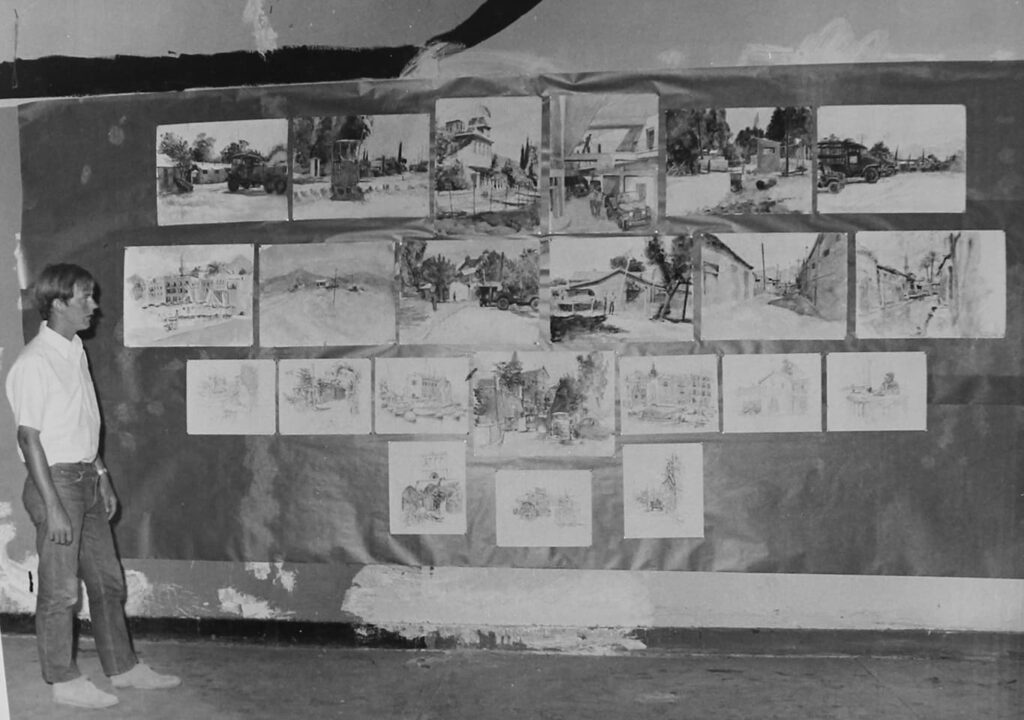
“Basically, what they wanted me to do was paint [the] military activity of the Canadian Armed Forces working under the United Nations peacekeeping mission.”
Afterward, Spuzak decided to return to his family farm.
“I thought, well I’ll just graduate and come back home to the farm, work on the family farm,” says
Spuzak, “I kind of had to think of how I was going to make a living at my art.”
He started working as a carpenter, helping to build several houses.
“Slowly I evolved to do more things with art, art-related things. Everything I learned I put to use if it was able to be used,” he said. “I developed a system where I could make a reproduction of my work, and I was able to market that.”
He started to produce and sell art on the road.
“We decided to take a holiday,” says Spuzak, “me and my whole family of kids. I just stopped all along the way and sold stuff and there and back and we stayed in hotels, ate in restaurants and stuff, which is very expensive. I come back with, like, 11, $1,200 in my pocket. Not a bad way to go for a holiday.”
Overt the past five decades, he’s tried almost every medium, from charcoal to oil paint, from paintings to statues and murals. He’s spent time in classrooms and sold his work through markets.
Spuzak’s exhibit at the Fort Frances Museum opens on Thursday, October 10 from 6 to 8 p.m. There will be a wine and cheese reception, and a chance to talk to Spuzak about his work.
The exhibit will be open until December 13.



