A delightful smell found me upon opening the doors of the Fort Frances Museum & Cultural Centre on Thursday evening. Something warm and savoury was drifting down the stairs, so I duly followed it.
At the top, a dozen guests were settling in for Taste of History: Homefront, sipping tea and coffee poured by Catrina Caira. The museum’s program and events coordinator had cooked the evening’s menu all by herself. Talk had already turned to rationing and, for guests of a certain age, “those old sticker books.”
The menu came straight from real wartime ration recipes: emergency steak, mashed potatoes, steamed broccoli, baked onions and glazed carrots were all among the offerings.
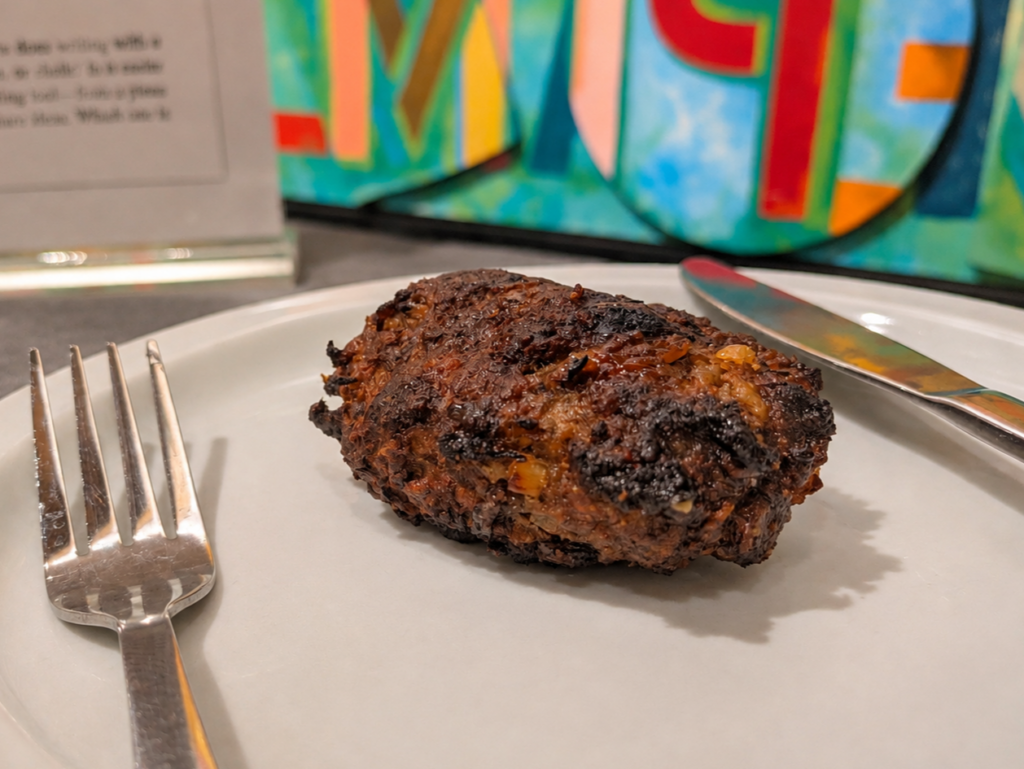
The curiously named emergency steak is in fact ground beef bulked out with Wheaties and shaped like a steak, a wartime trick for making meat go further. I have to admit to my doubts about breakfast cereal at dinner. But I can now say that the end result was surprisingly good and still juicy! Judging by the nods of approval around the room, I wasn’t the only convert.
A cauliflower recipe proved the trickiest and was swapped out for the glazed carrots.
“It’s always best to check these old recipes before serving them to someone else,” Caira warned, with a laugh.
For Josie Schill, 88, the spread was a step up from what she remembers.
“It was great. Above and beyond what we would typically have,” she said. “Sundays were for beef, pork … chicken. The rest of the time it was almost always soup. I’d see Grandma coming in with another big pot of soup and say, ‘Not again!’”
An only child, Schill grew up sharing a house with relatives. The family kept a cow and chickens, so they did well for eggs and milk. She also remembers plenty of canned goods, made with far less sugar than you’d find now.
Her father and three uncles all served in the war. One relative, Stoker 1st Class John Ossachuk, 25, of the Royal Canadian Naval Volunteer Reserve, was lost when the corvette HMCS Shawinigan was torpedoed in the Cabot Strait in November 1944. No one aboard survived. The men who did come home, Schill said, were reluctant to talk about what they had seen. Rationing ended in 1947. Their silence lasted rather longer.
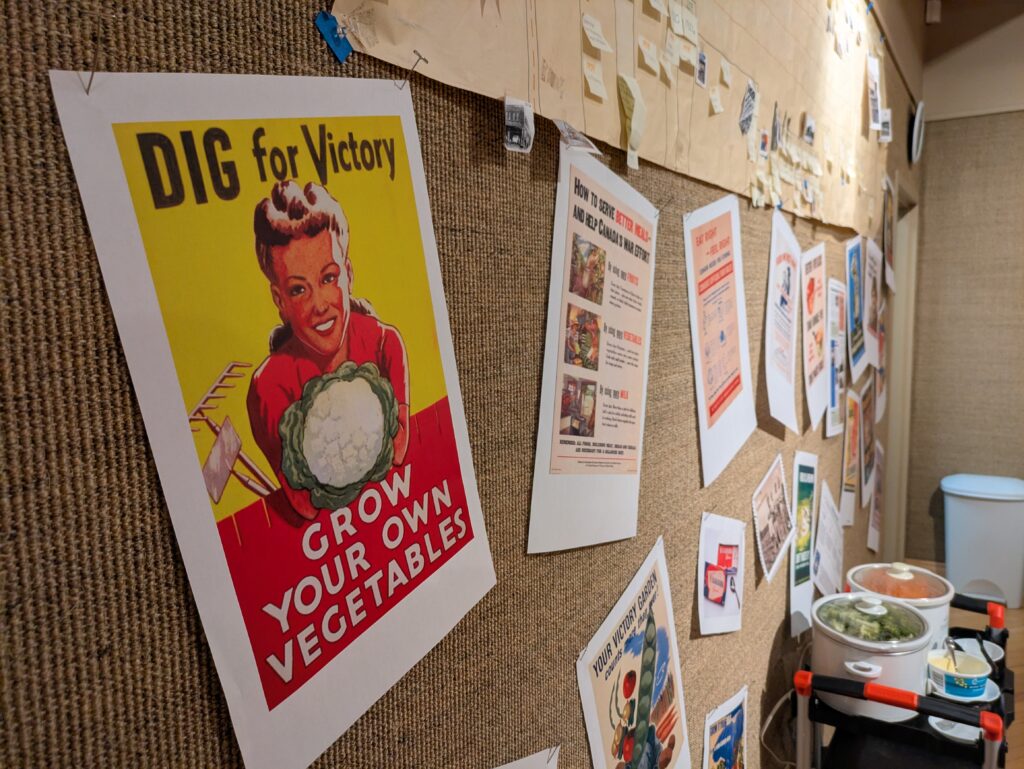
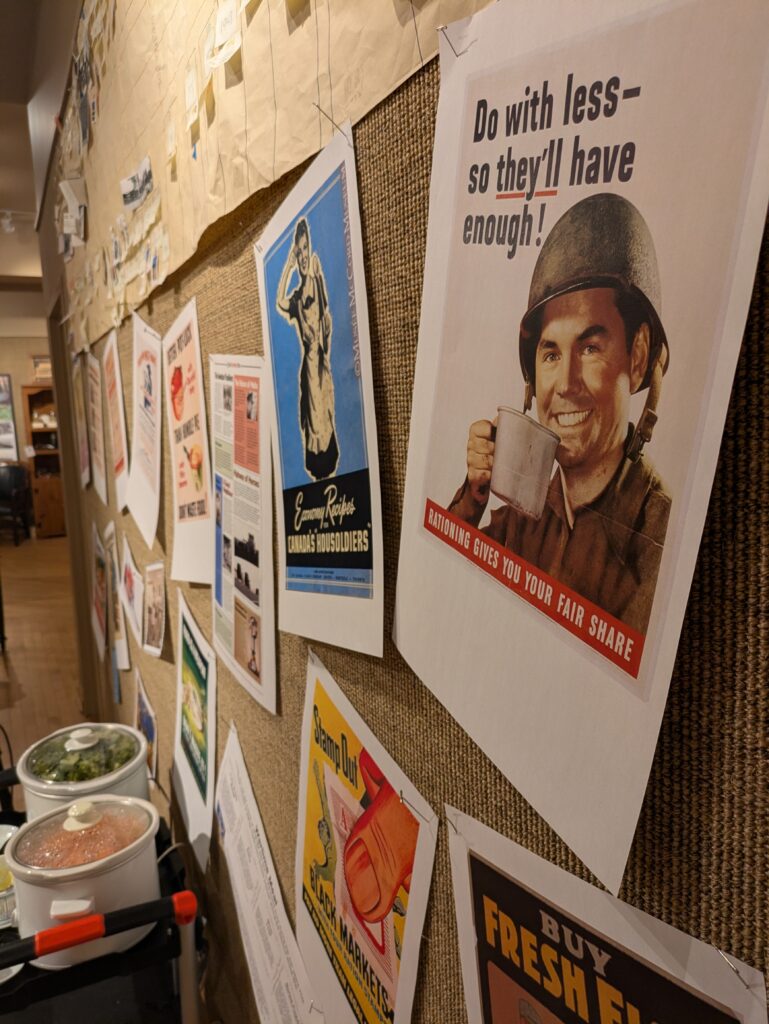
Caira filled in the bigger picture over dinner. Early in the war, she said, Ottawa urged beginners not to bother with victory gardens, since the tools would use up metal, a critical resource. Canning was pushed instead, with free classes popping up all over. By war’s end, she added, Canada was supplying a substantial share of the Allies’ food.
She also told guests about Kate Aitken, “Mrs. A” to her radio listeners, who taught Canadian homemakers how to stretch their rations and remake old clothes. An excerpt from Aitken’s cookbook sat beside a First World War cookbook, its recipes far more generous than the Second World War’s. The display case also held yellow and pink ration books, a gasoline ration book and coupons.
Dessert brought its own lessons in making do. Neither cake contained butter or eggs, and the chocolate option, known today as ‘wacky cake’, has no chocolate in it at all.
The war cake, a raisin-packed spice cake flavoured with cinnamon and cloves, has almost no sugar in it; the raisins do the sweetening. It’s in every ration cookbook, said Caira, who called it “one of the big recipes of Canada during the war.”
Caira came up with the Taste series and oversees it, including its Taste of Culture events.
“They are great for highlighting some of the heritage we have in this area,” she said. “We have multicultural roots all around us, and it’s nice to promote that fact.”
The next event in this series is the ‘Taste of Culture: Italy’ event being held at the Museum on Thursday Nov. 26. Tickets are $35 + HST per person and can be purchased here.
***
Recipe from tonight’s meal. Perhaps we could print as a sidebar?
Canada War Cake
Adapted from How to Eat Well Though Rationed: Wartime Canning and Cooking Book (1943)
Ingredients
- 2 cups brown sugar
- 2 cups water
- 2 tbls shortening
- 1 tsp salt
- 1 tsp cinnamon
- 1 tsp cloves
- 1 ½ – 2 cups raisins
- 3 cups all purpose flour
- 1 tsp baking soda
- 1 tsp hot water
Method
- In a saucepan, combine the brown sugar, water, shortening, salt, raisins, cinnamon and cloves. Bring to a boil and cook for five minutes.
- Allow the mixture to cool.
- Preheat the oven to 325 degrees Fahrenheit and line pans with parchment paper.
- Dissolve the baking soda in one teaspoon of hot water.
- In a large bowl combine the raisin mixture with the flour and baking soda slurry. It will form a dense and sticky dough.
- Form into two loaves and bake for 45 minutes.
- Allow to cool on a wire rack before slicing.