


When Jennifer Berti, Autism Support Worker for the Rainy River District School Board (RRDSB), first met Kebbi, a robotic learning companion designed to better support students on the autism spectrum, she supplemented the curriculum with Kebbi’s presence at the request of a parent.
Since then, the board purchased two Kebbi robots of their own to pilot with autism support workers like Berti. Berti quickly noticed that students had a greater willingness to participate and engage in learning with Kebbi’s presence. While Kebbi is a valuable educational tool, it does not directly teach the children. An educational worker, like Berti, pilots the robot.
“We could see a difference in some of the social skills that came out and how they interacted differently with Kebbi, as opposed to just us, when we were speaking with him,” said Berti. “[Students were] very interested in what Kebbi was, and were able to participate a bit more than they would in our traditional teaching style.”
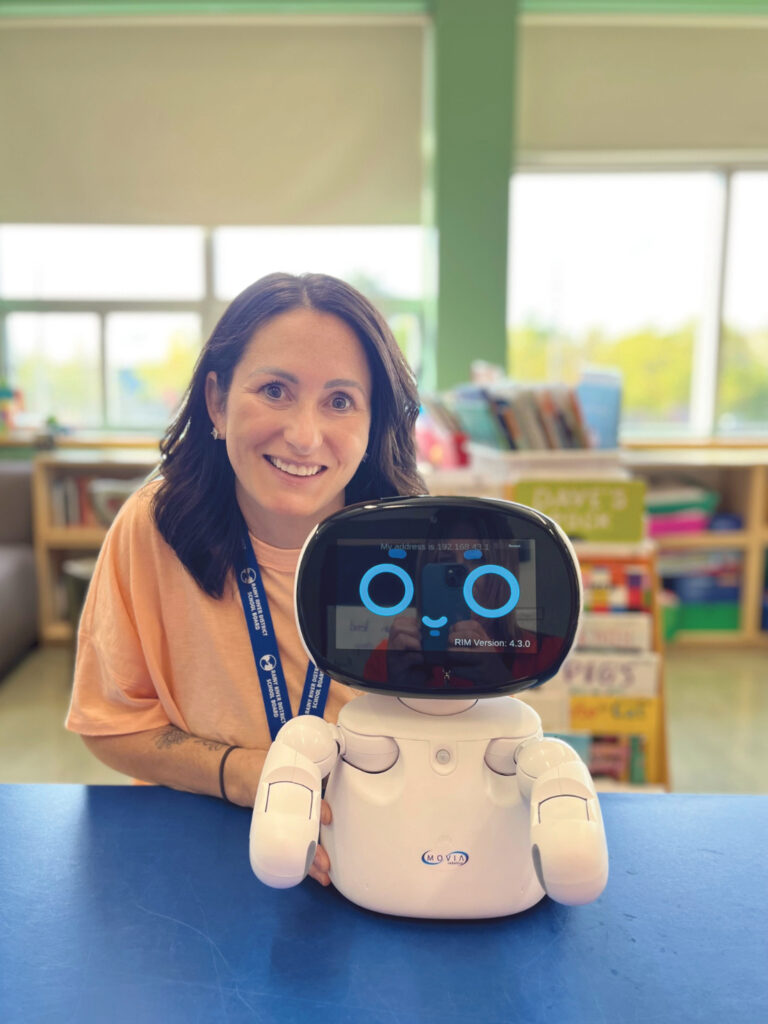
Kebbi is a product of NUWA Robotics, an international corporation that is focused on providing “a personal robot comapion for everybody,” according to its website. It currently offers a number of different products that revolve around the concept of personal robotics, including a self-guided tower unit that can be customized with shelves, drawers or ad screens to work in a variety of different retail and office settings, as well as a version of the Kebbi bot specifically designed for home use; think an Amazon Alexa with the ability to express itself using its screen/face and arm movements. The Kebbi robot itself can also be programmed for sales, healthcare and education settings, thus its presence at RRDSB.
According to Berti, because Kebbi is a robot, it helps reduce some of the sensory overload and social anxieties present in classroom learning sessions.
“It reduces some of that cognitive overload and some of the anxiety that they have when or if they struggle with some human interaction,” said Berti.
“It can slow down the rate of speaking or the volume so that they’re not overwhelming for the student as well. We had one student who had difficulty engaging because they had very little social communication with others. But again, when Kebbi was introduced, they were very interested, and we were able to see some skills with Kebbi that they weren’t able to do in our previous learning environment.”
So, Kebbi excels at managing the learning environment and sharing bits of information in a user-friendly way, while ensuring students meet their learning goals. But it is important to note that it is not Kebbi doing the teaching.
“The Kebbi is not educating the child,” said Berti.
“It’s just used as another educational tool, a different teaching modality. The lessons are very short. They’re about 15 to 20 minutes one to two times per week.”
According to Berti, the curriculum taught via the Kebbi robot is tailored to the students’ individual educational plan and provides greater opportunities to work on the skills identified in their learning plan. But still, something sets Kebbi apart from other teaching methods and modalities. Something akin to a personality.
“He’s fun and friendly to the students,” said Sonja Ahrens, Principal of Fort Frances High School, about Kebbi. “Some of the students like to talk to him,” added Berti. “We can talk, and Kebbi can talk back and engage with them.”





