



The Fort Frances Museum will be showcasing a law-enforcement-themed exhibit in the New Year, covering everything from the badges and uniforms of local officers to police equipment and court cases with over 100 years of history to draw from.
Fort Frances Museum and Cultural Centre curator Lisa Hughes said the exhibit will be an opportunity for the museum to pull out some historic artifacts that don’t often have the chance to see the light of day.
“We have so many things in storage in our basement, and they don’t get seen,” she said.
“So, a temporary exhibit is a chance for us to pull those things out and display them for people to get to see.”
As part of the exhibit, Hughes said the museum will be able to teach visitors about some notable criminal cases from Fort Frances’ history, and will include various artifacts, police equipment from a bygone era like handcuffs, and a mention of the infamous Hot Stove murder.
The goal of the exhibit is to explore the history of law enforcement in the district, from court hearings of criminal cases to officers on duty.
“The courthouse was built over 100 years ago, so the history and the changes of that are interesting,” said Hughes.
“This is just an example, but two boys ended up stealing horses in 1912, and then the owners ended up tracking down the youth and marching them back and putting them in jail. There are unique little crimes like that which have taken place and are interesting. We’re trying to highlight some of those, the unique ones of Fort Frances.”
Court proceedings for some of these crimes would land the accused in jail, and pieces of the former Fort Frances Jail will be on display.
“Our jail in town is actually one of the oldest in Ontario, the one that is still present and used today,” said Hughes.
“[The town] actually had an old, wooden-style jail, and they managed to save a few of the corner pieces when it was torn down. It’s really unique when you see the picture.”
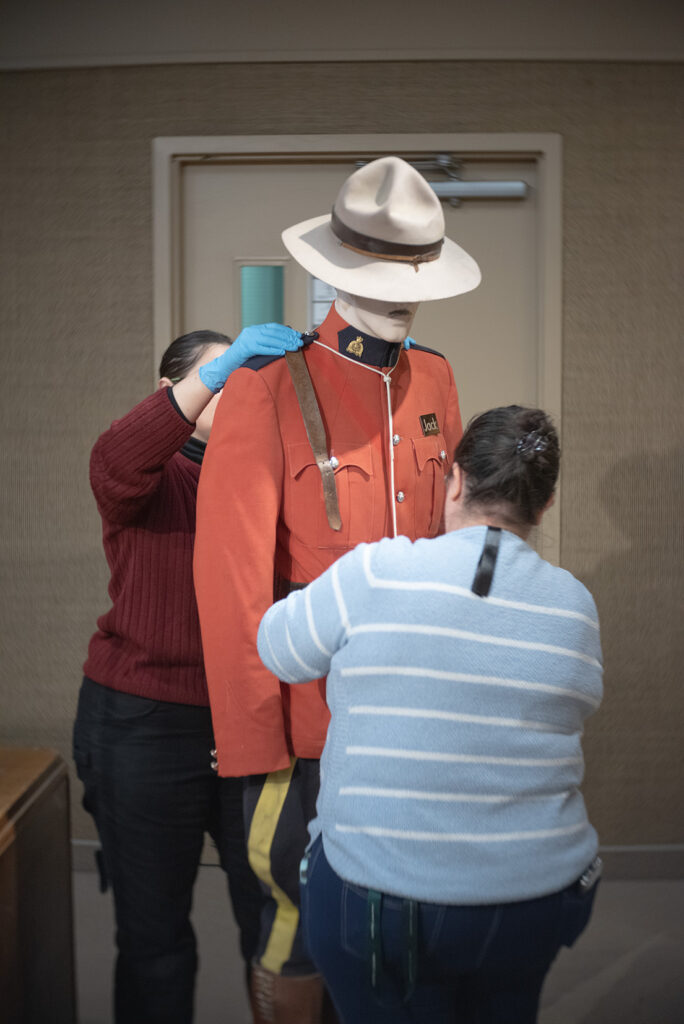
A selection of uniforms and artifacts from the various police forces that have operated withing Fort Frances across its history will also be on display during the exhibit.
“If you look at Fort Frances’ history, we have a town police department, we have the OPP, and we have the RCMP. Those will all be on display, and for many years, all three were running at the same time,” said Hughes.
“We’re very fortunate. This is actually Police Chief Mike Solomon’s uniform. We also have an OPP uniform, and if you look at the Fort Frances Police Department, they have their own logo. You can definitely identify that it’s related to Fort Frances. We also have two or three radar guns in our collection. At one time, they needed two people to operate them. They’re not exactly the lightest things, and they needed more than one person. Now you have the handheld version, but you can see the progression of that over time.”
According to Hughes, Fort Frances Police worked with a tailor at McTaggart’s to design its uniform. An old-style RCMP uniform will also be on display until it goes into storage for the foreseeable future due to light damage.
“In another 100 years, it can come out again,” Hughes said.
There will also be historic shackles from the 19th century, which were used during the genesis of lock-and-key technology.
“For many, many years, you would need a blacksmith to put on shackles, and then you’d also have to have them removed by them,” Hughes said.
“In the 1800s, they began to develop lock-and-key locking methods. This is one of the precursors to our regular style. Not having bars or a lock on your door, they put a rope or a chain around it.”
Lastly, there is the section of the exhibit about the Hot Stove Murder, an infamous case from the town’s past which led to three accused persons being given capital punishment for their involvement. Should observers choose to abstain from viewing that or other more sensitive materials, artifacts associated with the case will be on display behind a room divider with content warnings.
“We do have an area here that does actually talk about the death penalty, so that’s one of the reasons we do have a content warning,” Hughes said.
“If anyone doesn’t want to learn about capital punishment, we give them that option.”
The exhibit will open on January 5, 2026, and will run until sometime in the spring of 2026.




