



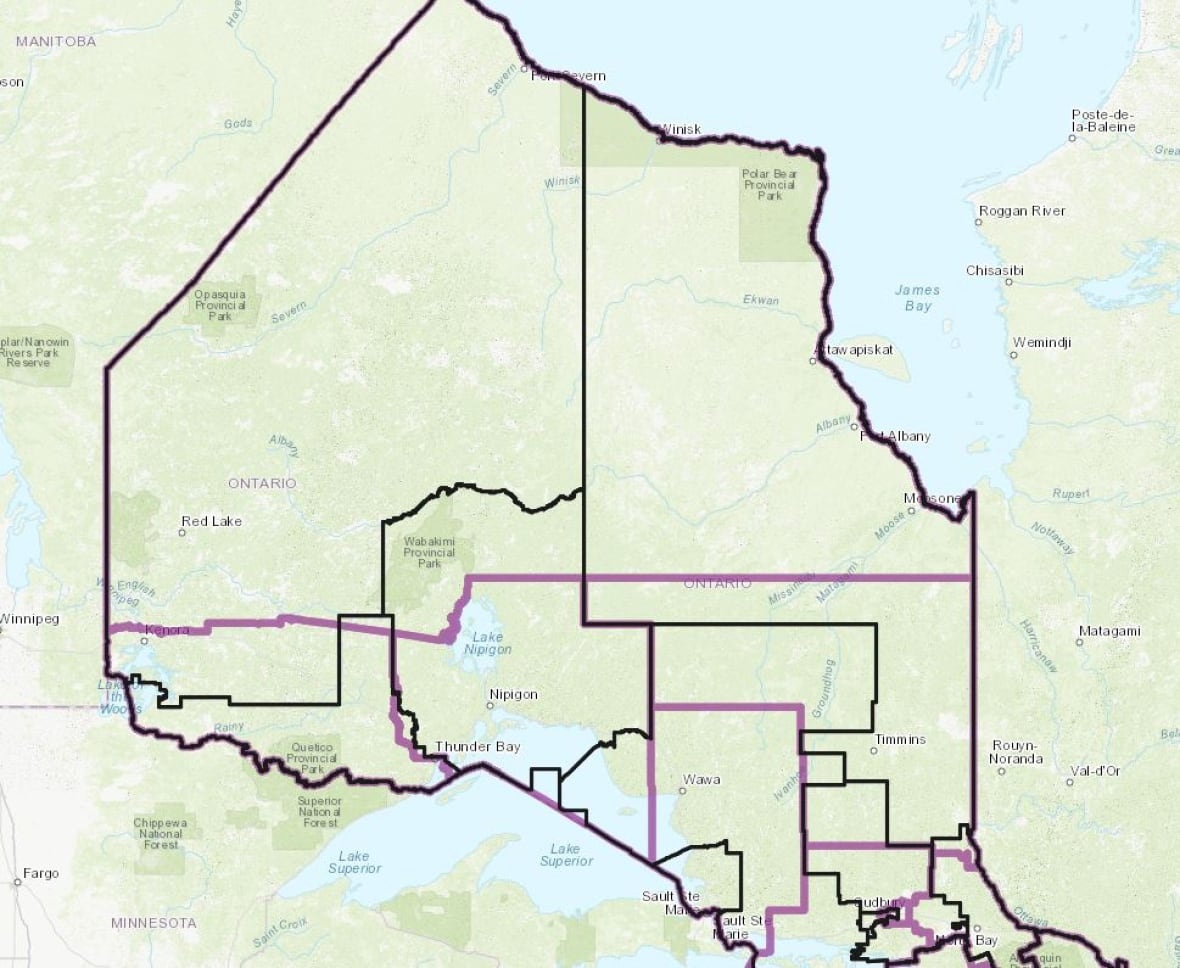
At Monday’s Town Council meeting a resolution was unanimously passed to submit a statement against the proposed redistribution of federal ridings in northern Ontario.
As published in the agenda for Monday’s Town Council the resolution speaks to the way that the redistribution of the boundaries would affect Northern Ontario and the Town of Fort Frances more specifically.
Ridings are being examined due to population shifts as is mandated in the Electoral Boundaries Readjustment Act every 10 years, per the current census. At Monday’s meeting Coun. Doug Judson–who submitted the resolution to council– explained that the Commission does things based on a formula to have each riding contain a population of about 116,000 people give or take 15 per cent. The commission does consult with residents to get their opinion on the proposed redistributions.
Judson says it is up to the people who live in these regions to show the Commission what they should consider when creating new ridings.
“The reason it’s important for municipalities and other stakeholders like us to speak on this is that the Commission’s job is a very formulaic one. It’s our job to apply politics and history and our community knowledge to that process to help inform the recommendation which ultimately will go to Parliament for approval,” Judson told council. “The reason that our role is important is because what the Supreme Court has said, is that Canadians have democratic rights under section three of the charter. Those rights actually don’t guarantee you parity of voting power. So with my vote here in Fort Frances, I’m not entitled to equal voting power to a person in Vancouver or Prince Edward Island or, or anywhere else. What the Supreme Court has said is that the section three charter guarantee entitles you to effective representation.”
The first point of the Council’s submission says “Council is concerned by the loss of northern representation in the proposed redistribution and is of the view that 10 seats ought to be reserved for the north to account for its geographic, economic, and social diversity”
The second point says “Council is of the view that the current proposal creates boundaries for the purpose of adhering to a population formula without fully accounting for the unique geographic, economic, and cultural realities of northern communities and their different community interests.”
The current proposed redistricting would see Fort Frances and part of Thunder Bay included with Kenora and Dryden in a new federal riding called Kenora–Thunder Bay–Rainy River. While a large new riding would be created to cover everything north of Kenora to Hudson’s Bay and from east to west in Northern Ontario.
Fort Frances Town Council are not the only ones opposed to the proposed new ridings.
In an open letter to the Electoral Boundaries Commission of Ontario 10 Northern Ontario MPs including MP for Kenora–Rainy River Marcus Powlowski laments that the proposed redistribution noting the challenging geography of the region as well as the fact that an electoral district would be lost and be detrimental to government service in the region.
“We understand that the commission has been seized with the difficult task of reviewing and adjusting riding boundaries,” the letter reads. “But Northern Ontario should not pay the price of having its representation dwindle in order to satisfy the population growth in bigger centres which have access to better infrastructure and resources.”
The proposed name for the far northern riding would be Kiiwetinoong–Mushkegowuk. The MPs write that a riding so vast would be difficult to serve adequately.
“The mix of physical and human geography should be balanced by what can be reasonably expected of any single Member of Parliament and what level of representation can be seen as being the most balanced and fair,” The letter says.”For example, the proposed electoral district of Kiiwetinoong-Mushkegowuk would be 520,307 square kilometers, the geographical equivalent of the nation of France. When you compare this to Brampton, which the Commission is recommending a 6th riding be created in a city that is only 266 square kilometers, you can see why it is difficult to substantiate the loss of a Northern Riding.”
As the population of the province grows it does make sense that some changes would happen.
The problem, Coun. Judson says,is the bulk of the growth of the population of Ontario is in the urban centres like the Greater Toronto Area.
“The problem we have across northern Ontario is that while the population of Ontario is ballooning, that balloon is in southern Ontario. And so as long as your number of seats remains constant, and your number of voters continues to rise in the south, every subsequent 10 years where you have this redistribution process, it becomes harder to justify keeping more seats in the north.”
One of the chief concerns is how effective representation can be when considering that Fort Frances as a rural town is also combined with part of Thunder Bay which is more urban.
“So it’s our job to inform the Commission as to what effective representation looks like for the Northwest. And that’s what this resolution attempts to do,” Judson said. “I think that there is an argument to be made that the commission should strongly consider whether effective representation for the North needs to take into account that urban rural split, so that you know, communities of commonality that are more economically similar, that have similar industries that are similar size are grouped together and larger and more urban centers that have different challenges are separate. There are other factors too, such as treaty boundaries and the unique needs of the far north that may factor into the process.”
Other communities across the region are submitting their own submissions in opposition to the changes and residents are also encouraged to weigh in. There will be in-person and virtual hearings throughout the province. The nearest in-person hearing will be in Kenora on Thurs. Oct. 11 at 5:30 p.m. at the Douglas Family Art Centre. A virtual hearing will take place on Wed. Oct. 26. At 5:30 p.m. The virtual hearing includes northern Ontario, eastern Ontario and Ottawa. To appear at a hearing, either in-person or virtually you must submit a Public Hearing Participation Form. Submissions can also be made in writing by mail or email. For further information on how to do this you can visit redecoupage-redistribution-2022.ca.




