

By Diane Johnston
Local Journalism Initiative Reporter
Temiskaming Speaker
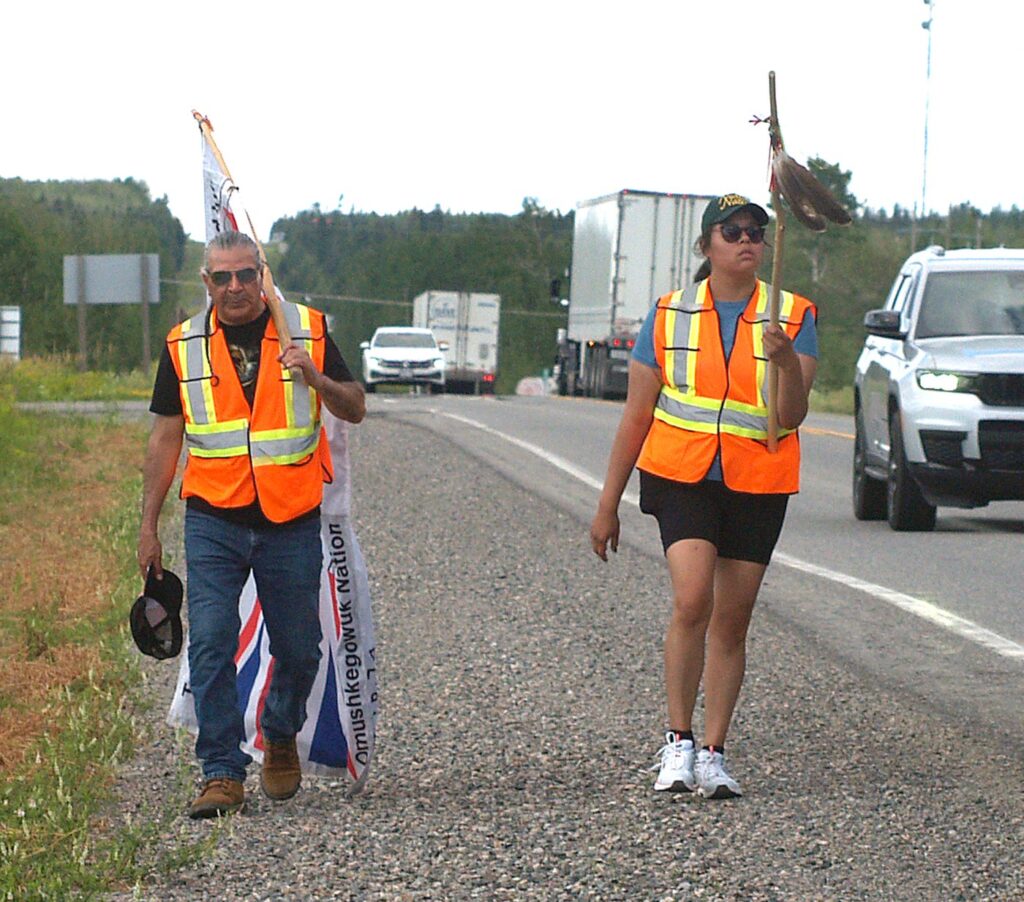
TEMISKAMING SHORES – Just over two weeks ago, a small group of First Nations youth protesters set out on foot from Timmins for Queen’s Park.
They’re calling for the repeal of provincial and federal legislation aimed at speeding development of major infrastructure projects in response to the trade dispute with the U.S.
Anger over Bill 5 and Bill C-5 – Protect Ontario by Unleashing our Economy Act and the One Canadian Economy legislation, which includes the Building Canada Act– spurred Tristan Ashishkeesh, a founder of the walk, to take action.
The legislation and governments’ responses echo previous governments’ approaches to First Nations’ concerns, said Ashishkeesh in an interview on the side of Highway 11 last week.
“We’re getting pushed, and no one’s really considering what we say,” said the 29-year-old from Attawapiskat First Nation as traffic sped past.
“What we’ve seen is not proper consultation.”
He doubted assurances from federal and provincial leaders that First Nations will be equal partners and share in the economic benefits flowing from projects.
First Nations, he said, “are not against development,” he said.
But while many Indigenous people are working in resource industries, he said they’re seldom in management positions.
Industries must realize they need to hear the opinions of grassroots community members, he said.
He’s calling for a meeting of treaty and hereditary chiefs with the prime minister, governor general, premiers, and elected First Nations chiefs and political organizations.
Living conditions in many First Nations, including boil-water advisories and housing shortages, should first be addressed under the original treaties, he said.
“You have third world communities living within Canada, so once these problems are fixed, yes, let’s talk about development, let’s talk about mining.
“But let’s do it in a way where our Indigenous people are still going to be able to keep their livelihood from the land, but also Canadians.”
He said many non-Indigenous men and women hunt, fish and hike on the land.
“What’s going to happen if this is all gone?”
He acknowledged that opposition to the legislation has come from environmentalists and other sectors. He encouraged mayors to stand with the protesters, “because your concerns are most likely in line with ours, as grassroots people.”
He said the walk, which began July 15, has seen support from both Indigenous and non-Indigenous people. There’s also been some negativity, but he said protest walkers have responded with kindness.
They’ve been joined at times by community members, who sometimes take on the five-kilometre stretches that walkers are doing in rotation.
The protest walkers are providing regular updates on their Facebook page Mahmo Inninuwuk Wiibuseego-stamok. Its name is from a James Bay Cree phrase meaning “uniting the people to stand together,” explained Xavier Kataquapit, a writer and columnist from Attawapiskat First Nation, in a news release.
The walkers reached North Bay on the weekend.




