

Northwestern Ontario wildfires tracked by the Ontario Forest Fires (OFF) agency have tapered off a little after recent rainfall dampened parts of the region and temperatures cooled.
OFF’s most recent fire update Tuesday evening pegged the tally at 113 active in the Northwest Region; 17 were not under control, nine were being held, three were under control and 84 were being observed. That was down from about 140 active fires last week.
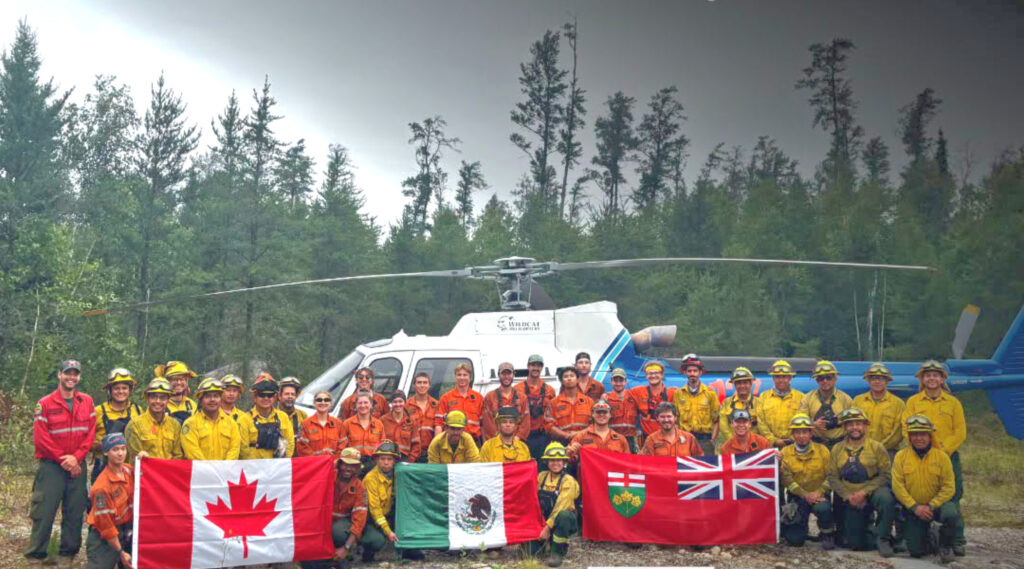
– OFF photo
The largest group of fires in the Rainy River District, the so-called Atikokan Cluster in and around Quetico Provincial Park, received between 14mm and 30mm of rain, which assisted firefighters’ efforts Tuesday.
“The rainfall is expected to maintain low fire behaviour over the next several days,” OFF said in its update.
“Infrared scanning continues on fire perimeter areas providing ground crews with hotspot targets to seek out and extinguish. Incoming crews are joining suppression efforts, replacing others who have completed their two-week fire assignments.”
Of the Atikokan Cluster fires, none of which were under control, FOR013 measured 25,279 hectares, FOR014 51,768 hectares and FOR015 42,273 hectares.
Two new wildland fires were confirmed in the Northwest Region by Tuesday evening: Fort Frances 59 (FOR059) was located west of Quetico Provincial Park between Vie Lake and Wisa Lake, which was called out at 0.2 hectares and the 0.1-hectare Thunder Bay 74 (THU074) fire near the north side of Weikwabinonaw Lake which was being held.
Meanwhile, the Rinker Lake Complex, which includes the monster Thunder Bay 36 (THU036) fire at more than 306,000 hectares and the smaller but still significant Dryden 34 (DRY034) and Dryden 35 (DRY035) fires, was being fought by 15 wildland firefighting crews from Ontario and Alberta, two 20-person crews of wildland firefighters recently arrived from Mexico, heavy equipment operators, pilots, overhead staff from Ontario and Québec, and an Incident Management team.
THU036, located deep inside Wabakimi Provincial Park about 220 km north of Thunder Bay near Armstrong/Whitesand First Nation) is considered the largest wildfire in Ontario history, mapped at more than 314,000 hectares at its peak, destroyed Namaygoosisagagun (Collins) First Nation and heavily impacted Whitesand and Armstrong.
“With the precipitation received over the Rinker Lake Complex overnight, lower fire behaviour was observed today, allowing crews to make good progress,” OFF said.
“Firefighting crews are patrolling for and extinguishing hotspots, consolidating hose lines, installing and maintaining values protection equipment and constructing helipads to allow for mobilization of equipment and gain access to more fire area.”
Heavy equipment operators continued to construct fire guards on the perimeters of the larger fires.
Last week, Ontario welcomed 100 firefighters and four agency representatives from Mexico to support wildland firefighting efforts.
“From all of us at Aviation, Forest Fire and Emergency Services, thank you to Mexico and all our mutual aid partners for your continued support!” OFF said.
Northern Ontario remains within a restricted fire zone until further notice “to reduce the number of human-caused wildland fires.”
“We are expecting the current fire hazard to remain, along with the potential for problematic fires to continue and expect a continuation of the increased forest fire activity into the foreseeable future.”
No open-air burning, including campfires, is permitted within the boundaries of a RFZ. Portable gas or propane stoves may be used for cooking and warmth but must be handled with extreme caution and all burning permits are suspended.





