

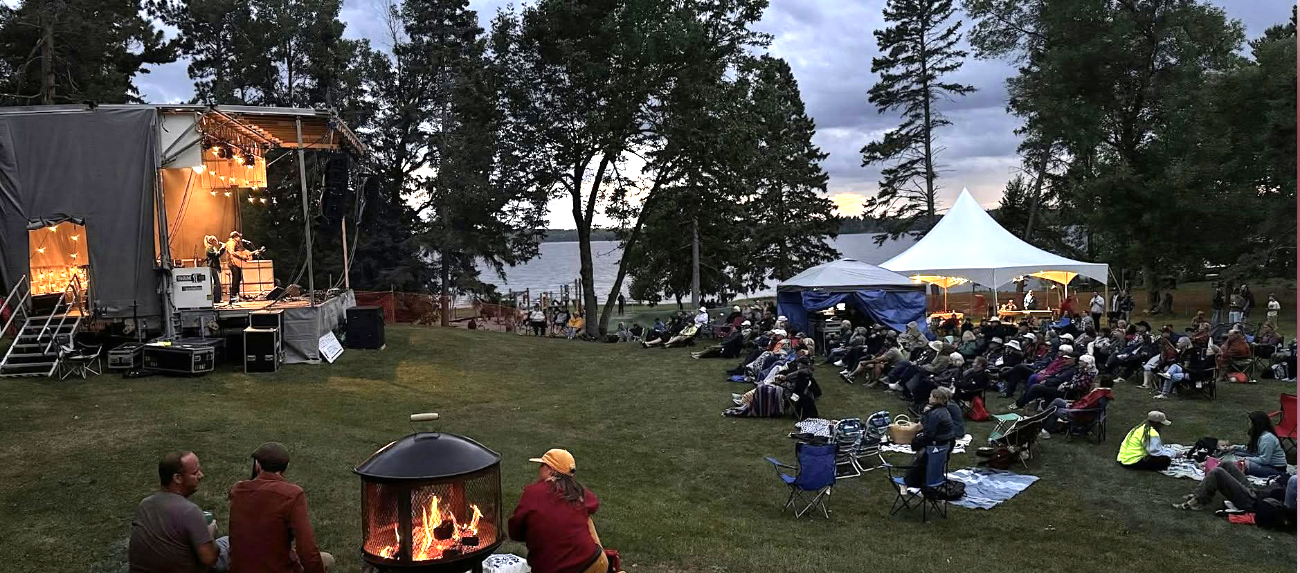
This past weekend, on the shores of Caliper Lake, a small northern festival reminded me what community can be.
Nestled among the pines and rocky shoreline of Northwestern Ontario, Caliper Lake is the sort of place that reminds you why people fall in love with the North.
It is also home to the Moose and Fiddle Festival. For one weekend each summer, the lakeshore comes alive with music, laughter and friendship.
Children dart between campsites, neighbours gather beneath towering pines and fiddle tunes carry across the water as the evening sun sinks toward the horizon.
For a few precious hours, hope feels a little closer and the noise of the world a little further away.
What struck me most was not the music. It was the people behind it.
Moose and Fiddle is not a corporate production. It exists because ordinary people decided it should exist. It persists because when the original stage burned down, the community rebuilt it.
Every year, volunteers donate their time, organize and plan. They take on the countless small and invisible tasks that make something beautiful possible.
The festival reminded me that community is not something we inherit. It is something we create together.
Hope and imagination are in rare supply these days. Moose and Fiddle provides them in abundance. It is a space where people can imagine a better version of the places they call home. A place where neighbours know one another. A place where children grow up seeing cooperation instead of division.
Looking out across Caliper Lake, I was reminded that the strongest communities are built much like the landscapes of the North itself.
A forest is not one tree. A lake is not one drop of water. Community emerges when many different elements come together and form something larger and more resilient than themselves.
As we approach municipal elections across Northwestern Ontario, that thought gives me hope.
It takes courage to put your name on a ballot. To stand before your neighbours and offer ideas about how to make a community better. In an age when public service often attracts criticism more readily than praise, every person who cares enough about their community to step forward deserves thanks.
Moose and Fiddle showcases what is possible when we come together. When we work not just as individuals, but together, for a common purpose.
This weekend also marked 15 years since the passing of Jack Layton. Near the end of his life, he left Canadians with a message which bears repeating today.
“My friends, love is better than anger. Hope is better than fear. Optimism is better than despair.”
Fifteen years on, those words still ring true.
You can hear them in the laughter of children playing beside a northern lake. You can hear them in a fiddle carried across the water by the wind. You can hear them in the volunteers who give their time simply because they care about their community.
And perhaps we can carry that spirit beyond Moose and Fiddle, and into our municipal elections, into our neighbourhoods, and into our everyday lives.
Because communities, like festivals, are at their best when we build them not for ourselves, but for one another.
And when we do, they can become every bit as beautiful as the northern landscape that surrounds us.
Luke Hildebrand is an Aboriginal law lawyer, partner at Headwaters LLP and the president of the NDP riding association for Kenora-Rainy River in Northwestern Ontario.




