

Jacquie and Martin Dufresne have been part of Rainy River ever since they moved here in 1976. Martin was first hired to work as a manager for Arctic Enterprises and then he and Jacquie became the new owners of its successor, Weather Wear.
In 1968 – eight years after building its first snowmobile – Arctic Enterprises of Thief River Falls Minn. opened a garment plant in Rainy River. this was the first truly viable industry for the town since the departure of the lumber companies. Arctic built a 15,000 square foot factory and employed more than 60 people. Although much smaller than the lumber industry, Arctic was a progressive company and injected millions of dollars into the community.
Artic Enterprises, which was later renamed to Arctic Cat, was the first snowmobile manufacturer which produced all of its own outdoor clothing in-house.
“We manufactured clothing for all of Canada out of this factory,” said Martin.
The production facility also housed parts, which were packed and distributed from Rainy River, noted retiree Garry Halverson, who worked for the company in the early 70s.
Arctic Cat fell on tough times, and went into bankruptcy in 1982. Although it re-emerged as Arctco, and continued to produce recreational vehicles, in-house garment manufacturing – including the factory in Rainy River – didn’t return.
Halverson remembers the factory shut-down. He was part of the skeleton crew kept on to pack up the parts department, and relocate it to Winnipeg. They were offered jobs in the city, but Halverson wasn’t interested.
“I was born here, so I wanted to come back to Rainy River,” he said.
Martin was the plant manager when Arctic Cat closed the Rainy River garment factory. But it wasn’t closed for long. He was able to secure enough grant funding to buy the building and machinery inside in 1982 and re-opened. For the first two years, the new company was a contract manufacturer for Arctic Cat, as well as its own line of clothing, Weather Wear. However, Arctic Cat had given in to pressure from customers to reduce the cost of its clothing, and had begun using overseas manufacturing plants.
Jacquie said Weather Wear operated until new import laws with Asian products became too much for Weather Wear to compete with, in the early 1990’s.
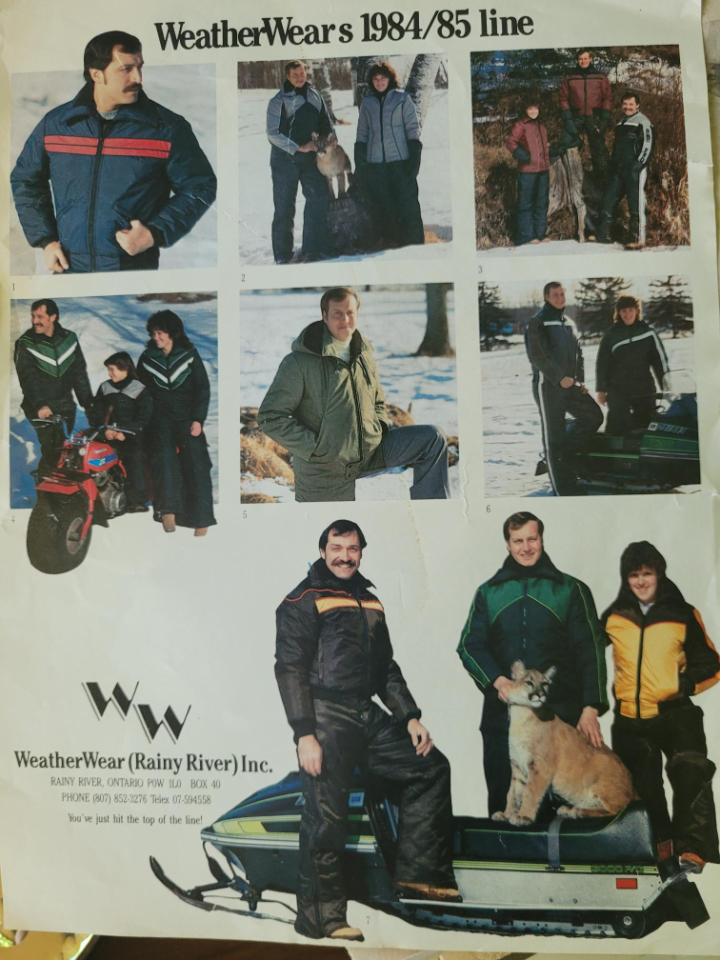
“Our garments and Artic garments originally would last, easily 15 years, and still look good.” said Jacquie, who feels that the switch to overseas manufacturers reduced the quality of Artic Cat clothing. Higher quality wasn’t enough to overcome the higher manufacturing costs.
“We did some really good sales to start with, but then the difference in price started catching up with us,” said Jacquie. “The price of labour just caught up with us.”
Although the plant closed, Arctic Cat put rainy River on the map, and was a point of pride for the families who worked there.





