After a series of meetings, local polls and formal declarations, MPP for Kenora-Rainy River Greg Rickford says that northwestern Ontario will not revert to standard time this fall.
In a press release issued Tuesday morning, Rickford announced the change, which will align the region with the province of Manitoba.
“Minister Rickford is pleased to announce that through the collective efforts of communities, First Nations, healthcare leaders, MPP Sol Mamakwa and constituents throughout the Northwest, we have reached unanimous support to align with neighbouring Manitoba and make daylight saving time permanent in Northwestern Ontario,” the release said.
“I wanted to be out in front of this, so I put out a call to all municipalities, townships, and First Nations leadership to attend a preliminary phone call,” Rickford told The Times.
“There were a couple of consensus items very quickly. First of all, we needed to see if we could get consensus, and secondly, people needed a sense sooner rather than later of what was actually going to happen, so that we weren’t scurrying around at the end of October or on the eve of Nov. 1 trying to understand. So, notionally on that call we said, ‘let’s try to put this down for the Tuesday after Thanksgiving,’ and then in earnest just about every community that I can think of put out their own formal polling.”
Rickford said he also undertook informal polling on his social media platforms, as did other towns, townships, cities, and First Nation communities.
“My friend, and full partner in all of this, Sol Mamakwa, dealt with the communities farther north, obviously because they’re in the Kiiwetinoong riding, but affected by this time zone change.”
Rickford said the polling was overwhelmingly in favour of adopting what he’s playfully billed as ‘Wab Kinew Time’ in reference to Manitoba’s premier.
“About 10 days later, or a little short of two weeks, some of the communities started to get their polling returns and general feedback from people, and it was in the 90 to 95 per cent range; I think the highest was 94.3 per cent approval for us to go on what I’m calling Wab Kinew time,” Rickford said. “I reached out to the premier (of Manitoba) and said we’re calling it Wab Kinew Time and he thought that was funny.”
Rickford said the responses came in quickly in favour of remaining on daylight time.
“The Rainy River Council of First Nations came out quickly with a position statement saying that they preferred to go with Manitoba on this, and Fort Frances had a quick turnaround, and very quickly a number of the other townships and towns followed,” he said.
“So, on the second call that we had last week, I said to all leadership, ‘We would really appreciate, there’s not a requirement, but we would really appreciate something in writing, either a position letter or a resolution, a decision note, whatever you want to call it, confirming or affirming that you’ve heard from the people in your respective community, and your support for changing or not changing was clear and unequivocal.’”
The response was overwhelming, Rickford said.
“We were waiting on Kenora and Dryden, who had put out their own polling and had requested to meet with council, and those final resolutions came in last Friday, and Dryden’s is on its way today. But I let the mayor of Dryden know we were moving with this. They did their polling and their formal polling in Dryden, and it was 90 or 93 per cent, I think.”
Rickford said it took a bit of research with the government on how to go about the process, given that the only precedent was from when Atikokan made its change several years ago.
“From the outset, we were trying to understand just how the legislation, the Time Zone Act, actually operated for issues like this because this is kind of new to us,” he said. “The only precedent that we had was that Pickle Lake and Atikokan had drafted resolutions on their own at some point in time historically to stay on Eastern Standard Time. So, on further review and investigation, I can say to you today that we are making a regulatory change that the legislation gives us the power to do so. It will run through the Legislative and Regulations Cabinet Committee and be approved by Cabinet before Nov. 1.”
Rickford said he felt like anyone who wanted to be heard was heard.
“We had a resolution early last week from all Treaty Three First Nations who were meeting at plenary, and they drafted a resolution, so we have heard from every community, but more importantly, we’ve heard from anybody who wanted to chime in on this,” he said. “Everybody, every person who lives in this northwestern Ontario time zone has had an opportunity, and I can tell you the numbers are overwhelming. How many people actually participated in the various fora, polls formally and informally, messages to my office and throughout political offices in the riding.”
Rickford said in consultation with healthcare stakeholders the resounding response was they wanted to deal with as few time changes as possible.
“We have heard from the CEO of Lake of the Woods District Hospital, representing all of the health executives or leadership of the various healthcare entities; they have participated from the outset,” he said. “Their primary concern was doing whatever meant the fewest time zone changes that their catchment would deal with. That’s because if they had to add another time zone, they were going to have serious issues with their technology capacity, especially electronic medical records.”
Rickford noted how crazy things could have gotten had the work not been done to remain on DST permanently in northwestern Ontario.
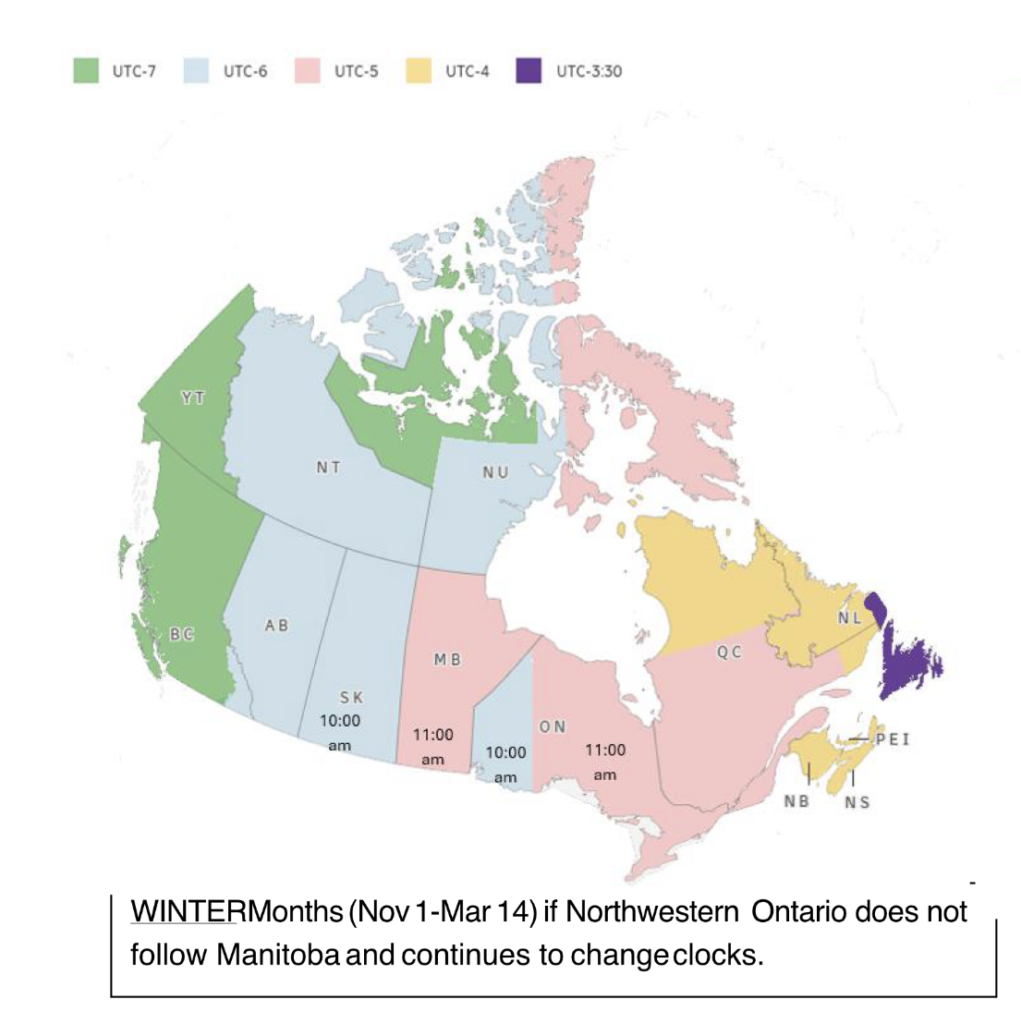
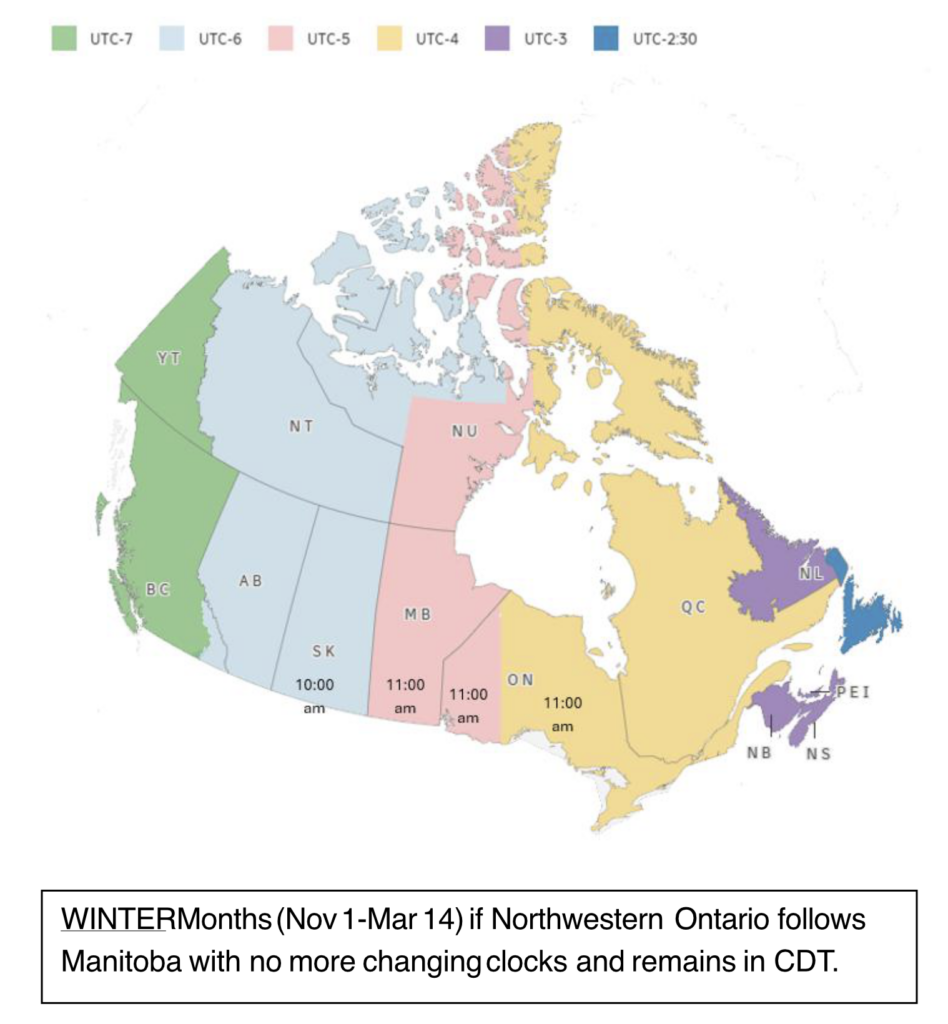
“If we had not done anything and just stayed where we are right now, we would have been heading west to Winnipeg and be an hour behind and then gone to Saskatchewan. Now we don’t get many healthcare, if any, services from Saskatchewan and be back in their time zone.” He said. “We would have theoretically been at least six months of the year in one, two, three, four, different time zones.”
Rickford said overall he’s pleased to see so many communities come together on the issue and sort it out so quickly.
“This was an extraordinary process. It is rare that communities, not just the people in the communities, give feedback by way of polls and social media platforms. But where we all convene as First Nation communities, townships, and municipalities. Obviously, we take this very seriously, and we took it very seriously, and it just brought us all together in a really cool way.”
According to the press release, this change will only affect the portion of northwestern Ontario which was previously in the Central time zone, west of the 90th meridian. This also means that northwestern Ontario and Manitoba would be on the same clock as the rest of Ontario and Quebec through the winter months. The province of Ontario has passed legislation that would put the entire province on permanent daylight time should the bordering state of New York and the province of Quebec also choose to do so.