


In an effort to help those in need, the Rainy River Soil and Crop Improvement Association chose a special project to work on and elected to grow a crop and donate the proceeds to a Canadian charity which strives to end world hunger.
Dave Schraa is the president of the Association and he says they like to try to do a community building project each year.
“So for the local soil and crop group we were looking for something to do this year to bring some value to the community and the agricultural grassroots it’s our job to represent. For example last year we did that Ag Expo event,” Schraa said.
“So this idea of the grains project came about, it’s in other jurisdictions, it’s something that’s done in southern Ontario, and across the prairies, everyone liked the idea so we thought we’d explore it.”
According to its website, “Canadian Foodgrains Bank is a partnership of 15 Canadian churches and church-based agencies working together to end global hunger.”
The organization says their history dates back to “the mid 1970s when Canadian Farmers were looking for a way to share their abundance with people facing hunger in the world.”
For a time, the organization would actually accept donations of grains and send them overseas to parts of the world where it was needed. However, more recently it has begun to function more as a financial institution, accepting donations raised through the sale of grains grown for the purpose of donating the proceeds.
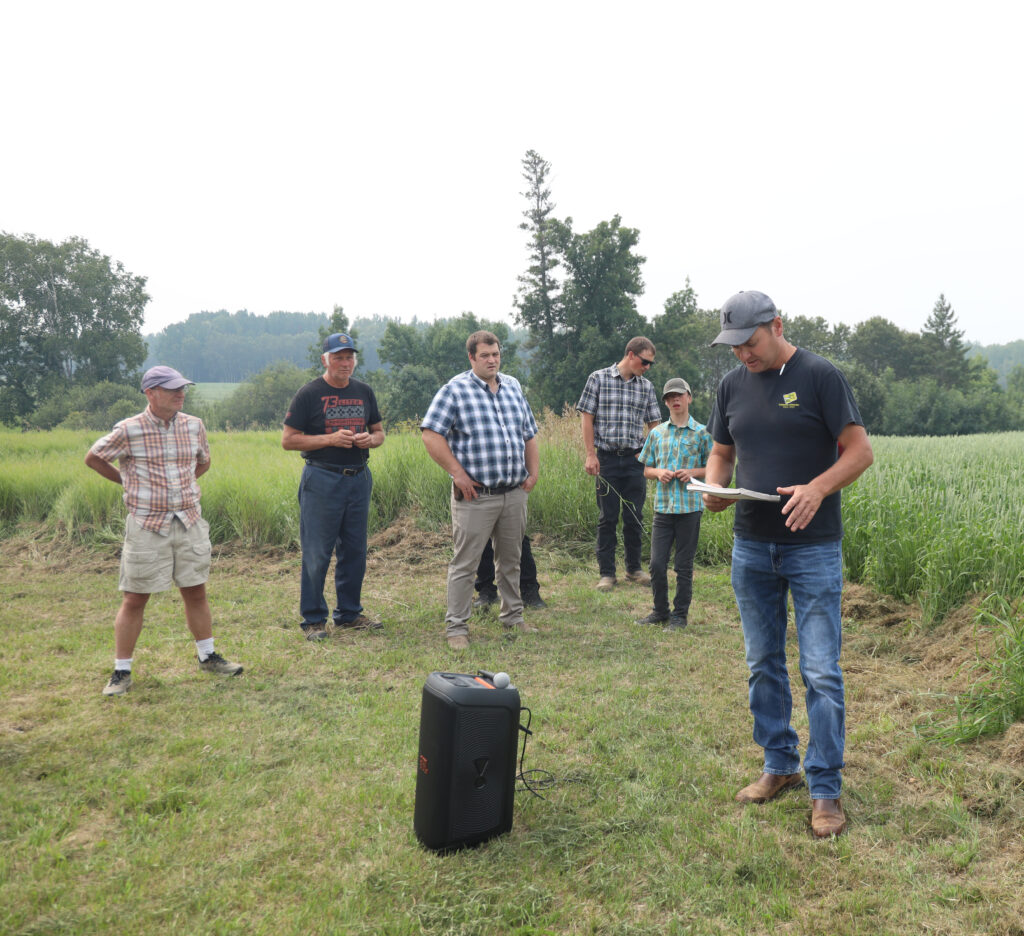
Dale Friesen is the Manitoba and northern Ontario representative for the Canadian Foodgrains Bank. He addressed those in attendance at the summer Soil and Crop tour.
“In 1983 a group of Mennonite farmers in southern Manitoba heard about a famine happening in Ethiopia, they became deeply concerned, and they said, we have to do something about this. So what they did in 1983 is they began to literally take a wheat harvest and ship that grain over to Ethiopia as a way of helping to alleviate a famine,” he said.
“That’s how Canadian Foodgrains Bank started. So how it works, think of it not necessarily as a food bank, which is what we sometimes tend to think of. Think of it more as a bank. We are a bank with 15 different members. Our 15 different members are across the theological spectrum. Some of the members include a Mennonite group, there’s a Dutch Reform group, there’s a Catholic group, there’s a United Church group, there’s an Anglican group, all different groups, all the different denominations.”
The organization also has a partnership with the Government of Canada.
“The Government of Canada has been an important partner of the Foodgrains Bank since it began. Today, the Foodgrains Bank is one of two primary channels for the Government of Canada’s funding for food assistance. Through the Government of Canada’s support, the Foodgrains Bank’s 15 member agencies are able to leverage donations from individuals, churches and businesses up to a ratio of 4:1 for food assistance in the developing world—up to $25 million each year,” the website says.
The local Foodgrains Bank Project has been a complete community effort. The land used for the project is owned by Dr. Phil Watley, who was looking for new tenants last spring and rented the land to the Soil and Crop Improvement Association at a generous discount.
Additionally, Kaemingh Fuel donated fertilizer to the project, Todd McLean did some spring tillage, and John Sawatzky and Emo Feed provided a pass of tillage and some herbicide to clean up some weeds on the project.
Schraa’s own company, Purity Seeds and Carpe Diem Farms, worked to apply the donated products to the field.
“We’ve done some applications of those products, the fertiliser, the spray, the seed and got the crop seeded,” Schraa added.
Pinewood Crop Services also donated in-crop herbicide for the project.
“The current plan is the wheat, its final destination will be, Emo Feed, which actually will be turned into livestock feed, and then further feed livestock in the district,” Schraa said.
After paying for any further expenses on the project, the remaining profit will be donated to the Canadian Foodgrains Bank.
The hope earlier in the season was for a yield of 50 bushels of grain which would lead to an approximate donation of around $5,000.





