A Thunder Bay-based team from Seven Generations Education Institute (SGEI) has received a national award for a high school course that trains students to prepare for and respond to emergencies, drawing on First Nations knowledge.
Seven staff members were named recipients of the Emergency Management Exemplary Service Award in the Resilient Communities category, presented Nov. 9 in Edmonton. They were among a record 297 recipients from across Canada.
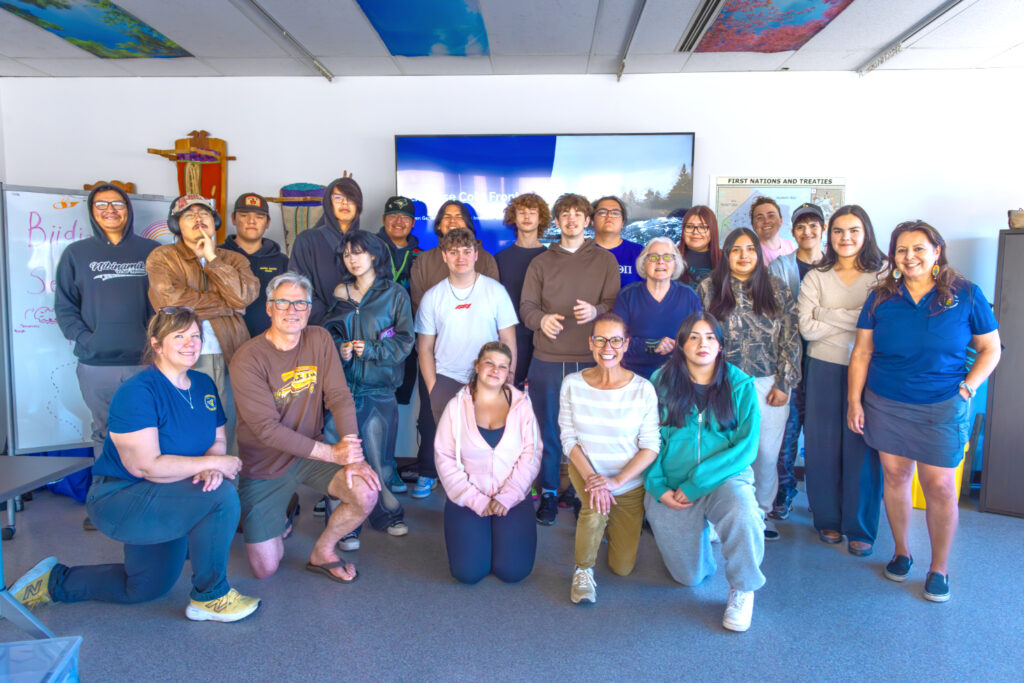
“I was speechless,” said Cathy Rodger, SGEI’s lead curriculum writer. “Just to be alongside people who have had careers and done such meaningful work, it was very humbling.”
Emergency Management and First Nations Perspectives is a credit course for Grade 11 and 12 students. Public Safety Canada describes it as the first secondary-level program of its kind in the country.
Rodger said the idea came from Indigenous Services Canada (ISC), which funds the project and wanted to build capacity in communities by getting students interested at a younger age.
“Often the people who are in emergency management didn’t chose this as a path,” she said, noting many arrived from jobs such as 911 dispatch or fighting forest fires.
Rodger and her co-lead curriculum writer, both teachers for 25 years, come from science rather than emergency management.
“We had to start from ground zero,” she said.
They conducted more than 40 interviews with experts, Elders, Knowledge Keepers, and educators across the province, then identified the top 100 things those people wanted to see in the course. A key recommendation was that students earn recognized certifications. The writers were also directed to weave in First Nation history, traditional practices, land management and local knowledge.
“Emergency management, our people practise this,” said Rodger, who is from Fort William First Nation. She pointed to cultural burning and to people moving each year to avoid spring floods and breakup.
The project formally launched in October 2024, and a two-school pilot began this February with students from Matawa Education and Care Centre in Thunder Bay and Geraldton Composite High School. Public Safety Canada says 22 students enrolled.
They trained in first aid and CPR, wilderness first aid, ice rescue, fire extinguisher use, naloxone and de-escalation. Emergency Management Ontario delivered its EM201 course, and students also went canoeing and spent a week camping on the land. Each student received a 72-hour emergency kit for home.
“None of it was watered down because they were in high school,” Rodger said. “They received the exact training that adults get.”
Leighton Wabano, 19, from Fort Hope (Eabametoong First Nation), was in the first group to complete the course at Matawa and now works with the SGEI team as a co-op student.
In an email, he said he was hesitant at first, but his guidance counsellors kept telling him it was a great opportunity. “And it was and is,” he said.
The content of the course hit close to home. Wabano was evacuated from Fort Hope to Niagara Falls at the peak of last summer’s wildfire season.
The team is working to bring the course to schools across the province, “hopefully including here in Fort Frances.”
His personal course highlights included ice rescue training and canoeing, though he admitted struggling with the paddling at times.
Feedback from the pilot led to changes, including shorter lessons, and the course is now preparing to expand to new communities. Rodger said those communities will have access to up to $30,000 to deliver it, because the same training costs far more in a remote community such as Poplar Hill or Fort Severn than in Thunder Bay.
“It’s about equity, not equality,” she said.
Teachers receive lesson plans, videos and online training, and will gather in Thunder Bay later this month for a two-day session.
The team is working to bring the course to schools across the province, “hopefully including here in Fort Frances,” SGEI marketing specialist Daniel Adam said in an email. Interested schools and educators can contact emcurriculum@7generations.org.
Since finishing, Wabano has presented at a conference, connecting with government officials and educators.
“I really like working here,” he said of his co-op placement. “I’m very thankful for the team’s determination and efforts in making this course happen.” He said the program has opened his mind “to a world of possibilities.”
SGEI is an Indigenous-owned and operated institute founded in 1985, with its main campus in Fort Frances. The awards, delivered jointly by federal, provincial and territorial governments, recognize exceptional contributions to emergency management in Canada.
“When they have this knowledge, they’re excited to share it with others,” Rodger said of the students. “It’s been a beautiful experience watching the students learn and grow.”