Westmeath — Residents of the Ottawa Valley, as well as visitors, appreciate the majestic Ottawa River as a large component of what makes the area special. But the beauty of the almost 1,300 km watercourse, or its world class whitewater, or its boating and fishing opportunities, are not its only claims to fame. In recent decades it has become a Mecca for cave divers.
Cave diving is one of the riskiest activities engaged in by humans on this planet. A craving for the associated extreme adrenalin rush could be the initial motivation to pursue this life-endangering activity. However, awe and wonder at the abundant life that becomes visible, when illuminated by the diver’s headlamp, has led some to develop their passion into a career. Cave divers are now an indispensable resource for biologists, geologists, and other research working to unlock the secrets of the dark underwater world.
“They are the eyes of the scientist,” says Dr. Andre Martel, Ph.D. Zoology and principal investigator in a research project about freshwater mussels, a component of his work with the Canadian Museum of Nature.
One of these sets of eyes, ears, and hands is cave explorer, author, photographer and filmmaker, Jill Heinerth. At present she is the first Explorer in Residence for the Royal Canadian Geographical Society, and an Honorary Ottawa Riverkeeper. A veteran of over thirty years of filming, photography, and exploration on projects in submerged caves around the world, she has made TV series’, consulted on movies, written several books and is a frequent corporate keynote speaker. She is a recipient of Canada’s prestigious Polar Medal and a Fellow of the International Scuba Divers Hall of Fame.
In his studies, Dr. Martel, who is recognized as one of Canada’s leading experts on molluscs, has worked extensively in the cave network known as the Gervais Caves, under the section of the Ottawa River that loops around the “Westmeath Peninsula,” a major part of the geographical Westmeath Township, now part of the Township of Whitewater Region.
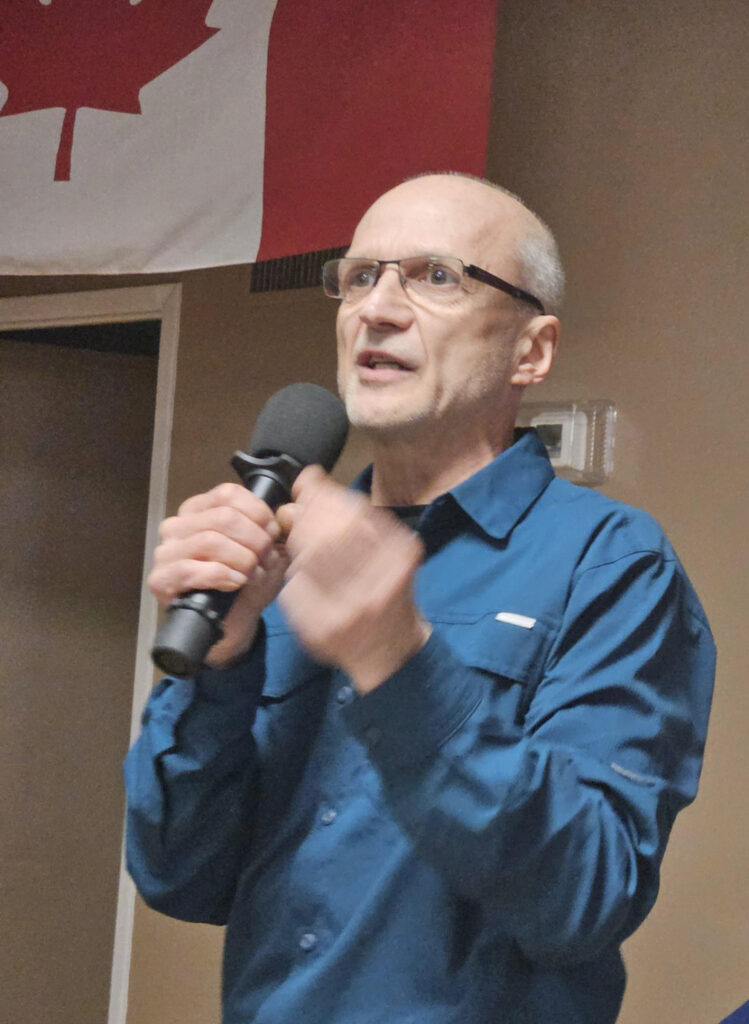
A standing-room-only audience of 200-plus packed the Westmeath Recreation Hall last week to hear Ms. Heinerth and Dr. Martel present an overview of their work.
The Ottawa River watershed is home to roughly 38 per cent of Canada’s mussel species: 21 of 56. North America has 300 of the almost 1,000 species in the world.
“All the continents have them except Antarctica; so, (they are found) across Europe, Ontario, Quebec, and BC. Yukon has some, but if you go too far north, they disappear.”
However, it’s the Hickorynut mussel that’s capturing most the attention of the researchers at present. It is generally rare worldwide but is found in abundance in the Westmeath caves.
Native mussels are natural water filters.
“Imagine this,” said Dr. Martel in helping the audience comprehend the impact of the mollusks. “One or two liters (of water) per hour, sometimes three, so 48 liters a day per mussel. Metric tonnes of water are filtered through the gills in one year, by one mussel. Imagine what happens when you have millions of mussels. And some of them live for decades. It’s well known that they can live over a century in some countries.”
Dr. Martel illustrated the impact of mussels by showing a slide of two identically sized aquaria: one in which the water was clear and the one beside it with very murky water. What made the difference? There were no mussels in the murky one.
Dr. Martel explained features that differentiate mussels from clams.
“There are rings that look like the growth rings of the tree,” he said. “Ridges, the shape, the contour, hinged teeth that are like the hinges on a door. Bivalves – freshwater mussels like these – have teeth where, when the two halves are closed, they’re well locked.”
Another feature of marine life in and around the Westmeath caves is its Lake Sturgeon population, to which, as it turns out, the Hickorynut likely owes its survival.
How? It’s complicated.
For almost all freshwater mussels, reproduction depends on a symbiotic relationship with specific species of fish, and a lot of waiting. For the Hickorynut, that’s widely presumed to be the Lake Sturgeon. Here’s how it works: Sperm that is ejected by the male mussel floats downstream to a female, who releases fertilized eggs into specialized compartments of her gills, called glochidia, where the young develop into a microscopic specialized larval form. The larvae wait in these compartments until a potential host fish gets close. Then the mussel expels the glochidia, which snap onto the gills of an immature fish. After attaching to the fish’s gills, the glochidia encyst and remain inside for weeks or months, nourished by the fish’s hemolymph, a fluid analogous to blood in vertebrates. The juvenile host fish carries the parasitic mussel babies until they mature enough to excyst and bury themselves in the river bottom, where they will further develop for a couple of years before re-emerging.
The young fish are not harmed by their participation in this collaborative effort. However, if the glochidia attach to an older fish, they will be expelled or rejected by the fish’s immunological defense system.
But why should anyone, other than marine biologists or daredevil adventurers, get excited about a creature that, for the most part, lives out its lifespan in deep underwater darkness?
For these efficient water purifiers, life is fraught with perils, among them habitat loss, pollution, dams, viruses, bacteria, and non-native species.
The proximity of human habitation to much of the fresh water supply puts stress on one of the most effective ecosystems on the planet.
“The oceans are also sometimes said to be troubled, but that is rarer,” said Dr. Martel. “It’s easy to damage the river or lake. Threats to the ecosystem are numerous and include invasive species destroying the riparian zone, (loss of) vegetation bordering the stream causing erosion, and the depositing of silt in waterways.”
And then there are hydro dams.
“Light, electricity, how wonderful it is,” said Dr. Martel. “But the dam comes with a cost. When you build a dam, the sturgeon doesn’t go upstream anymore. Above the dam the river becomes a lake, and biodiversity can take a beating. So, aside from these threats, and aside from the fact that, freshwater mussels are among the most endangered group of animals, 72 percent of all of North America’s freshwater mussels are either in decline or are endangered or threatened. Thirty per cent of all freshwater fish in North America are in trouble. Fresh water animals are among the top species at risk; not birds, not reptiles.”
Fresh water species are often big trouble around the world, including in North America, and 33 per cent of all freshwater mussel species of Canada are at risk.
“That is, 19 out of 56,” he said. “A colleague of mine wrote that freshwater mussels are a good alarm system. They’re the most sensitive indicators of water quality in the ecosystem.”
He noted that people tend to think in “compartments” rather than connections.
“But in fact, in ecology, everything is connected,” he said. “There are so many species, you would wonder, how do we know which is which, what eats what — we don’t know too much about it. And yet, every piece has a role to play. No fish – no reproduction of native freshwater mussels.”
The Ottawa River has been called the sixth Great Lake.
“The watershed is twice the size of New Brunswick, so, just under twice the size of Lake Superior,” he added.
Many unanswered questions remain about the connection of various species to each other and to the environment. Among them are questions around the Hickorynut mussel and its presumed host, the Lake Sturgeon.
“We’re the first team in the world that are going to tackle this question,” he said. “We are trying to scratch the surface.”
The team of researchers includes other scientists, Ms. Heinerth, and colleagues from the Department of Fisheries and Oceans (DFO).
The project of collecting sturgeon, checking the gills, also involves collecting other fish species to see if others are also involved in the reproduction and dispersal of the local freshwater mussels.
“We’re now talking about a water camera that we could set up permanently in the caves, filming this in a unique environment to be the first in the world doing this,” he said. “It’s so exciting!”
“Our team believes that the Hickorynut mussel and the Lake Sturgeon are two key species that could be a tool to further protect what you’ve got here, which is extraordinary and is not found in many other reaches of the Ottawa.”