



A total of 117 active wildland fires were reported as active in the Northwest Region late Monday, down from a high of 148 earlier in July, after a rainy weekend helped to dampen forest conditions.
There were 23 fires not under control, three being held, eight under control and 83 being observed, according to Ontario Forest Fires (OFF).
Fires in the Atikokan cluster, about 100 km east of Fort Frances, were still among the largest measured in the region, Fort Frances 14 (FOR14) at 51,806 hectares and Fort Frances 15 (FOR15) at 42,279 hectares. Both fires were listed as not under control. The smaller Fort Frances 38, north of Crystal Lake, was considered under control at 44.2 hectares.
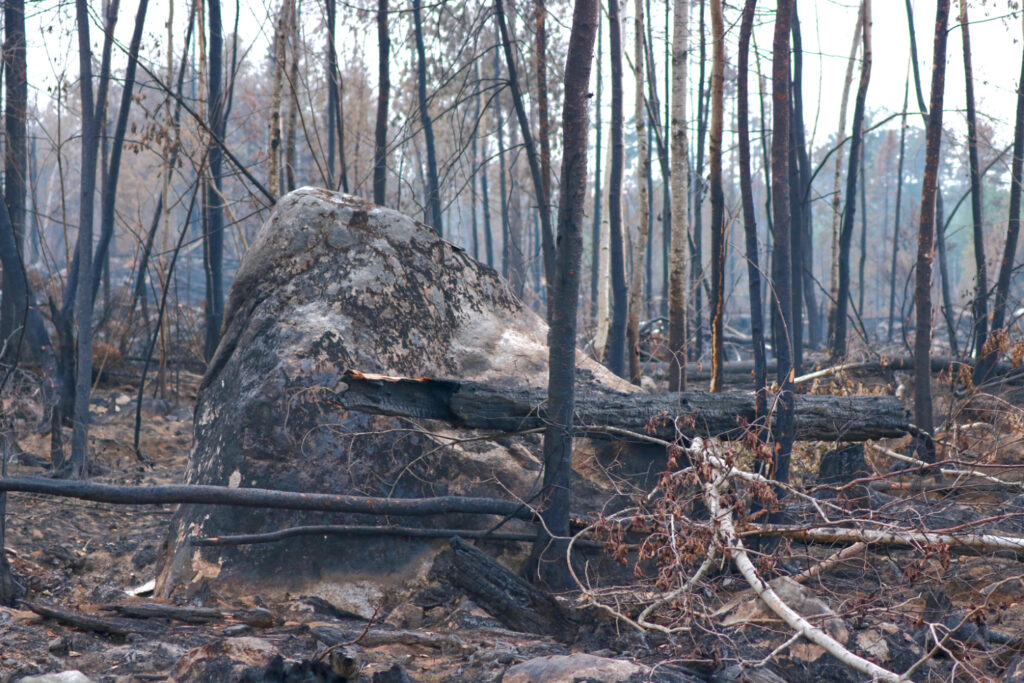
“Overnight rainfall and high relative humidity have contributed to low fire behaviour today,” OFF said. “Ontario and Alberta crews are patrolling the fires for activity, establishing hose lines and utilizing helicopter buckets to extinguish hotspots.”
FireRanger crews assigned to a specialized wildland fire engine were establishing hose lines near road-accessible areas of FOR014, while B.C.-based Q-400 tanker aircraft have added retardant barriers along high-ground areas across the northern perimeter and infrared scanning flights are providing targets for firefighting crews and bucketing helicopters to find and extinguish.
Several nearby zones have now been placed under full evacuation orders, the closest being FOF14, northeast of Byers Lake, where provincial officials ordered residents out on July 17. This area lies roughly 40–60 km northeast of town, directly along the corridor between Fort Frances and Atikokan.
It has been one of the heaviest fire years in recent decades. So far, there have been 599 fires this year in Ontario’s northern fire region, compared to 387in 2025 and a 10-year average of 401.
The entire Northwest region of Ontario remains a restricted fire zone, with all open-air burning, including campfires, prohibited and all burning permits are suspended. Portable gas or propane stoves may be used for cooking and warmth “but must be handled with extreme caution,” OFF said.
“This order is required to reduce the number of human-caused wildland fires. We are expecting the current fire hazard to remain, along with the potential for problematic fires to continue and expect a continuation of the increased forest fire activity into the foreseeable future.”





