


As wildfires continue to rage across Northwest Ontario, destroying homes and sending thick plumes of smoke across Ontario and as far as the Eastern Seaboard of the United States, the province is reaching out to the federal government for help, Thunder Bay-Rainy River MP Marcus Powlowski said Thursday morning.
The province has submitted an official Request for Federal Assistance (RFA), Powlowski said in a social media post, noting that federal Minister of Emergency Management and Community Resilience Eleanor Olszewski was in touch with Ontario Minister of Emergency Preparedness and Response Jill Dunlop.
“The request from Ontario was precautionary in nature,” Powlowski said. “Minister Olszewski is in contact with her provincial counterpart, Minister Dunlop, so that as the situation evolves, federal resources can be rapidly mobilized to assist specific needs as part of the ongoing provincially led wildfire response.”
Federal resources already involved in the firefighting
According to Powlowski, federal resources are already involved in fighting the fires raging across Northwestern Ontario and helping those displaced by evacuation orders.
“Federal resources are already supporting the response — four federally funded wildfire-fighting helicopters have been deployed to Ontario by the Canadian Interagency Forest Fire Centre (CIFFC) and Indigenous Services Canada (ISC) is on the ground actively assisting affected First Nation communities.”
In a statement posted on social media on Wednesday evening, Prime Minister Mark Carney said the federal government is staying apprised of the situation and stands ready to help where necessary if called upon.
“The wildfire situation has escalated significantly over the last three weeks across the country, and particularly in Northwestern Ontario,” Carney said.
“Thousands of people have been forced to evacuate their communities, not knowing if their homes will survive. On behalf of Canadians, I want to thank the brave firefighters, first responders, Indigenous and local leaders who are working tirelessly to keep people safe. Our government is in close contact with provincial, municipal and Indigenous partners and stands ready to provide any additional support as needed.”
Fire spreading rapidly as weather outlook calls for rain, thunderstorms
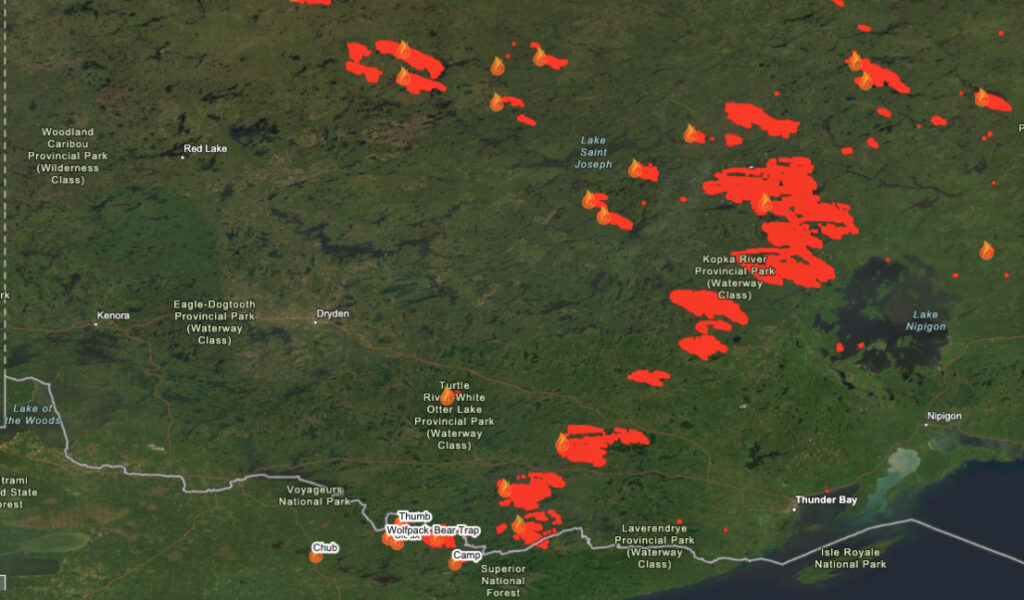
As of the MNR’s most recent update on Wednesday night, there were 136 active wildland fires in the Northwest Region. Of those fires, 63 were not under control, five were being held, five were under control and 63 were being observed. A total of four had been called out.
The weather forecast for the next week doesn’t necessarily bode well for firefighting efforts—according to Environment and Climate Change Canada, there should be some showers today, but there is a risk of a thunderstorm that could lead to further fire ignitions as lightning strikes the tinder-dry forests.
Friday has a 40 per cent chance of showers or thunderstorms in the daytime and a 60 per cent chance of showers in the night, while Saturday again has a 30 per cent chance of showers and smoke is expected to be in the air later on Saturday.
Smoke from the Northwestern Ontario fires is still being carried east and southeast by strong northwest winds, pushing plumes toward Wawa, Chapleau, Sudbury, and into southern Ontario.
On Wednesday, a dense plume dipped south and briefly hit Toronto, giving it some of the worst air quality of any major city in the world for a few hours.
Today, the smoke is tracking north of Georgian Bay, and the heaviest concentrations remain well away from the GTA. Higher‑altitude smoke, however, is being carried by the jet stream and has already reached Quebec, New England, the Atlantic provinces, and thin layers have been detected as far as Iceland and western Europe in satellite modelling.
Evacuations across Northwest in place, other communities on notice
Northwest Region OPP said Wednesday they were assisting with evacuation orders across the northern part of the province.
“Evacuation efforts remain ongoing in Armstrong, Whitesand First Nation, Collins First Nation, Gakijiwanong Anishinaabe Nation (Lac La Croix First Nation) and surrounding area, and Lac des Mille Lacs First Nation and surrounding area,” the OPP said in a social media post.
“Residents in areas under mandatory evacuation orders are urged to leave immediately and seek safety away from active fires. Other communities continue to be monitored, and residents should remain informed and prepared to act if additional evacuation orders or advisories are issued.”
Several communities have been all but destroyed by the advancing fires, including Collins (Namaygoosisagagun) First Nation, north of Lake Nipigon. Social media posts showed residents fleeing the fire in boats as flames consumed the shoreline.
It is not known how extensive the damage has been as neither residents nor fire crews have been able to return to the area, which is not accessible by road.
Hundreds of firefighters and 40 aircraft already deployed
In a statement issued Wednesday, Kenora-Rainy River MPP Greg Rickford said the province is “working hard to put out fires and keep residents safe,” with several hundred highly trained Ontario wildland firefighters supported by nearly 40 aircraft, including helicopters and waterbombers in action.
“We stand ready to respond, and we are taking action to ensure communities across Kenora–Rainy River have the support they need as wildfire season continues,” Rickford said. “These crews and pilots are continuing to operate under challenging conditions.”
Rickford said he and his team are working across government agencies to do everything necessary to stay ahead of all eventualities.
“My team and I have been in ongoing discussions with the appropriate ministries, agencies, and emergency management partners to ensure we are prepared and doing everything possible to stay ahead of an unpredictable and rapidly evolving situation,” he said.
“We remain actively engaged with the Ministry of Emergency Preparedness and Response and Ministry of Natural Resources and are coordinating closely with municipal, federal, and Indigenous partners across the province.”
Rickford noted the fires can be unpredictable and urged residents to obey restrictions and emergency orders.
“This season has already demonstrated how unpredictable wildfire behaviour can be. I encourage all residents and visitors to follow restrictions and emergency directives,” he wrote. “These measures are in place to protect communities, reduce risks, and support the firefighters and emergency personnel working tirelessly on the front lines. While no one can predict exactly how this wildfire season will unfold, I want people to know that we remain vigilant, prepared, and ready to act. “
Float planes assisting in evacuation and rescue efforts
Evacuation orders don’t affect only residents; many areas that are home to remote-access fishing camps are also under evacuation orders. Angie Korzinski, owner of Rusty Myers fly-in fishing camp service, said the fires have been a disruption to the company’s operations and threaten some of its camps. Rusty Myers pilots have been pitching in to help rescue stranded campers as some fires have spread quickly in remote areas.
“We’ve had to evacuate a lot of our camps,” Korzinski told The Times. “And we’re not allowed to put people in the camps because Wabikimi Park is actually shut down, and it’s starting to mushroom to different areas where we have outposts.”
Korzinski said they’ve also been able to help some other folks stranded in the provincial park.
“We’ve been doing a lot of rescue flights for other people in canoes and stuff like that, people that have been caught in the Wabikimi Park area with canoes or people that have been going out from Kenora,” Korzinski said.
“There were some people canoeing south of Savant Lake, our base there, so we’ve been doing a lot of rescuing people there, too.”
Stranded campers help keep camp safe
One group of stranded canoers was also able to lend a hand to help keep one of Rusty Myers camps safe. The MNR would normally set up sprinkler systems to protect the company’s cabins, but the drain on resources this summer has meant they can’t always get to them.
“One of our farthest ones, on Grayson Lake, the fires were right there, so we actually went in and set up our own sprinkler system there. And we were lucky enough that some canoes were coming through, and we allowed them to stay at our cabin and they monitored the water pump because there’s only enough gas [to run the pump] in there for a couple of hours.”
The campers stayed up much of the night monitoring the fire and refuelling the pump.
“So it was kind of an exchange; it was nice that they did that,” Korzinski said.
“We said, well, you know, there’s nothing we can do at night, so that if it does come towards the cabin they should actually just get in the boats and go in the middle of the lake.”
The volunteers were eventually rescued in the daylight hours when planes are able to fly into remote areas.
As some of their clients have had to be evacuated, Rusty Myers is ready to help out when called upon by parks, the MNR or OPP to help evacuate people from danger zones.
Currently, the Dawson Trail Campground and backcountry entry in Quetico Provincial Park is closed, as is Wabikimi Provincial Park, 200 km north of Thunder Bay. In the U.S., part of the Boundary Waters Canoe Area in the Superior National Forest is closed, and two of the major fires which originated south of the border have breached into Canada.




