


After days on the front lines of a growing wildfire near Lac du Bonnet, auxiliary firefighter Kyle Adamski is home again — exhausted, but proud of the work he and his team carried out to protect lives and property in one of Manitoba’s most active fire zones this spring.
Adamski, an auxiliary firefighter with the Portage la Prairie Fire Department, who also serves under Canada Task Force 4 with the Office of the Fire Commissioner (OFC), was deployed last Tuesday as part of a wildfire value protection crew tasked with safeguarding structures from the approaching blaze near Lac du Bonnet, about 100 kilometres northeast of Winnipeg. He returned home early Monday morning after nearly a week of 18-hour days.
“It’s a war zone when you drive in,” said Adamski. “You see a large smoke plume, emergency vehicles going in, people evacuating, helicopters overhead, water bombers dropping — it’s an intense situation.”
The Lac du Bonnet fire is one of several major blazes burning across the province, fed by dry conditions and strong winds. Although some recent rainfall helped firefighting efforts, the province has said the wildfire remains active.
Adamski is part of a specialized “all hazards” team deployed by the OFC. Their mission during wildfire season is known as “value protection,” which involves deploying high-volume water pumps and sprinkler systems around homes, farms, and other buildings threatened by fire.
He said the workdays are long and gruelling.
“We’re up at 5:30 a.m., breakfast, then the morning briefing. From there we head out to the assigned areas and set up pumps, water lines, sprinklers,” Adamski said. “Sometimes we get lunch air-dropped in by helicopter. We don’t get back until around 7 or 8 p.m., and sometimes we have to go back out again for more work in the evening.”
This spring’s fire season has already proven dangerous and, tragically, deadly. Although Adamski was not directly involved in a fatal incident linked to the Lac du Bonnet fire, he said the human toll adds urgency to the work.
“People are scared. It’s stressful — for residents and responders,” he said.
Earlier this month, Adamski was also deployed to The Pas, where a fire encroached on surrounding farmland and even touched parts of the Opaskwayak Cree Nation. That fire, unlike Lac du Bonnet, required more “pump operations,” dealing directly with flame suppression rather than structure protection.
Every fire is different, he said, but many this year share a disturbing commonality: human cause.
“There’s been very few lightning strikes. Most of the fires we’ve seen are human-caused,” he said. He reminds people to practice responsible burning. “If there’s a fire ban, don’t have a bonfire. Don’t burn your garbage. Even if there isn’t a fire ban, if it’s dry and windy, don’t light a fire.”
Adamski notes there were issues with first responders encountering folks trying to witness the fire, getting in the way of their work.
“Something that’s always fun to go and do, but you get yourself into trouble as well,” he said. “You’re now part of the incident. We have to rescue people that are just out there trying to gawk or take some pictures of it.”
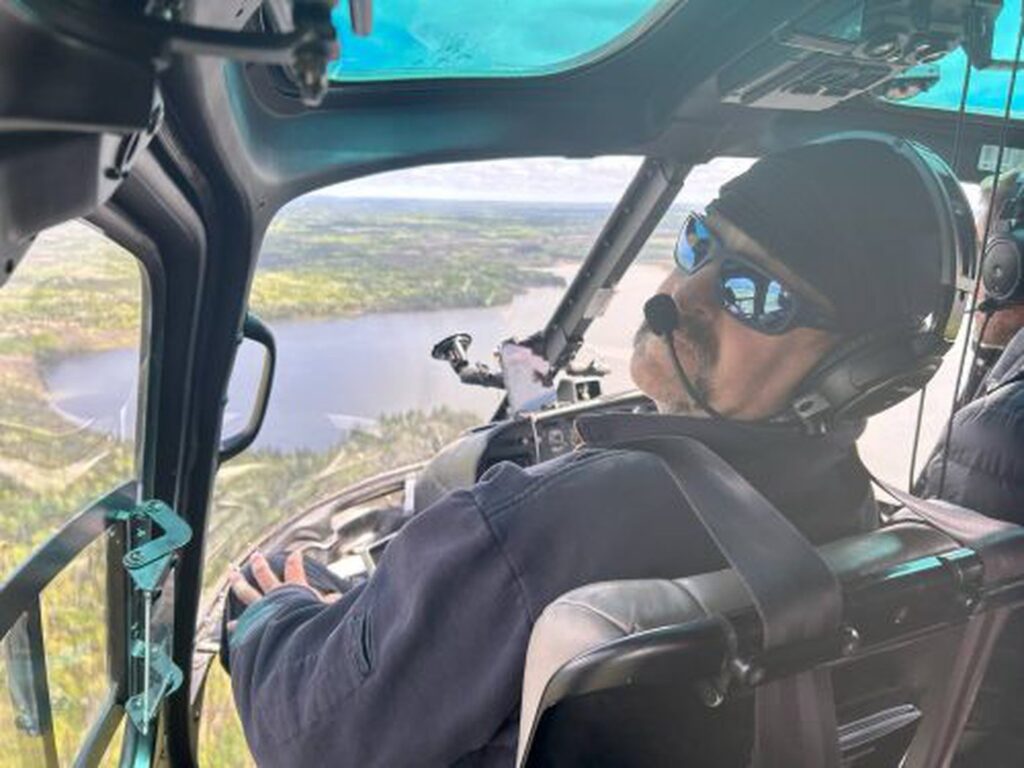
Adamski has been an auxiliary firefighter with the Portage la Prairie Fire Department since 2016 and worked with Canada Task Force 4 for the past two years. He also owns Sirius Protection and Security Services, which is contracted out by the city for bylaw enforcement services.
“We have things in place so that when I leave, I can rely on others to take care of business back home,” he said.
He now plans to take a two-week break, noting that his latest deployment meant missing both his anniversary and Mother’s Day.
“I need to make that up,” Adamski said with a laugh. Though he knows there’s no guarantee he’ll have fire-free days off.
“I’ll go if they call.”
There are currently 13 active fires in Manitoba. To find out more, you can check out the province’s website:
https://www.gov.mb.ca/conservation_fire/Fire-Maps/fireview/fireview_map.html




