



The number of wildfires burning across Northwestern Ontario continues to increase, with 146 active, 53 not under control, five being held, seven under control and 81 being observed, according to the latest update from Ontario Forest Fires (OFF).
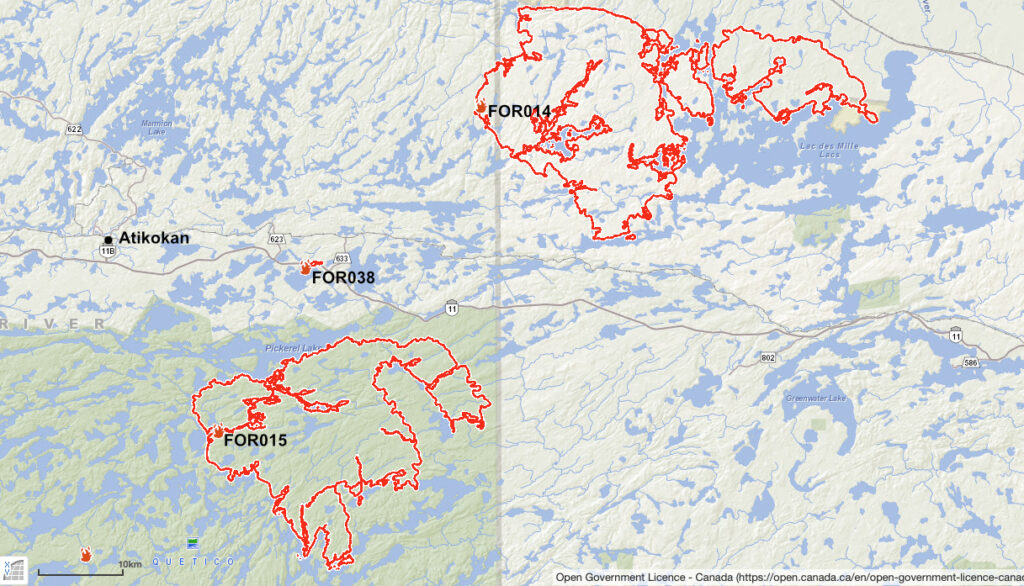
The closest large fires, Fort Frances 14 in Quetico Provincial Park and Fort Frances 15 just northeast of the park, were part of the so-called Atikokan cluster and not under control as of late Tuesday.
Fort Frances 14, a massive blaze just northeast of Quetico Provincial Park straddling the western and northern shores of Lac des Mille Lacs, is now bigger than 50,000 hectares. Fort Frances 15 was estimated at 41830 hectares.
The largest fire in the Northwest is the massive Thunder Bay 36, covering a whopping 318,812 hectares stretching about 125 kilometre from the northeast shore of Lake Nipigon to the northern end of Wabakimi Provincial Park. That fire is not under control and fire ranger crews, helicopters and heavy equipment operators are assigned to suppression efforts, OFF said.
“Recent precipitation over the last several days has helped to reduce fire behaviour, allowing for crews to make good progress on the fire line,” OFF said in its most recent update.
The weather leading into the weekend will not likely offer much in the way of respite, according to Environment Canada’s forecast, which calls for occasional cloud and scattered showers, but nothing resembling a sustained rain event.
Overall, the region remains warm, breezy, and intermittently unsettled, a pattern that keeps fire crews alert for short‑term changes in fire activity rather than major shifts.
Winds will be the main factor, with gusts reaching 40 to 50 km/h at times from today through Thursday as systems pass through. Temperatures stay in the upper 20s to around 30°C right into the weekend.
This weather pattern doesn’t dramatically shift fire behaviour, but gusty winds can momentarily increase spread potential on active edges, and short showers may dampen fuels only for a short period before they dry out again in the heat.
A few thunderstorms are possible Thursday that could bring fire-sparking lightning or produce sudden, erratic gusts even without significant rainfall.
Meanwhile, 12 new fires were confirmed in the Northwest Region by Tuesday evening, a number of those in the far north. One small fire, Fort Frances 45, on a small island in Bartley Lake about 50 km north of Fort Frances is being observed.
The entire Northwest remains under a restricted fire zone designation, prohibiting all outdoor fires including campfires, brush burning, fire pits and charcoal barbecues. The Fort Frances Fire Rescue Services has also implemented a total fire ban within municipal boundaries, suspending all fire permits and prohibiting open air burning, including campfires and recreational fires.
OFF said Monday that the Pan Canadian Aerial Asset Program (PCAAP), managed by the Canadian Interagency Forest Fire Centre (CIFFC), has sent two Q400 airtankers to the region, twin-turboprop aircraft with an external tank that can drop water, foam or fire retardant and a “birddog,” a spotter aircraft that flies ahead of airtankers to identify targets.
Highway 599 reopened at 11 a.m. Monday after several days of closure between Highway 516 and Mishkeegogamang First Nation, though officials warned it may have to close again without notice if conditions deteriorate. Highway 527 at Gull Bay First Nation remains closed except for limited local evacuation traffic. Drivers are being urged to use extreme caution, as smoke has reduced visibility on several northern routes.
Ontario continues to deploy significant resources to the Northwest, with more than 150 fire crews and over 80 aircraft assigned across the region. Additional support has arrived from Alberta and Yukon, and federal assistance remains available if required. Thousands of evacuees are being hosted in communities across the province, including Thunder Bay, Kenora, Sioux Lookout, Red Lake, Sudbury, Niagara Falls, Toronto and others.



