


GULL BAY — When a number of First Nations communities in the region were directly affected by wildland fires this summer and the Ministry of Natural Resources was already stretched thin, 35 firefighters were available from a relatively new partnership between the Indigenous Police Chiefs of Ontario, the RCMP and Indigenous Services Canada.
These firefighters were trained at Kab Lake Lodge during four training sessions between November 2025 and October of this year, according to Ashley Russell-Taylor, chief operations officer for the Indigenous Police Chiefs of Ontario (IPCO).
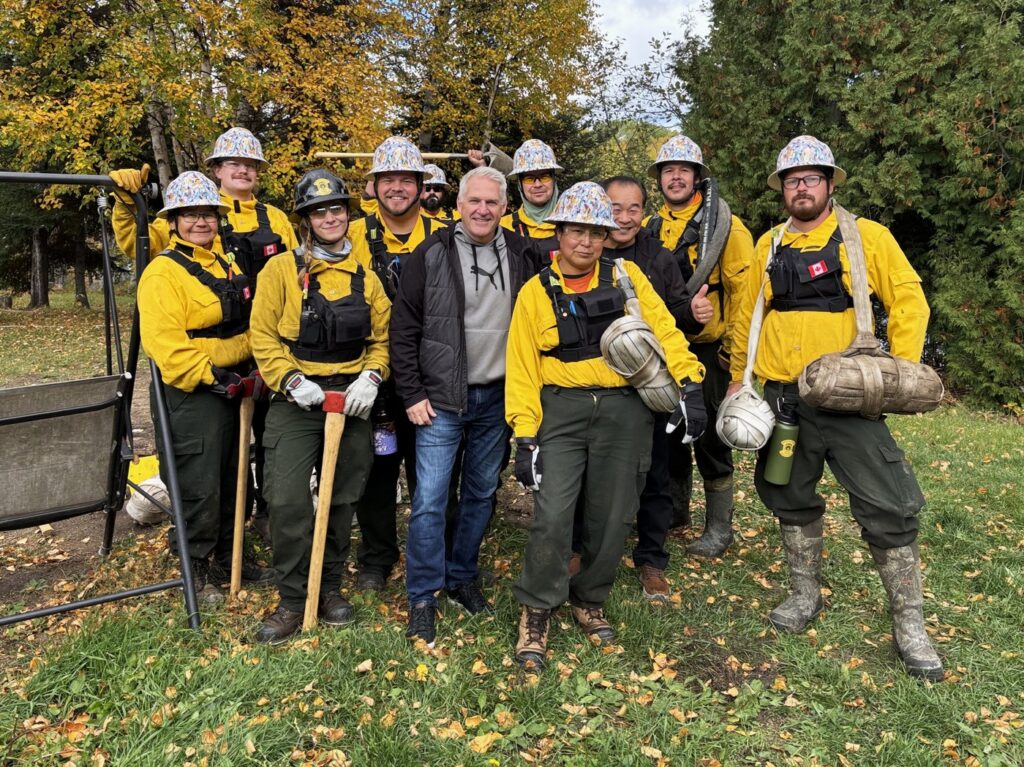
Russell-Taylor and representatives from IPCO, Indigenous Services Canada and the RCMP were in Kab Lake during the first week of October to observe a week of fall training of First Nations firefighters in preparation for the 2027 forest fire season.
He said each session has seen about 25 new recruits graduate from the one-week training.
“Approximately eight years ago, I brought forward the project to Indigenous Services Canada as an opportunity to say, hey, can we make this happen?” Russell-Taylor said.
The project was in recognition of an Assembly of First Nations resolution made almost 10 years ago calling for more standardization and acceptance of First Nations-trained wildland firefighters.
“At the time there wasn’t enough attention and need on wildfire response and a nation-to-nation response,” Russell-Taylor said.
The demand for trained firefighters from communities across the north is threefold: first, to have people trained and ready to manage fire safety and preparedness in remote communities.
Second, to provide culturally-informed emergency response in First Nations communities, as per the Assembly resolution.
And third, said Normand Roy, to deliver standardized, certified training to Indigenous people who can then obtain employment with the provincial government or elsewhere.
Roy is the Ontario manager of emergency management for Indigenous Services Canada. He said that this initiative is a vision that comes from elders and chiefs in Northern communities.
“A few years ago we were on a call with a First Nations community that was affected by fire and they were waiting for crews to come in and address the fire,” Roy said.
“When the crew arrived, it happened to be international firefighters from outside the country. That kind of triggered (us) saying, we’ve got to change things,” with a goal, he said, to have First Nations communities helping each other during forest fire season.
Roy said that traditionally, First Nations communities had firekeepers.
“They maintain their wildland fires and this is what I heard from elders, and from members.”
From those discussions, he said, Indigenous Services Canada partnered with IPCO to provide funding and deliver the training.
The Thunder Bay 59 fire, outside of Whitesand First Nation, is an area of traditional hunting grounds, Kai Liu, IPCO executive director, said.
“It is their food source, their berries, their medicine that got destroyed,” he said.
The firefighter training that the partnership with the IPCO has put together considers the protection of what he called, “natures’ grocery store” and includes traditional hunting grounds, harvesting areas, traplines and even burial sites.
“When we talk about the First Nations having the decision-making powers as to how they would like our response to happen, it feeds back to their inherent right of their own public safety and their sovereignty to make that decision,” Liu said.
But aside from First Nations-trained firefighters, the group still needed further resources to be able to send their Indigenous firefighters to the areas where they were needed, Russell-Taylor said.
That’s where a partnership with the RCMP came into play.
“Over a year ago Norm had put on some training out in Fort Francis, and it brought together all the different emergency management teams all along the Lake of the Woods area and it brought them into a room to concentrate on evacuation planning, wildlife fire planning, emergency planning,” Thunder Bay RCMP detachment commander, Darryl Warnuk said.
He said he told Roy that the RCMP marine section would be available in the event of a forest fire in a community accessible only by water or float plane.
This past spring, Warnuk said, when everything started to go ablaze and you started seeing the wildfires raging in places like Collins First Nation, he called Roy and offered marine-trained members and other marine assets to assist.
“It was in an area that took us out of our comfort zone,” Warnuk said.
Typically, he said the RCMP patrol Lake Superior and border areas.
“We had to learn a little bit about the area speak to some locals and get some maps and charts. We brought in assets from outside of Thunder Bay so we had various different vessels because we weren’t quite sure how we were going to get in there.”
Using Kab Lake Lodge as a home base, he said there were about 10 RCMP officers involved who made safety and evacuation plans.
“We got to be part of it and it was nice because we are police officers, but we all are a part of that emergency services team.
“And when something like that was affecting all these communities, it’s naturally something we want to be involved in.”
Warnuk said it was a good mission for the RCMP, to get into an area they don’t normally get to.
“It challenged us to make various plans and contingencies and safety plans and test our skills and our equipment. It was rewarding, and we’re happy to be a part of it.”



