
Physical endurance. A tolerance for insects, smoke and being perpetually dirty. A love of the outdoors.
These are a few of the prerequisites needed to fight wildfires in the Northwest Territories.
Crews from across Canada travelled to Fort Simpson this summer after the territorial government made a request through the Canadian Interagency Forest Fire Centre, the national body responsible for moving fire resources between jurisdictions.
While Fort Simpson’s evacuation order was downgraded to an evacuation alert on Saturday, firefighting crews are still working to extinguish nearby hotspots.
Megan Patterson, a crew leader with the BC Wildfire Service, said plenty of work remains.
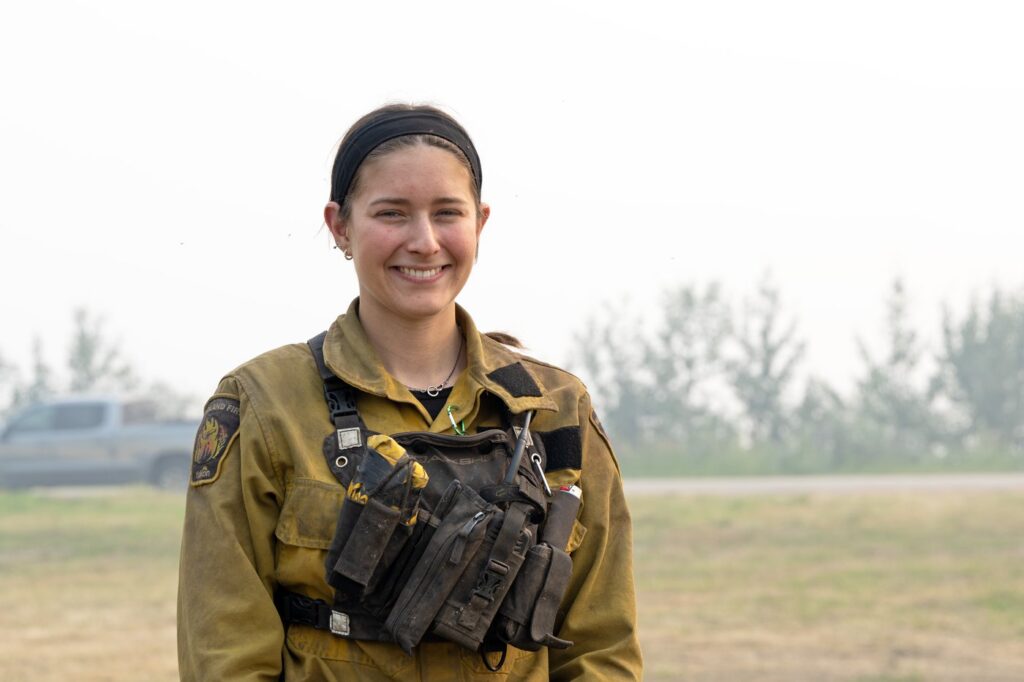
“We got here after the intense couple days, so when we got here, we actually got a lot of rain,” said Patterson. “It allowed us to go in and push lines on the fire.”
She said fighting the fire in Fort Simpson feels similar to fires she’s worked on in British Columbia – but with more mosquitoes.
Originally from north of Montreal, Patterson said she worked as a backcountry ski and kayak guide after moving to BC before falling in love with firefighting.
“Being in a unit crew, you’re in a team of 22 or 24 people. Those people just become your family,” said Patterson. “They see you [at] your worst – where you’re so tired – to the happiest you’ve ever been.
“It’s a tough job physically and mentally, and it’s just so satisfying to see how much you can push your body and your mental strength … Sometimes I’m carrying three quarters of my weight up a mountain, and you’re in smoke.”
Hendrik Stam, a first-year crew leader from BC, said he started working on wildfire equipment maintenance and recycling after high school in Thunder Bay, Ontario.
“My buddy called me one day asking if I wanted to show up for work – I guess the 2018 season was pretty rough back in Ontario,” said Stam.
Last year, he said, he decided to transition his work to BC, though seeing communities near his hometown hit hard by wildfire in the past two years has been tough.
“A lot of the people that I know are having a really tough time with their family. It’s not easy for anybody and you wish you could be there,” said Stam.
“Last year and this year it’s been really weird, not knowing if it was the right time to make the switch over to BC. You never know what the season’s going to look like until it kind of comes about.”
Kate Gyles, a crew member with Yukon Wildfire, said firefighting feels meaningful to her.
“It’s one thing to do physical labour by itself, and another thing to do physical labour with a purpose, especially of helping out our neighbours and protecting community,” said Gyles.
She said she didn’t get the chance to speak with many people from Fort Simpson, given it had been under an evacuation order until recently, but she did get to talk to a water tender. (“Shoutout to Bob!” she added.)
“He was telling us that the first couple of days, when the fire was first encroaching on Fort Simpson, he was riding around with his bike and a shovel and putting out hotspots by himself,” said Gyles.
She said Bob also stepped in to care for three of his neighbours’ dogs, despite admitting he was no dog person.
“I just thought it was really incredible to see how people step up in times of need and help out their own neighbours,” said Gyles.
She said some of the more difficult aspects of tackling this fire have been dealing with the bugs, heat and smoke.
“Some people, my crew, have had headaches and coughing, and so that’s definitely been difficult – and just the fatigue over time,” said Gyles. “Thirteen days working 12-hour days is a long time to be here.
“The people that are in wildland fire are some of the most hardworking and committed people I’ve ever met.”
Dean Daquano, a crew leader from Quesnel, BC, is in his ninth wildfire season. It took time for him to adjust to the long daylight hours that are part of NWT summers.
“It doesn’t really start getting a little bit dark until midnight, and the sun never really fully goes down, so that’s a little bit tough to deal with,” said Daquano.
“Then we’re kind-of living in the smoke for 24 hours a day while we’re out here, so that can be tough on some people that aren’t used to it.”
At the same time, he has enjoyed getting to meet other people with a shared love for the outdoors while fighting the Fort Simpson fire.
“We came out here with four other crews that I’ve never met before and never worked with before, but we’re all here for the same job and to do the same thing and have the same goals,” said Daquano.
“You end up getting really close with them in just the two weeks you’re working with them … you feel like you’ve known them for longer.”
Andrew Harrison, a crew leader based in Haines Junction, Yukon, said that since Fort Simpson residents have returned home, a few people have stopped by to offer thanks to the crews.
“We’re here just doing our jobs, so we’re more than happy to, and don’t need that ‘thanks,’ but it is always nice to chat with people that are coming back,” said Harrison.
“You don’t see a lot of the the impact you have, but you know that you have made a difference and have helped out people.
“It’s been kind-of special in this fire, getting to see people returning back to their homes.”



