


“Oh my God, ew!”
This was Jesse Heichert’s first reaction when she spotted an invasive, toxic creature while working in a client’s garden in Port Sandfield on May 7.
“I just saw it out of the corner of my eye,” she said. “It was gross.”
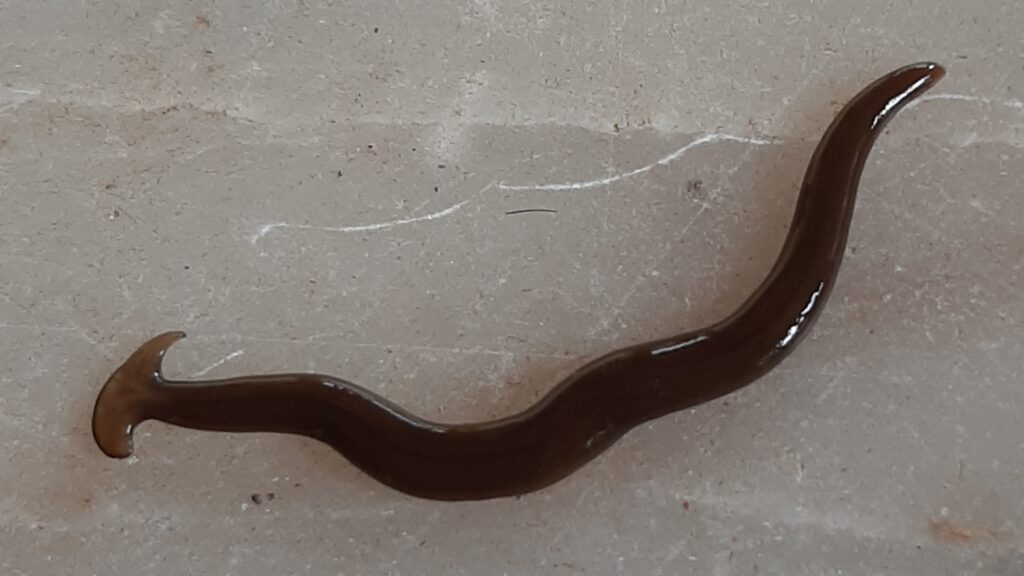
The creature seems to have been a hammerhead worm, distinguishable by its flat head and stripe along its back. Heichert said it clearly wasn’t an earthworm, and she initially recognized it from recent news coverage.
“You can’t miss it,” Heichert said. “It was two inches long, which is really creepy … I wouldn’t want to see a bigger one.”
She did more research and found that cutting them up isn’t a good idea, since hammerhead worms can regenerate from fragments. She said to kill it, she used what was on hand — hornet spray.
“After the first time we sprayed it, we checked it and its head was still moving, so we sprayed a second time and left it for about an hour,” Heichert said. “That definitely killed it, and it kind of went to mush.”
Though Heichert has been a gardener with Lakeland of Muskoka for five years, it was her first time seeing a hammerhead worm in person. She searched the surrounding soil but didn’t find any others, but said she suspects there could be others nearby.
“We informed the client,” she said. “We know that they’re very toxic to pets and there are pets around the property, so that’s what our big concern was.”
Heichert also filed a report with the Ontario Invasive Species hotline to alert officials that hammerhead worms have made their way to Muskoka.
She suspects the worm arrived in imported plant material.
“It’s good for people to be aware, especially the cottagers, that if they’re going to bring plant material, then they really have to be cautious of what’s in their plants,” she said. “They can’t just put soil in the ground, because they could introduce so many different kinds of invasive species.”
Heichert said she’s also seen other invasive species pop up in client’s gardens over the past few years, such as garlic mustard and dog strangling vine.
While she mostly tends to properties in Port Carling, Heichert said she wants everyone in Muskoka to be cautious and vigilant, and for seasonal residents working on their gardens “to be very aware of what they’re bringing up.”
What does the Huntsville Horticulture Society advise?
“It’s a little disappointing to know that (the hammerhead worms) are on their way up here,” said Debora Marshall, president of the Huntsville Horticultural Society. “(The Township of Muskoka Lakes) is not very far away distance-wise … It’s just a matter of time before they’ll be in Huntsville.”
As a horticulture professional, her advice to gardeners is to visit the Canadian Council on Invasive Species website. While it doesn’t mention hammerhead worms specifically, she says many of the prevention tips for jumping worms also apply to both species.
The site recommends avoiding plants, soil, compost, or mulch from potentially infested areas and checking all new materials carefully.
With plant sales and swaps happening this time of year, Marshall says prevention is key.
“You’re coming up, you’re beautifying your cottage. You may be bringing something in that you don’t want to be bringing in,” Marshall said, adding that visitors and locals alike should be careful and “very diligent” in checking all plant material to help stop the spread of invasive species and protect Muskoka.
What steps is the District of Muskoka taking?
Glenn Cunnington, manager of Watershed Programs with the District of Muskoka, submitted the following comment to The Forester:
“The District does not currently have any information available regarding hammerhead worms but will be connecting with the Ontario Invasive Species Awareness Program in the coming weeks to learn more about this invasive species and any potential local impacts. In the meantime, the Hamilton Conservation Authority has shared helpful information that we believe to be the most reliable Ontario-based resource currently available.”
To report an invasive species sighting or to learn more about invasive species affecting Muskoka, residents can visit the Ontario Invasive Species Awareness Program online at: https://www.invadingspecies.com/invaders/.



