



COLEMAN TOWNSHIP — It’s that time of year when the geese fly south and tiny snapping turtles crawl out from their sandy nests.
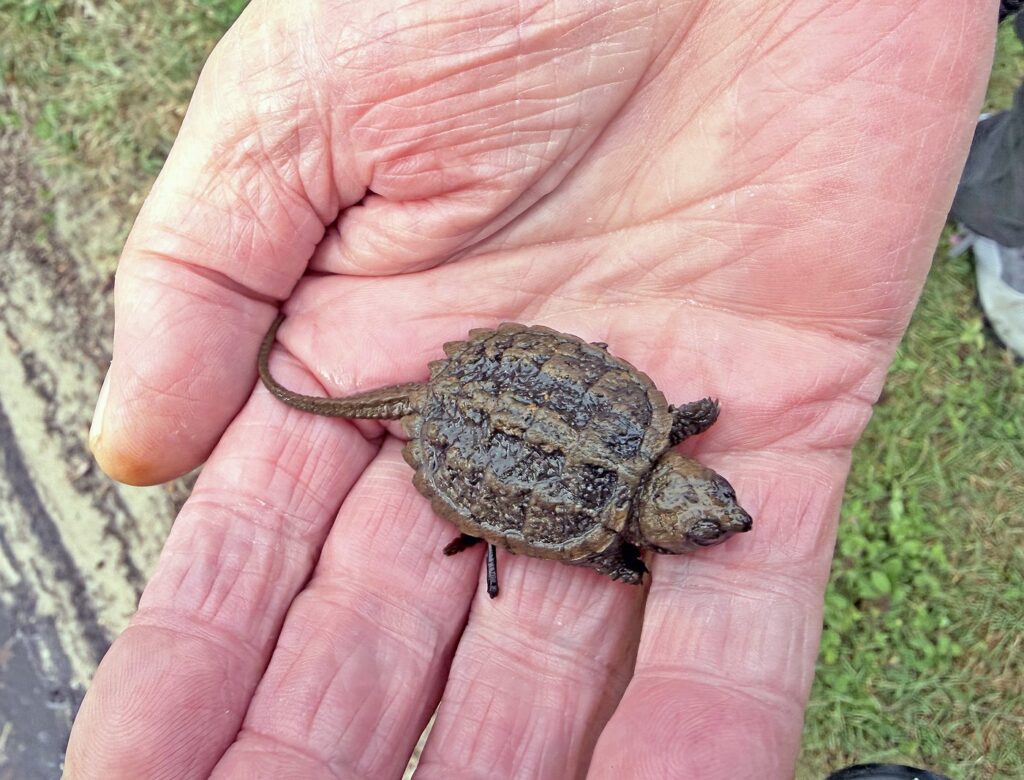
A nest of snapping turtles hatched from their roadside nest to make their way over to Loon Lake in Coleman Township on September 20.
Tim Moore, who lives near Loon Lake, has been watching snapping turtles hatch from their nests for years.
Some years in early spring – anywhere from May to June – he sees the mother snapping turtle wind her way up from the lake to the gravel roadside to scratch a hole in the ground laying upwards of 50 or more eggs.
After she lays her eggs, Moore places a wooden box around the nest and bright orange cones alerting motorists of the presence of the nest and to avoid driving over it.
That’s the last time the mother snapper will see her babies as they will hatch all on their own and make their way to the nearest lake to grow and mature.
It takes between 60 and 90 days for eggs to develop into hatchlings that will tear their soft leathery eggshell with their egg tooth.
The egg tooth is a sharp bump on their snout that allows them to break open their shells.
The amount of eggs that hatch into baby turtles varies each year. This year Moore hasn’t seen as many compared to previous years when he watched upwards of 50 turtles crawl out of the nest going in all directions.
They measure about two inches long at this point.
TURTLE BOXES
He has rescued them from the nearby road where cars and trucks drive past and from the nearby woods, placing them gently on the shorelines of the lake, the turtles’ new home.
He encourages people who love turtles to protect their nests after the turtle lays her eggs by installing a protective box around the site.
The boxes have small holes with which the hatchlings can escape when it’s time for them to hatch and the boxes protect the nest from predators who dig up 90 per cent of turtle nests within a few days of laying.
The boxes should have open bottoms to allow rain, air and sunlight to reach the nest for normal incubation.
It is a dangerous time for newly hatched turtles as predators like herons, skunks, racoons and large fish will feast on the tiny creatures.
If they survive their first year, they can live up to 30 to 40 years.
The baby snappers will burrow down in the mud at the bottom of the lake when the weather turns cold and emerge next spring as one-year-old turtles.
Moore says in the spring the mother snapping turtle will choose a spot near Portage Bay Road for her nest, lay down and deposit her eggs.
Then he watches all summer long over the nest to make sure no predators get to it or cars do damage to the nest site.
Then he is rewarded in the fall when the hatchlings appear, the grin on his face is evident of another successful hatching year for the turtle family.
Snapping turtles are not considered an endangered species but they are listed as a species of special concern.
This means they are not endangered but they live with significant pressures that could push them towards endangered status, says the Ontario Turtle Conservation Centre.




