

About a half-hour north of Barrie, on a small farm just outside the village of Elmvale, one man has spent a large part of his adult life creating his own utopia.
Purchased 50 years ago by his father at his request when he was in Grade 8, Dr. William Shotyk has transformed a simple, naked piece of land into a natural oasis that teems with life forms that have been lured to the farm because of its idyllic man-made habitat.
Shotyk started the transformation with trees — many, many trees.
“I started when I was in high school in 1975,” he told the audience that gathered at the Elmvale Community Hall last night to hear his presentation, titled ‘Celebrate nature: 50 years of ecological restoration in the Wye River Watershed.’
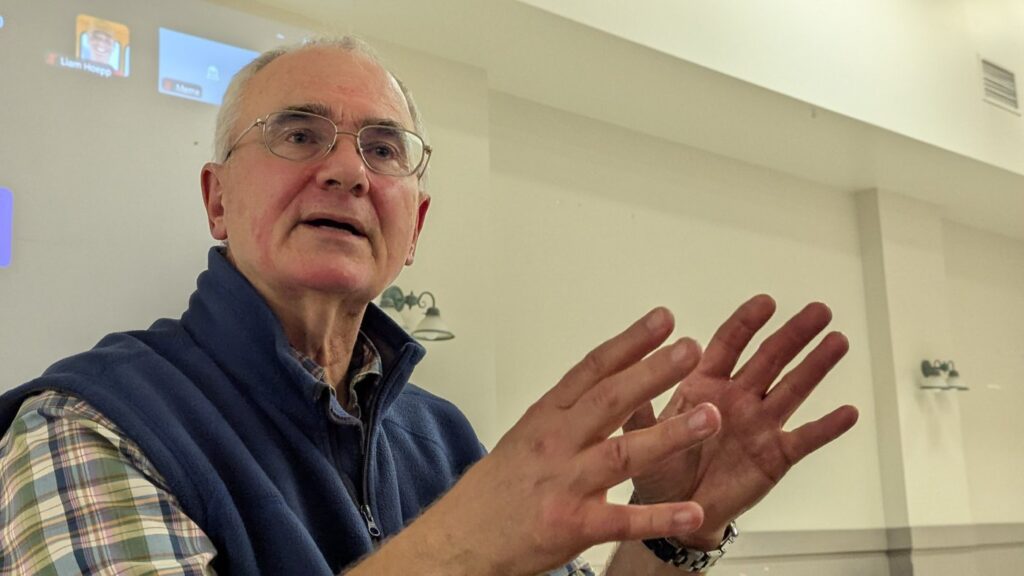
“We planted 2,000 white spruce and red oak, and that was my first summer living at the farm. It was a wonderful place for a young person from Toronto to live for the summer,” he added. “That’s really when I fell in love with the farm.”
Born and raised in Toronto, Shotyk returned to the 72-acre farm a couple of years later with 16 of his pals to plant more trees — seedlings he purchased from the Ministry of Natural Resources (MNR) nursery in Midhurst, which was shuttered in 1996.
He paid one penny for each seedling.
“We planted 5,000 seedlings all around the farm property,” he recalled. “We all slept in the old hay barn.
“I know they’ve forgiven me for all that hard work,” Shotyk added with a laugh.
Ten years would pass before Shotyk would return.
He was off to university to pursue an education in agriculture, first at the University of Guelph, where he completed his bachelor’s degree in 1981 and then the University of Western Ontario where he earned his PhD in 1986.
Shotyk recalls visiting the farm once, around the time he earned his doctorate, to thin out the spruce trees.
A year later, he cut down some of the trees and sold them at a gas station as Christmas trees. He sold enough of them to cover the cost of an airline ticket to California, where he had secured a position doing scientific research at the University of California Riverside.
A year later, he was back at Western.
From there, Shotyk joined the Geological Institute at the University of Berne, Switzerland. In 2000, he was hired by the University of Heidelberg as a professor. He became the director of the Institute of Environmental Geochemistry. Since 2011, he has held the position of Bocock chair in agriculture and environment at the University of Alberta.
Before he went to Europe, he entered into a Woodland Improvement Act agreement with the MNR, which would see the ministry plant almost 14,000 spruce trees on the farm.
Today, the farm is home to more than 25,000 trees, and includes more than 50 species. They all contribute to a healthier, more sustainable ecosystem.
According to Shotyk, trees protect crops, livestock buildings and conserve moisture. They also provide a habitat for birds, which consume insect pests, a benefit for farmers, and they also remove carbon dioxide from the atmosphere.
“When I was born in 1958, the concentration of carbon dioxide in the atmosphere was 315 parts per million,” Shotyk said. “Today, we’re at 426 parts per million.
“Those trees that we plant are removing carbon dioxide from the atmosphere, helping to battle climate change,” he added.
By his own calculation, Shotyk says that by planting so many trees, he’s offset his own carbon footprint for the next 300 years.
With the forestry component of the property taken care of, Shotyk turned his attention to other matters. In 2016, he started to work with Ducks Unlimited to build a wetland on the property.
In the fall of that year, it was nothing more than a hole in the ground. The following spring, it was full of water and that’s when things really began to happen, Shotyk said.
“Immediately, the frogs arrived,” he said. “I don’t know how they found it, but they did, and the water turned black with tadpoles and lots of waterfowl.”
A variety of plants began to take root. A painted turtle arrived, followed by snapping turtles.
“I have no idea how the painted turtle found the wetland in the middle of the farm, but it did,” Shotyk said. “I’m pretty sure the snapping turtles spend their winter in that wetland, because when I arrive in May, they’re slowly dragging themselves out of the wetland to go back to the Wye River.”
But it’s the birds that have captured Shotyk’s attention. He said the farm has played host to 145 species of birds, including bluebirds, meadowlarks, green herons, trumpeter swans and, the ultimate reward, a pair of bald eagles that made their first appearance last year.
“Why is it so incredible to have bald eagles on our farm? Because they were almost wiped out by DDT,” he said of dichlorodiphenyltrichloroethane, which is a man-made insecticide once widely used for pest control, but is now banned in most countries due to its environmental persistence and negative health effects.
“If you look at the bald eagle population in the early 1960s, there was almost nothing there. Nobody would see a bald eagle in Elmvale, Ont.”



