


Drones are changing the landscape for many industries, and for conservation, they are proving one of the most effective tools in the fight against invasive phragmites.
Research from the University of Waterloo reveals that using spray drones, remotely piloted aircraft systems (RPAS), to apply the herbicide Habitat Aqua to areas overtaken by phragmites has a 99 per cent effectiveness in suppressing the common reed.
The three-year research project took place from 2022-2025 and was a collaboration among partners such as the Invasive Phragmites Control Centre (IPCC), Drone Spray Canada, the Ministry of the Environment, Conservation and Parks (MECP) and the University of Waterloo. The primary location was at Rondeau Provincial Park on Lake Erie, specifically in a 50-hectare swamp slough tucked into the park’s southern end. The phragmites had been challenging to tackle because of the ring of trees circling the swamp.
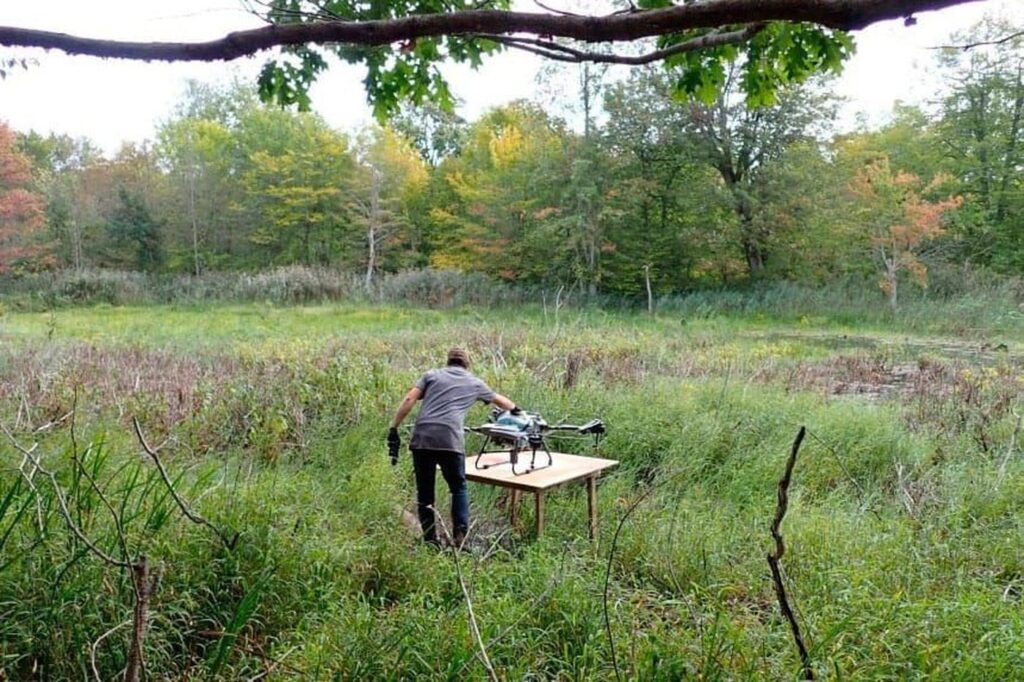
“Phragmites is an invasive plant that’s been called Canada’s worst invasive plant by Agriculture Agri-Food Canada, and it is something the Ontario government has put an $11-million fund in place to try to manage here in Ontario,” said Dr. Rebecca Rooney at the University of Waterloo (Department of Biology). Master’s student Grace Lew-Kowal led the research project.
Phragmites cause environmental havoc, crowding out other plants from wetlands and hurting local biodiversity. It also quickly becomes a safety concern, blocking sightlines on roads and interfering with stormwater pond operations.
One of the best methods for removal is herbicide application. Habitat Aqua is the only herbicide approved in Canada for application to phragmites in standing-water environments.
“It’s a really, really big sort of problem, and it’s really hard to get rid of. Mowing doesn’t work, burning doesn’t work, mechanically digging it up can work, but it requires sustained effort, and it’s very labour intensive. Then it’s also very damaging to the ecosystem,” explained Rooney.
Currently, Habitat Aqua is applied using helicopters, backpack sprayers, amphibious vehicles or boats, but the problem is the collateral damage associated with these applications.
“The problem with this kind of amphibious vehicle approach is that it’s also quite damaging to the habitat, so you’re crushing and trampling all the native plants and also turtles and snakes that are in there. Aerial application is kind of lower disturbance, but with the helicopters, they have this really wide boom width of four metres-you are getting a lot of non-target spray, so you’re aiming to just hit the phragmites, but the phragmites is not growing in nice rectangular patches,” said Rooney.
This means that while spraying for phragmites, a helicopter’s four-metre boom width can kill surrounding vegetation and harm local wildlife. By using drones for the herbicide application, operators can significantly minimize this collateral damage.
“They’re smaller and much more precise, and so they can kind of fly out to the area that you need to treat and do a much tighter zigzag to spray,” said Rooney.
The research findings were used by the manufacturer of Habitat Aqua to apply for a label change in the product to allow it to be sprayed by drone in Canada last year.
The study also paved the way for the IPCC’s new Commercial Spray Drone Control Program, which launched this summer.
The program will take place across Ontario and use drones to map and spray phragmites-infested areas, with a heavy focus on sensitive wetlands, municipal properties, and shorelines.
Dr. Janice Gilbert, founder and executive director of the IPCC, said she is excited by the project. The program is something she has been hoping to get up and running in Canada for almost a decade.
“It is a tool that I have been aware of for a long time. It was just very slow coming to Canada,” said Gilbert. She added that she was happy to take part in the previous research collaboration with Rooney because it was pioneering work.
“I just knew it was going to be a game changer for us in terms of our ability to restore these really remote coastal areas, these large coastal wetlands, these other areas where it’s just really hard to get in to treat the phragmites.”
This year marks the first time that any qualified operator can use a spray drone to apply Habitat Aqua. Health Canada officially legalized the use of drones for pesticide application, including the herbicide Habitat Aqua, on June 30.
Gilbert is excited for the changes but cautions that drone spraying is not as easy as people think.
“There’s still a lot of considerations you need to take into account,” said Gilbert, noting that it’s important people are trained properly in drone flying to prevent crashes and spills.
Still, the benefits outweigh the potential negatives. Considering the destructive nature of phragmites, Gilbert said that the drone program has achieved a 100 per cent mortality rate in some areas.
“That’s really difficult to achieve from the ground because the sites that we used the drone for were large, high-density phragmites and typically ground control in those areas… we typically get over 95 per cent mortality, but…it’s hard to kill 100 per cent of it, but with the drone, we actually were able to achieve that in some [cases].”




