

Seven Generations Education Institute (SGEI) Rainy Lake Campus hosted the annual Gagwe or “Quest for Knowledge,” on April 23, continuing a decades-old tradition that encourages students to learn and celebrate the Anishinaabemowin language.
The annual event, which takes its title from Gagwe-gikendamaawiziwin— “to seek knowledge”—has been a long-standing annual gathering in which students compete in fun and friendly competitions to utilize and display their linguistic skills, said Robert Horton, SGEI’s Anishinaabe language educator and facilitator.
“We coordinate this event to celebrate Anishinaabemowin, celebrate language learners, but definitely celebrate those elders and the teachers that make this possible,” Horton told The Times. “We reach out to the First Nation schools, the Rainy River District School Board and the Catholic board, and each one of them have Anishinaabemowin students. So, we provide an opportunity where a group of eight can represent their school and their division.”
The competition at SGEI is broken up into two separate divisions; Grades 5 and 6 students are placed in the Junior Division, while Grades 7 and 8 are placed in the Senior Division. Students work their way through five stations, each offering a different form of communication and testing their knowledge on a wide spectrum of language skills.
The first station’s events were held in the campus Circle Room, challenging participants to give a performance, which could be a song, poem or acted scene that they had created.
The second station was based on the TV game show Jeopardy, but testing Anishinaabemowin sentence construction. “The first station has to do with creation and the use of your language; Jeopardy has to do with conjugating verbs,” Horton said.
The third station revolved around the concept of creating new words. As a language that is constantly growing and adapting new words to reflect the modern world, Horton explained that its young speakers must know how this process works.
“Maybe 20 years ago, we may not have had the word for laptop—Mazinaabikiwebinigan—but now we do,” he said. “We have to keep creating new words, so the students are trained and taught and supported to add new words to their lexicon. Anishinaabemowin is known as polysynthetic, kind of like ancient Greek, where you can build it almost like LEGO.”
The fourth station was a game of charades, in which the competing students would draw a prompt in Anishinaabemowin and need to act it out. The final station was the creation of art projects.
Across these five stations, students test their skills but are also encouraged to engage with and learn the language further as a lifelong ability.
“It’s amazing because we see these up-and-coming language technicians, but also we may be looking at some of our colleagues in teaching language,” Horton said.
Horton said the competitors earn points towards a rating placement, and awards of trophies and certificates are given for the first, second and third placing groups over both divisions.
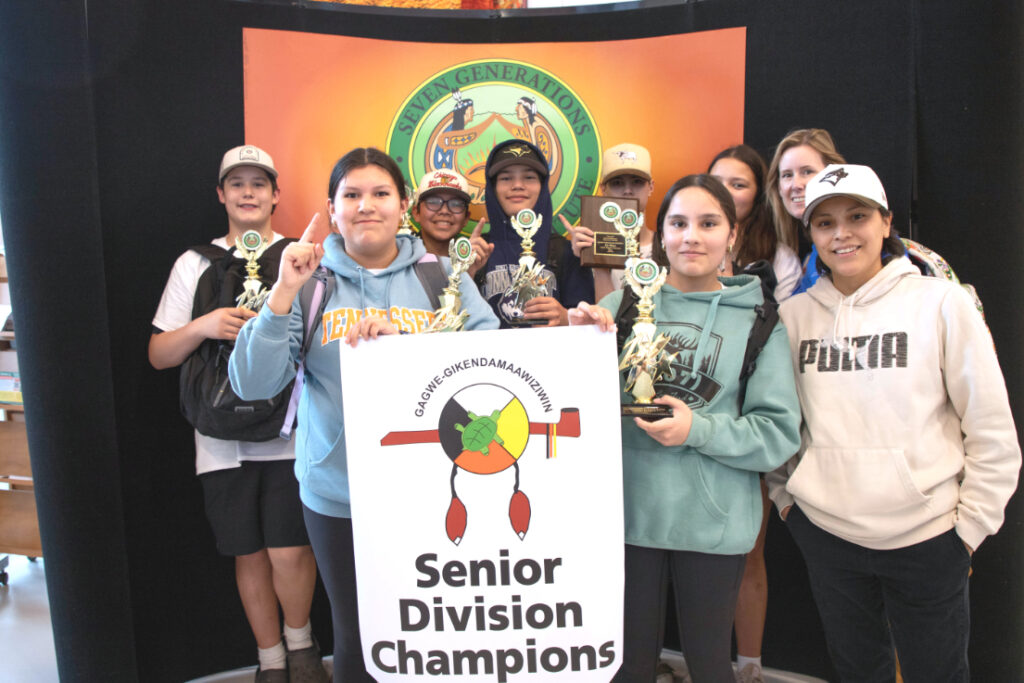
The winners of the competition are listed below:
Junior Division: First place – Robert Moore School; second place – J.W. Walker School; third place – Our Lady of the Way School
Senior Division: First place – Crossroads Public School; second place – Mine Centre Public School; third place – Donald Young Public School.





