


On October 3rd, 1873, an elegant stone (reflecting promise, potential and a massive amount of hope) was cast into the waters of legacy and memory, from which the subsequent ripples continue to find their way to our collective shores.
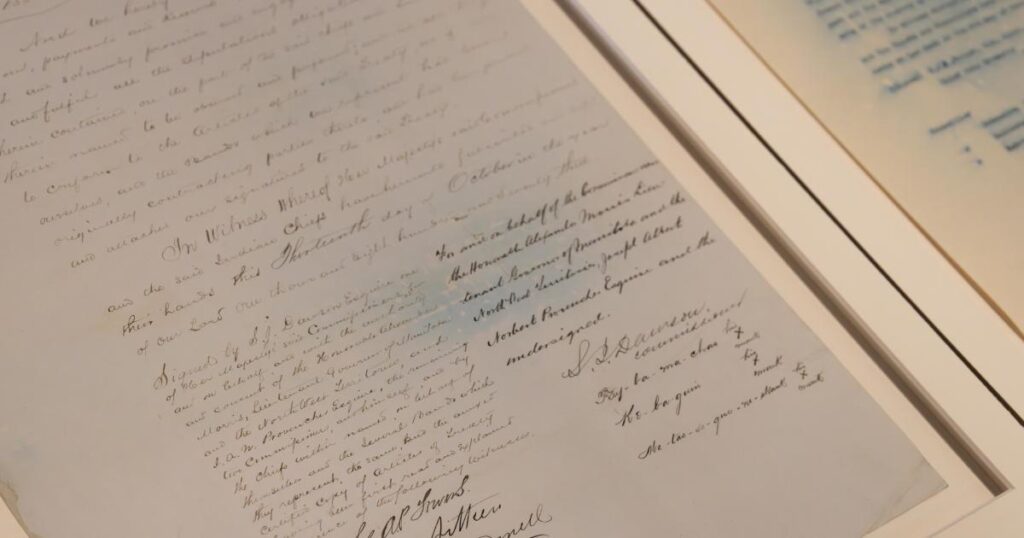
Photo credit: Canadian Museum for Human Rights.
Sometimes calmly. Sometimes crashing. At times, washing ashore with misunderstanding, misinterpretation, or inaccurate vantage points from different sides. However, it still washes ashore with truth as its headwind and clarity as its shimmer.
Treaties in Canada
To ignite knowledge of how treaties are embedded (and how they function) within Canada, there are a few points that are crucial to understand. Treaties are affirmed and recognized by section 35(1) of the Constitution Act, 1982.
Existing treaty rights are constitutionally recognized and affirmed and cannot simply be extinguished unilaterally by one party. It doesn’t matter the form they take (such as wampum belts and similar agreements). A nation-to-nation relationship defines it, and Indigenous understandings and the historical and cultural context are indispensable to treaty understanding and implementation.
Lastly, treaties are classified sui generis, meaning they are unique agreements arising from the distinctive relationship between the Crown and Indigenous Nations and are therefore subject to special principles of interpretation.
Onward and upward: The treaty relationship
The treaty relationship in this part of North America is not based upon Treaty #3 alone, but a line of crucial agreements linked in succession. The Two Row Wampum was agreed upon by the Haudenosaunee and the Dutch. Its principles would continue to inform relationships involving European powers, including the Crown of England, while the French developed their own relationships and agreements with Indigenous Nations.
This agreement forged a relationship in which the ship of the European newcomers and the canoe of the Indigenous Nations would sail side by side down the river of time. Peace, honesty and friendship would define how they sailed together. Together, they would be interdependent, interconnected, and interrelated—but autonomous. At no point will one vessel try to control the other. There can be harmonized legal traditions and new partnerships, but autonomy would not be undermined.
Following the British victory over French forces at the Plains of Abraham in 1759, the Seven Years’ War continued until the Treaty of Paris formally ended the conflict in 1763. Later that year, King George III issued the Royal Proclamation of 1763. The King acknowledged that Indigenous Peoples were nations, could only surrender interests in land via treaties and would only seek treaties if the Indigenous Peoples desired them. At the same time, the King assumed underlying right and title to Indigenous lands under a guise of guardianship.
The proclamation violated the principles represented by the Two Row Wampum agreement with the Crown. Another gathering of leaders from 24 Indigenous Nations and representatives from the Crown subsequently took place for eight weeks at Fort Niagara. Utilizing wampum beads on sinew and beautiful oratory, Sir William Johnson spoke on behalf of the King.
By means of the Treaty of Niagara (and the Silver Covenant Chain belt), what were understood within this treaty tradition as necessary corrections to the relationship were finalized. Underlying title would not be claimed, as land would be shared. No underlying title was given up. Making necessary corrections with particular stipulations (an annual and symbolic giving of gifts), this agreement would make the Crown’s presence and existence in what would become Canada legitimate and within a Nation-to-Nation relationship.
These are the legal foundations upon which Canada is built and upon which future treaties are situated.
The following decades and centuries would reveal that without treaties (and the treaty relationship), Canada would not exist.
Biidaaban: Setting the stage
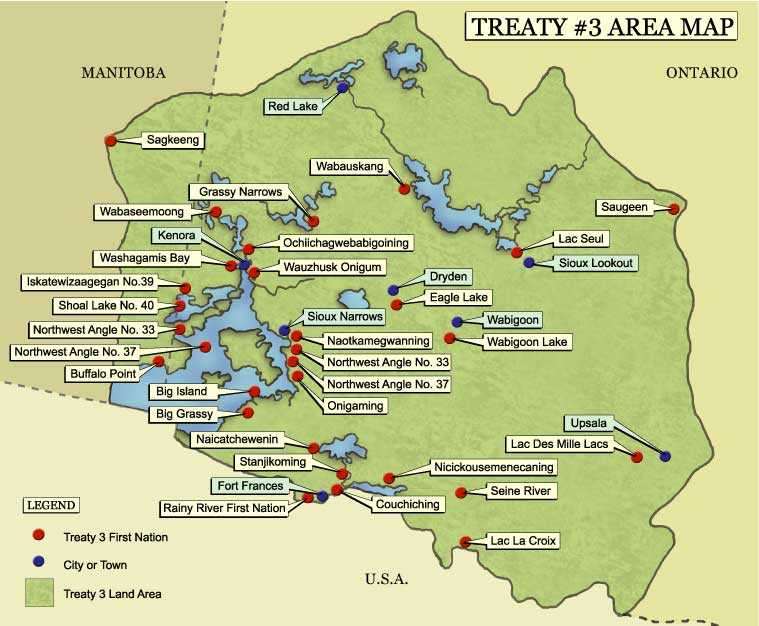
Our beautiful region has always been a beacon to travellers, explorers and countless generations of Indigenous Peoples who have made it home.
Beginning in the 1860s, a renewed interest in the region would take shape. First, British Columbia would only join eventual Confederation if it had a cross-country railroad. Second, a supply route from Fort William to Fort Garry (Thunder Bay to Winnipeg) was desired. Third and fourth, safe passage through the region and room for settlement were sought. Lastly, natural resources such as timber and minerals were desired.
Treaty #3 is not with Canada, but rather with the Crown of England.
As both sides of the treaty relationship required spokespeople, notable names would echo throughout history.
Bringing the voices and concerns of the Anishinaabeg forward into four years of negotiations, Mawedobines (lead spokesperson from Long Sault Rapids) and Powassin (of the Northwest Angle) were selected among the Anishinaabeg. Dozens of other area leaders were also present.
On behalf of the Crown and its interests were Alexander Morris (who arrived in the final days), surveyor Simon Dawson, Indian Agent Provencher, Wemyss Simpson (who left negotiations early) and Indian Agent Robert Pither (who also left negotiations early).
Early negotiations were conducted along the western shores of Lake Superior, as well as here in Fort Frances.
The final days of negotiations took place at Harrison Creek, where high-level ceremonies such as shaking tents, sweat lodges and the lifting of pipes took place.
The matter of how to share land, space, and place where both parties would benefit (albeit in various different ways, but also together in many ways) was the challenge that needed a solution.
The pipe is lit and a stone is cast
With the lighting of pipes, Manidoo Mazina’igan concluded the agreement in which land would be shared with the Crown of England in exchange for making and following through with crucial Treaty Promises in seven areas of Anishinaabe life.
Manidoo Mazina’igan, the Spirit Document, is the name of the agreement before it came to be titled Treaty #3. High-level ceremonies were activated and conducted to guide negotiations, as well as to ratify, via witness, the spirit and intent of the treaty.
For providing safe passage for the railroad, the Dawson Trail, room for settlement, and agreeing that all land (with the exception of reserved lands) is to be shared and, to be sure, to the depth of a plough, the Crown agreed to deliver and protect various rights.
These are the protected treaty rights of the Anishinaabe people upon the signing of Manidoo Mazina’igan (as well as the implications of various Supreme Court rulings that give a more robust understanding).
Education
- Financial assistance for schooling.
- Learners can attend school off-reserve if they wish.
- There are no limitations such as age or grade. It is based upon lifelong learning.
- The Supreme Court of Canada has made it clear that how treaty rights are applied can evolve—it doesn’t need to be only carpentry or agricultural learning.
- A school will be built and established on reserve land at the request of a band.
Hunting and harvesting of animals
- All animals hunted, trapped, or harvested on reserve lands are exclusively for Anishinaabeg.
- All animals hunted, trapped, or harvested on shared treaty land (all land off reserve lands) are to be shared.
- No animals hunted, trapped, or harvested for what they give were ever surrendered, sold, ceded or given up—but shared.
- It is not only the right to do so, but the ability to use one’s treaty rights.
- There will be no hindrances or restrictions. Anishinaabeg will be free to do as before.
Fishing and fisheries
- All fisheries and fish harvested on reserve lands are exclusively for Anishinaabe use only.
- All fisheries and fish harvested on shared treaty land (all land off reserve lands) are to be shared.
- All fisheries and fish harvested were never surrendered, sold, ceded, or given up—but shared.
- It is not only the right to do so, but the ability to use one’s treaty rights.
- There will be no hindrances or restrictions. Anishinaabeg will be free to do as before.
Forestry and wild Plants
- All forestry resources or wild plants harvested on reserve lands are exclusively for Anishinaabe use only.
- All forestry resources or wild plants harvested on shared treaty land (all land off reserve lands) are to be shared.
- All forestry resources or wild plants harvested were never surrendered, sold, ceded or given up—but shared.
- It is not only the right to do so, but the ability to use one’s treaty rights.
- There will be no hindrances or restrictions. Anishinaabeg will be free to do as before.
Minerals and resources
- All minerals and resources on reserve lands are exclusively for Anishinaabe use only.
- All minerals and resources (and mineral/resource wealth) on shared treaty land (all land off reserve lands) are to be shared.
- All minerals and resources on shared treaty land were never surrendered, sold, ceded or given up—but shared. The Crown may harvest to the depth of a plough—the limit to what was shared.
- If an Anishinaabe person locates a mine in shared treaty land (all land off reserve land), he or she will be compensated for discovering it.
Self-government
- Traditional governance was the medium that was utilized to negotiate and finalize Treaty #3. It was understood and acknowledged that traditional governance would continue without hindrance.
- If there would be any conversation or further discussion about Treaty #3, rights or the Treaty relationship, it must be done through the medium of traditional governance.
Agriculture
- Reserved lands will be free of Provincial encroachment.
- Land of good quality.
- On a one-time basis—a variety of farming equipment (two hoes and one plough for every 10 families, five harrows for every 20 families, one scythe and one axe for every family), animals (one yoke of oxen, one bull and four cows for each band), crops (enough wheat, barley and oats for the land broken up) and instruction to learn how to farm.
Miscellaneous promises
- $1,500 per year in twine and munitions.
- $12 as a first payment to each Anishinaabe person and $5 for each subsequent year (this is not to increase—as it is only a symbol, a gift, to bring the Crown and the Anishinaabeg back together each year).
- $25 to every Chief, every year.
- $15 to every Councillor, First Soldier, and Messenger.
- Coats for Chiefs and Headmen every three years.
- The English Government will never call the Anishinaabeg to assist in battles.
- There is the expectation to live in peace.
- An Anishinaabe family that is living afar has two years to join their families, settle, and benefit from Treaty #3.
- Agreements and understandings will take place about reserve locations. The Government will survey them.
- Anishinaabeg will not have to immediately leave their fall harvest to move to reserved lands.
- There will be no sale of liquor on reserve lands, and laws against the introduction or sale of intoxicating liquor will be strictly enforced.
- Rations will be received during the time of payment each year.
- The Queen’s policemen will preserve order, and whenever there is crime and murder, the guilty must be punished.
- This Treaty will last as long as the sun will shine and water runs—that is to say, forever.
Adhesions and awareness
- In great appreciation for the Nolin brothers’ help with translations of discussions (to ensure fair negotiations), several mixed-heritage families who were already living among the Anishinaabeg near Rainy Lake (and their descendants) were included in Treaty #3 as part of the Anishinaabe Nation through the 1875 adhesion. These specific families who are included in Treaty #3 welcomed this, but did not wish for annual payments, twine, or ammunition.
- Signatures of Anishinaabeg at Lac Seul who could not travel to Harrison Creek due to fall harvests.
- Signatures of Anishinaabeg near Shebandowan Lakes who could not travel to Harrison Creek due to fall harvests.
Important points
There is a lot of misinformation about Treaty #3 on all sides.
Treaty #3 as published by Canada fits a serious critique: fraudulent, hollow, greatly misunderstood or incomplete as conveyed. It contains draft points from what the Crown sought and brought to negotiations in 1871-72—not the true Agreement points of 1873.
This means that up to two years of negotiations and points were not even included in Treaty #3 as published by Canada. No single document, standing alone, contains every term and dimension of the Agreement known as Treaty #3.
We know this via analysis of the Paypom Document (mistakenly referred to as ‘the Paypom Treaty’), which contains some notes written and given to Chief Powassin in the last days of negotiation; the Nolin Notes; the Shorthand Report; Dawson’s submission; letters to Indian Affairs; newspaper articles; letters to newspapers/government; oral and ceremony accounts and actions taken when Treaty #3 was violated.
Although Métis leader and interpreter Nicolas Chatelaine worked with government officials to attempt to get all Métis people under Treaty #3, this is not what happened. Anishinaabe leadership had concerns about Chatelaine and did not trust him. During the 1873 negotiations, however, Anishinaabe leadership itself raised the matter of mixed-heritage families living among them and sought their inclusion.
The Nolin brothers played a crucial role in the negotiations by providing the language skills necessary to ensure discussions were understood and fairness could reign. The Manitoba Act’s Métis land provisions applied within Manitoba and did not themselves establish equivalent Métis land rights outside the province in the Treaty #3 territory. The matter continued after the 1873 agreement and culminated in the 1875 adhesion, through which a number of mixed-heritage families were included within Treaty #3 as part of the Anishinaabe Nation.
With the help of the Nolin brothers (who spoke languages crucially needed), Crown Representative Alexander Morris was very clear (evidenced by his own quotes) on the Anishinaabe demands to finalize and ratify the treaty. This demonstrates there were not simply two different understandings of the Agreement. There was a common understanding.
However, here we have two roads.
One follows the broad cession language of the Treaty as published by Canada, in which lands and interests are understood as surrendered to the Crown subject to specified treaty rights.
One honours an understanding of sharing in which the land and its wealth were not wholly surrendered, but were to sustain both parties to the treaty relationship.
The first, when treated as an exclusive model of ownership and resource wealth, risks casting one treaty partner into poverty while the other accumulates the economic benefits of the land. The second strengthens the possibility of healthy economics in which the wealth and opportunities arising from the land can sustain both treaty partners.
Reflections in the waters of memory
Perhaps most importantly, Treaty #3 belongs to us all—and binds us all. Whether you are Anishinaabe or mainstream Canadian, this treaty belongs to you, although it does not place everyone in the same legal position within the treaty relationship. The difference is that we have (and are) benefiting from our treaty in different ways.
The Crown (and later Canada) ensured citizens would benefit greatly from the resource wealth and the formation of economies. Anishinaabeg, in turn, continue to benefit from honoured treaty promises. Perhaps the next step is when we are willing to shake hands and benefit together with a meeting of the minds and searching of spirits.
Based upon his eloquent words, the Spirit of Saagajiwe is alive and well when we understand that what we have both brought to the table is priceless (our languages, cultures, transmission of knowledge, and legacies)—let’s put the best of each of us together to benefit future generations collectively.
Standing together on the shores of these waters, we are neither savages nor settlers. We are partners, as well as individuals with irreplaceable gifts within the human family.
My Uncle Delbert once told me: “Long ago, we used to celebrate Treaty Day. And it wasn’t the five dollars we get every year, that’s only a symbol of what the relationship is supposed to be. Many like you, my nephew, are holding up signs, yelling, and blockading. But that’s not treaty because that sign can be put down when you go home.”
Then he extended his hand and shook mine when I extended mine back.
“Treaty is how we are to walk beside each other every day.”
Robert Horton is an educator, author, orator and linguist. He is a member of Rainy River First Nations and a descendant of Mawedobines of Long Sault Rapids.
For further reading: “We Have Kept Our Part of the Treaty” and “The Creator Placed Us Here” by Grand Council Treaty #3.



