



Located in the Rainy River district of Northwestern Ontario, along the southeast shore and on Big Island in Lake-of-the-Woods, the Anishinaabeg of Naongashiing First Nation (AON) is a dynamic community that has long depended on natural resources for its livelihood. After traditionally thriving on fishing, hunting, trapping and forestry, this small community of less than 200 resident community members is taking a bold economic development step forward. It has leaped into the development of an aquaculture project that has community members focussed, motivated and loaded with excitement.
Fishing has always been a central component of AON’s economy. The community currently owns the largest commercial fishing quota in Treaty 3. For several years now, fish have represented the principal export revenue source for the community during the summer months. AON is now looking to grow its economy and, as the community’s motto outlines, “to ensure, enhance, and protect the culture, traditions, land, language, resources, health, social and economic wellbeing of our community.”
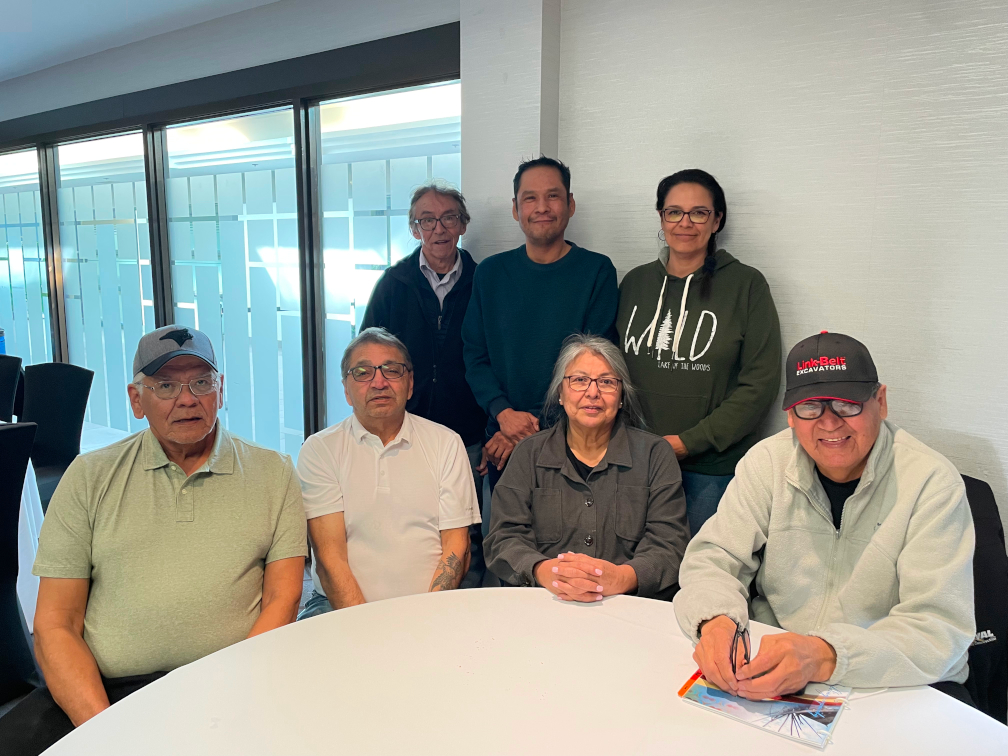
What was a dream not too long ago has slowly but surely become a reality. It began in earnest in August 2024, when members of the AON aquaculture team, the community’s aquaculture consultant and employees of Waubetek Business Development Corporation (WBDC) held brainstorming and development meetings in Winnipeg. WBDC is an Indigenous-owned and controlled organization that provides economic development services and business financing to Ontario First Nations. WBDC manages and facilitates Fisheries and Oceans Canada’s (DFO) Northern Integrated Commercial Fisheries Initiative (NICFI).
The result of these meetings was to explore the feasibility and potential of developing two land-based aquaculture facilities that would produce fish for human consumption such as rainbow trout and a second component that would produce walleye fry that would be grown and released into local waters to enhance existing stocks.
Two months later, WBDC representatives and the community’s aquaculture consultant travelled to AON. The group conducted property site investigations and located two sites that would be ideal for both components. Both sites are located on Big Island. An underused, structurally sound building with existing infrastructure that would be easy to renovate was determined to be the perfect location for the walleye enhancement component. A second property (land) adjacent to an existing community retail business was found to be an ideal location for the commercial rainbow trout aquaculture component.
In the evening following that work, the visiting representatives also participated in and presented an overview of the project in a community engagement session. Group meetings were also held earlier in the day in order to organise the subsequent steps involved. Community members embraced the project. Hence, the project was not only born but growing wings.
Sonny McGinnis is AON’s Economic Development Officer and the aquaculture project coordinator. He has been working on this project since day one and he guided the day-visit in October. “It has been a long time since our community has been this excited and motivated. We not only have the opportunity to further develop our economy and create solid, long-term employment but we will greatly contribute to the long-term subsistence, recreational and commercial fishing activities for ourselves and surrounding First Nation communities,” said Mr. McGinnis.
Since that visit in October 2024, the first phase of the project’s development has been in full swing and is close to being concluded. During this business plan phase, everyone involved is working on all the basic elements required to realize a project of this magnitude. At this juncture of the project, AON called upon WBDC to hammer out the fine details of the project.
During this phase, people worked on four main required streams: a production strategy to optimize the production of rainbow trout and walleye fry in two distinct intensive, land-based aquaculture facilities. The designation of fish culture and recirculating aquaculture water reconditioning systems to ensure effectiveness and efficiency in production. The preparation of technical design drawings, a technical report and investment prospectus. The determination of a capital budget for the project, operating budgets, financial statements while evaluating the scale and economic viability of the venture.
Once the “team” has completed this complex and detailed development phase, the second development phase involving pre-construction planning will begin followed later on by the construction phase. Also, the community will focus on recruiting in order have future employees fully trained to work in both facilities by the time they become operational. The Fleming College in Lindsay, Ontario offers high quality aquaculture training courses. “This is a life-changing opportunity for our community members, especially our young people,” added Mr. McGinnis.
While both the commercial and enhancement aquaculture components will continue to be developed simultaneously, because it is easier and quicker to complete, the walleye enhancement component will most likely be completed first. It has an existing building with infrastructure and is an aquaculture project that is easier to complete. Approximately two years after the enhancement component is completed, the commercial aquaculture facility should also be fully operational.
Once fully operational, the enhancement component is projected to produce and release up to 245,000 walleye into Lake-of-the-Woods. The hatchery will begin operations annually in late Spring with approximately half a million larvae. Five weeks later about 120,000 1 to 2 gram walleye will be released and in the Fall, another 125,000 larger 30 to 60 gram walleye will be released into the lake. The success of this annal process will depend on the lake’s capacity to feed the additional walleye. Albert Handorgan, the community’s hatchery project leader is confident things will work out: “A lake has limited natural resources available to provide the food required by walleye to thrive. But the sheer size of the lake combined with sound and balanced fishing practices will ensure the strong, long-term supply of walleye for generations to come.”
The commercial land-based aquaculture facility is currently being projected to produce 150,000 tons of rainbow trout per year in full operation. However, in the future, if the community was to discover a strong export market for another specie such as arctic char or white fish for example, it would be possible to make this kind of transition. “Our job will be to get out there and find markets for the fish we will produce. If we were to discover an opportunity to sell a certain specie to a certain buyer signed to a long-term contract, we would have that flexibility,” added Mr. McGinnis.
Rainbow trout is generally very popular across the potential export markets for AON. Located close to the U.S. border and not far from large cities like Thunder Bay and Winnipeg, there are excellent opportunities to find buyers. That will be a top priority for the community’s business leaders as the project evolves toward completion. “Our most important challenge is to locate markets for the fish we will produce in our commercial aquaculture facility. We will be ready when the time comes,” added Mr. McGinnis.
Although it is a few years away from fruition, the project is moving along. The community’s leaders arrived at a decision to take a risk and build a business. And now that business is beginning to take shape. Everyone is looking forward to that first day, to the ribbon-cutting ceremony that will mark the beginning of a new era. From then on, and for generations to come, the benefits of great jobs, higher revenues for the community, increased food security and a permanent air of excitement and vitality will no longer be a dream, but a most comforting and rewarding reality.
The Anishinaabeg of Naongashiing First Nation is not only proud of this project but very thankful to the “team” that is working with them to get it done. They wish to acknowledge the professionalism of Waubetek Business Development Corporation for their invaluable knowledge and assistance. They also want to express their appreciation to NICFI program at DFO for their support. “Thanks to all of these people, Big Island will never be the same. But most importantly, it is an indescribably great feeling to know that our young people will be blessed with new opportunity and that the generations of tomorrow will inherit even greater opportunities. That makes it all much more than worthwhile,” concluded Mr. McGinnis.




