



Art takes many shapes and forms, but none more sublime than the “Nipigon Nets” created by my friend and yours, Lorne Morrow. Lorne grew up in Fort Frances, enjoying summers on Wasaw Lake, which undoubtedly instilled in him a deep love for the waters and forests of northwestern Ontario. Lorne came from good stock – his mother Dorothy graduated with a Bachelor of Science from the University of Manitoba in 1942 and worked in a munitions plant in Quebec during the war, and his father Lloyd, who had an easy laugh, learned early on the value of finding new purpose for all manner of building materials and the importance of knowing where your money went. Lorne graduated from the University of New Brunswick, followed with being a first to earn a master’s degree in forestry at Lakehead University. He ran the Boston Marathon in 1978 with a time of 2:44 and has covered countless miles on his bike and cross-country skis, all of which confirm that Lorne is always up for a challenge. His education took him to Red Rock with Domtar, where he spent forty-three years in a community of a thousand people, in roles from overseeing tree planting to mill manager, finishing his career with eleven years as plant manager until the plant closed in 2006. Lorne had grassroots understanding of many of the small communities of Northern Ontario, a way of life that few in the south of Ontario have any idea of, and… where there’s no better place to fish.
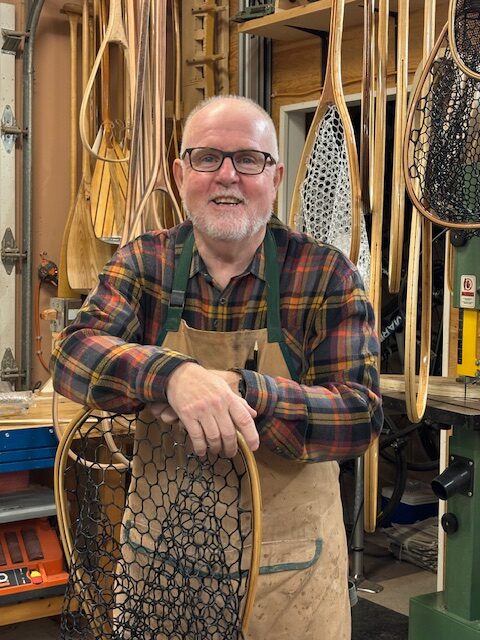
Fast forward to retirement, a term used loosely, when crafting paddles became Lorne’s “hobby,” alongside cycling and cross-country skiing. Mastering the creation of paddles evolved into fishing nets and what started out as a pass-time eighteen months ago, has become a legacy. Lorne’s workshop would rival that of Santa’s, except in Lorne’s case, Santa is doing all the work, no elves. No assembly line is involved in these Nipigon nets, but instead the precise crafting of one net at a time, each with its own story of wood transformed into function. Every handle/hoop is a masterpiece, handmade using knot-free woods. A combination of several varieties of wood is used, be it white or black ash, cheery, black walnut, hickory, butternut, birch, each with its specific colour and vibrant qualities. Has Lorne a favourite? Perhaps. When the Domtar Packaging Mill, of which Lorne was the manager, was being dissembled in Red Rock after the 2006 closure, a dock made of “old growth” Douglas Fir was salvaged, some of it more than 250 years old. This wood found new life in Lorne’s nets, with the growth rings visible in the handles.
The net handles are made from strips of wood cut into a fine width of one tenth of an inch, which is hard to imagine. Five to seven strips are glued together, some nets requiring twelve feet; a messy and tricky task ensues to align and clamp the materials together. The nets are given four coats of epoxy, finished with four coats of urethane, and finally a polishing to give them a smooth mirror finish. Lorne’s choices of materials are guided by a “catch and release” principle, using either rubber or catch and release nylon, depending on the availability of net material and the size of the net’s hoop. Like any piece of art, no two handles are the same and each final product carries with it the story of the wood that went into its making; each one numbered, dated and signed. Visit www.nipigonnets.ca to learn more.
Lorne’s nets are named after rivers in the Nipigon region – the Little Cypress and Cypress, both flowing into Nipigon Bay; Jackpine, a river east of Kama Point on Lake Superior; Split Rock, for the famous Split Rock Rapids on the upper Nipigon River. His latest net is called Rabbit Rapids, on the upper Nipigon River where the world record brook trout, weighing in at 14 pounds, 8 ounces, was snagged in 1915. Fishermen come to buy Lorne’s nets and stay to tell him their stories. “Outdoor Canada” shared the tale of Nipigon Nets, written by Gord Pyzer, a member of the Canadian Angler Hall of Fame and National Freshwater Fishing Hall of Fame and a giant among Canadian fishermen.
Does Lorne craft his nets with visions of monetary gain? Not a chance. After spending an entire career in a small community where he knew everyone, where he had worked with and managed most of the town’s population, retirement wasn’t a comfortable transition. His newfound craft has brought people to his door. He donates his works of art for many fund-raising events in the Nipigon area, giving back to an area that sustained him and that he and his family called home. Lorne is a testament of “do what you love,” a life well spent.
wendistewart@live.ca




