

When you come from a family of pranksters with a deep appreciation for dry humour, you don’t just inherit the jokes. You inherit the stories—and they tend to stay with you for life.
I was in Grade 8, in Living Skills class. Our teacher, Mrs. Mundahl, taught us practical things like how to cook, proper table etiquette, and how to sew. One of our major sewing projects was making boxer shorts out of fabric featuring Taz the Tasmanian Devil, which felt like a bold and confusing design choice for us who barely understood laundry. We learned all of this using Singer sewing machines, which, for reasons I still don’t understand, felt industrial enough to demand respect.
Looking back, there must have been some kind of district-wide initiative happening at the time, because several of our projects seemed clearly designed to discourage us from having children too early in life. One involved watching a video of a baby being born, which—at thirteen—was borderline horrifying and not something you ever really forget, no matter how much therapy or selective memory you employ later.
The other project, and the focus of this story, was called Flour Babies.
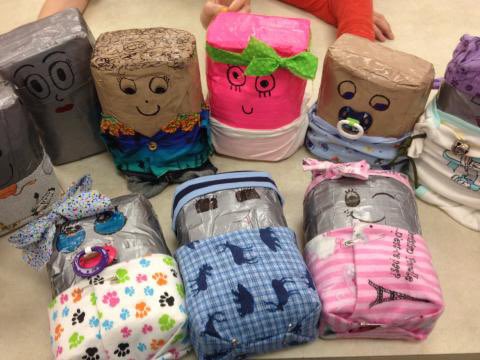
name, and place into an empty Kemps ice cream bucket. This bucket became our child’s car seat, bassinet, and general life-support system. We were then required to carry our “newborn” with us everywhere for two to three weeks. – Submitted photo
Each student was given a five- to ten-pound bag of flour that we had to diaper, draw a face on, give a name, and place into an empty Kemps ice cream bucket. This bucket became our child’s car seat, bassinet, and general life-support system. We were then required to carry our “newborn” with us everywhere for two to three weeks.
Every class period looked like a low-budget maternity ward. Rows of students sat with their flour infants positioned carefully at their desks. Going to the store? Bring the baby. Family gathering? Baby comes too. Just trying to exist peacefully? Nope—still parenting. It’s safe to say the thin plastic handles of those ice cream buckets left permanent grooves in our hands, both physical and emotional.
Flour Babies, however, were the sensible option. For extra credit, you could choose to carry a cyborg baby doll instead. This mechanical demon screamed and cried at random intervals, with the volume and urgency of something yelling through a megaphone surgically attached to a tracheotomy ring. It didn’t care where you were, what you were doing, or whether it was socially appropriate. It simply screamed, as if powered by spite and rechargeable batteries.
I chose flour.
My Flour Baby’s name was Alex.
I carried him everywhere. The school bus? Alex rode along. Playing Super Nintendo? Alex was there, quietly judging my Mario Kart skills. Dinner? Guess who joined us at the table. Inside the cramped ice cream bucket were also a baby blanket and a worksheet that required our parents to sign off whenever we completed “scheduled feedings”—which really just meant proving we didn’t forget our child somewhere like Rabbit Park or the nearby Strawberry Patch.
I often wondered what the rest of our town thought, watching a parade of middle-schoolers proudly nurturing grocery items. It must have looked like a failed sociology experiment or a warning about budget cuts.
Despite everything, the project went well. I leaned into it. I took it seriously. As long as the Skynet Baby wasn’t nearby, silently calculating how to overthrow humanity and plot against John Connor and the Human Resistance, things were manageable.
Then, during the final week of the project, my family planned a trip from the northwest metro suburbs to Fort Frances to visit relatives. This timing was unfortunate, because I had just watched Menace II Society. Suddenly, the idea of transporting a heavy bag of white powder across an international border seemed less “school assignment” and more “future headline” or “international incident.”
A flour sack wrapped in Pampers, complete with a drawn-on face and baby blanket, secured in a makeshift car seat, did not strike me as a convincing explanation to border guards doing their jobs. I imagined questions. I imagined scissors. I imagined losing points—or worse, becoming a story told at border patrol holiday parties.
So, in what I believed to be a responsible and rational decision, I placed Alex on the top shelf of my closet while we traveled north.
A few days later, we returned. I rescued Alex, completed the final days of the assignment, and earned a B. I quickly forgot about the strange few weeks of flour-based parenthood, as middle-schoolers tend to do.
Until about a month later.
I came home from school, checked the mailbox, and found a letter addressed to me. It looked official. Important. The kind of envelope that immediately raises your heart rate even before opening it.
Inside was a court summons and subpoena ordering me to appear in court at the end of the month.
The charge?
Abandonment, confinement, and endangerment of an infant named Alex.
Those three days on a closet shelf had apparently escalated into legal peril.
My heart stopped. When my parents got home, I showed them the letter. They confirmed it was real—and told me there wasn’t much they could do about it. I panicked. I cried. And when you cry while sporting a bowl cut, it somehow makes everything worse.
That evening, they sat me down in the living room and finally told me the truth.
It was a joke.
You see, my mom was friends with—and worked with—a county judge. Over lunch, she’d been laughing about the Flour Baby project and my handling of international travel logistics. The judge found it hilarious, processed an official court document, signed it, and sent it out via courier.
I had been legally pranked.
It turned out the project wasn’t just about responsibility—it was about how humour and love can steer decisions just as effectively as any lesson plan. In our house, that counted as extra credit.
Well played, Mom.
Well played.
– Robert Horton is an educator, author, orator, and linguist. He is a member of Rainy River First Nations.




