

In our era, popular music can feel disposable, easily scrolled past, or at least overly similar to the rest.
Regardless, there remains a band that doesn’t merely stand apart. They stand firmly where concepts like genre, description, or classification are but details. These matters, merely dust on the windshield between the driver’s ears and eyes and some arcane scenery that awaits.
This band is Tool.
Tool is not music in the easy sense. Tool is an all-encompassing experience.
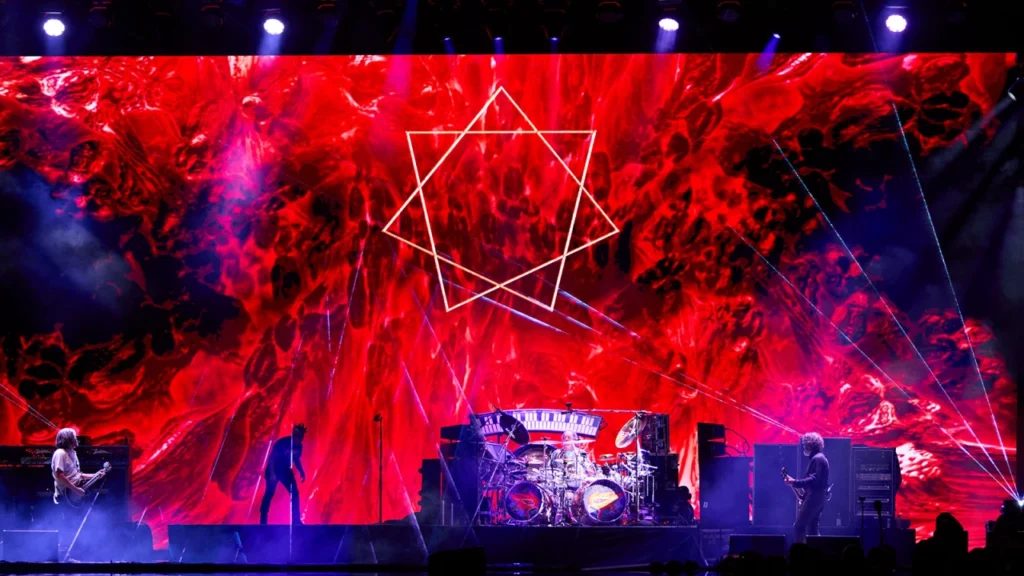
Some have called them the Pink Floyd of our age. An understandable comparison. Their live shows? Awe-inducing. Immersive. Overwhelming in the greatest possible way. But even that label (a comparison defined by reverence) may sell them short. Tool is not merely a successor to anything that came before that simply holds the crown today. Their sound? Atmospheric and ethereal. Heavy yet thoughtful. Grounded in raw power while doing something more—reaching for something transcendent.
What finally pushed me to write this column was a moment of quiet regret at an airport on the other side of the world. I was seated on a plane in Auckland, New Zealand, waiting for takeoff back home to Canada. While killing time, I checked my phone and noticed that Tool was playing live in Auckland that very evening. Had I possessed access to Doc Brown and his DeLorean, I would have happily postponed my flight by one day. It felt like history repeating itself.
Years earlier, during the “Lateralus” tour cycle, I had a ticket in hand, but university classes had just begun. Responsibility won that day, but the decision lingered far longer than the semester ever did. Some choices echo.
Tool inspires that kind of reaction because the talent within the band is extraordinary. Each member contributes something essential to the whole.
Vocalist Maynard James Keenan walks a razor’s edge between beauty and menace while delivering performances that are controlled, intimate, haunting, beautiful and unsettling all at once. His voice does not dominate the music so much as further reveals it.
Drummer Danny Carey is routinely named among the greatest drummers in the world. For good reason. Watching him play feels like witnessing an octopus orchestrating controlled chaos and order, indivisible. Nothing short of complex rhythms flowing effortlessly from every limb.
Guitarist Adam Jones (who also worked in Hollywood special effects on several recognizable films) shapes sound the way a sculptor shapes stone. Deliberate. Textured. Unmistakable.
Bassist Justin Chancellor anchors everything. As he blends seamlessly with Jones, they create a sound that is both massive and hypnotic.
People who attend Tool concerts often struggle to describe them as “shows.” They are more accurately described as experiences. Stunning visuals, atmospheric soundscapes, and staggering lighting transform an arena into something closer to a cathedral. Sound becomes stained glass.
You don’t simply listen—you inhabit the space the music creates.
Even outside of a live setting, Tool’s music rewards immersion. Put on a pair of good headphones—noise-cancelling if possible—and the effect is profound. Layers reveal themselves slowly. Rhythms shift. Patterns emerge. The music feels less like something playing at you and more like a world unfolding around you.
One of my most vivid memories in our region happened at 1:00 a.m., driving back toward Manitou Rapids during a lightning storm while listening to “Jambi.” The sky flashed in time with the music, and for a moment everything aligned. Even now, thinking about it still raises goosebumps.
Tool is notoriously difficult to categorize. Not only do they shatter expectation and category, they sit somewhere between progressive metal, art rock, and something altogether their own. Their lyrics cast a wide net. They explore psychology, philosophy, lived experience, and spiritual insight (without ever becoming preachy or simplistic). In some cases, the music itself incorporates complex mathematical ideas, such as the Fibonacci sequence and the Golden Ratio—details that most listeners will never consciously notice- but somehow feel.
Visionary artist Alex Grey has designed their album art (which stuns audiences when such visuals adorn their live shows).
Maynard James Keenan’s side project is the amazing band A Perfect Circle.
For those curious where to begin when exploring Tool, a few standout tracks include “Fear Inoculum,” “Pneuma,” “Forty Six & 2,” “7empest,” “Parabol” and “Parabola,” “Jambi,” “H.,” “Vicarious,” “The Pot” and the deeply moving “Wings for Marie” and “10,000 Days.”
These songs are not quick listens. Rather, they unfold over time, revealing new dimensions with each return.
Dear reader this column is an invitation.
If you’ve never listened to Tool, consider setting aside one quiet evening.
Lower the lights. Put on your headphones. Cancel out the rest of the world for a while.
Enter the journey without expectations.
You won’t be disappointed.
I’ll see you on the other side
Robert Horton is an educator, author, orator, and linguist. He is a member of Rainy River First Nations.




