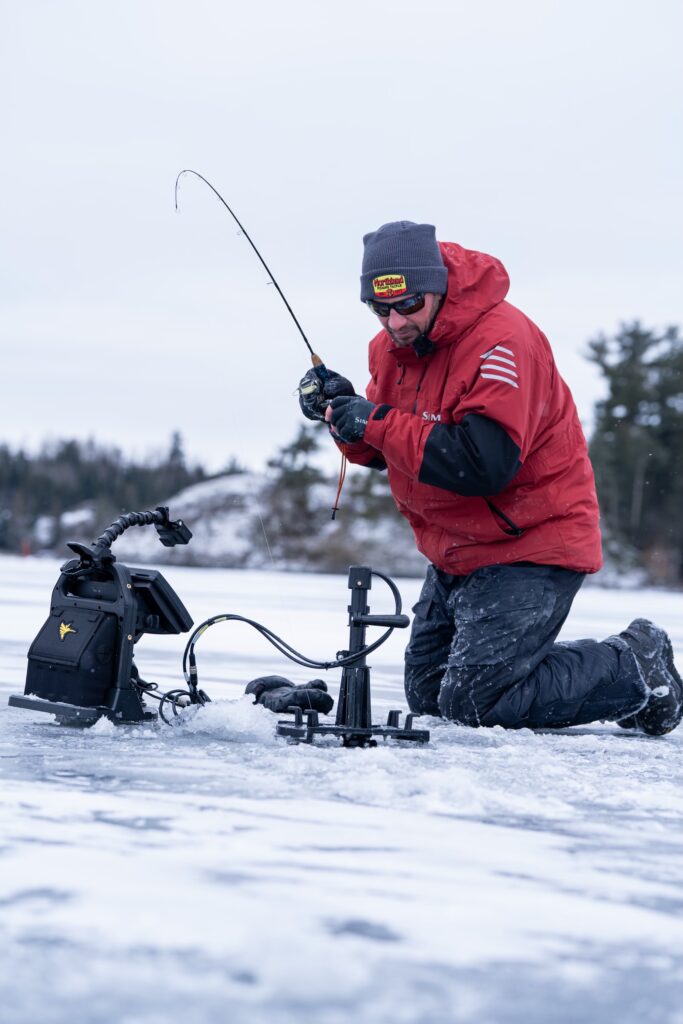
Since I was a teenager, I have had the luxury of always using a flasher on the ice. It’s the most basic form of sonar technology that anglers can get and it’s fantastic for ice fishing. The returns are fast, meaning that you see your bait in real time. They are reliable and durable; proven in the cold temperatures we endure in central Canada. The only knock on flashers today is that are not able to cover the wide areas around our hole in the ice that live sonar can, the new technology that more and more anglers are utilizing. Flashers are still a great tool and one that I will continue to use for years to come but they lack the ability to scan an entire hump or flat as we look to drill our next hole.
My first experience with a flasher was fishing with Gord Pyzer, probably around the time I was in middle school. He used to let me tag along on trips to Nestor Falls to catch crappies through the ice and man did I ever learn a lot from him back then. I had never used a flasher but Gord had one and it was amazing that he could drop the transducer down the hole and then watch his jig as he lowered it to the fish. Once I got to see it in action, a flasher immediately moved to the top of the Christmas wish list. Eventually I got one and haven’t gone ice fishing without one ever since. I love being able to see if there is fish beneath my hole and then if there are, watch how they react to my bait.
Over the past several years, live sonar has come along from all of the major sonar brands and it has become popular with both ice and open water anglers. We can use this technology to look up to 150 feet all around us to see fish, changes in depth, our lures, it really is incredible. For ice fishing I like to run a one-two punch of forward mode when I first drill a hole on a spot, to look around, and then down mode once I find a hole that I like. We can watch our baits and watch as fish approach or ignore our presentations.
The Humminbird Mega-Live ice unit that I have been using this year has been fun to play with. I have used this sonar on my boat for the past three seasons but this is the first year that I’ve used it on the ice. It’s made it fun to fish new spots and discovery quickly if they are holding fish or not. It makes finding crappies much easier because instead of drilling a grid of holes over a flat, we can drill one, scan around and hopefully find the school or keep moving.
For crappies in particular, this new sonar is very beneficial because they tend to roam over larger flats or deeper basins in the winter and they almost always suspend, at least a few feet above the bottom so they are easy to spot on the sonar. On a recent outing, my buddy Jamie Bruce and I got to witness that crappies move around a lot more than we thought over these flats and they got spooked by the auger a lot more than we thought. As the ice gets thicker that will probably be less of a factor but we witnessed several times where there was a school of around 15 to 20 crappies and when we drilled a hole on top of them, the majority scattered away.
Of course, the downside to the live sonar is the cost; it’s not cheap technology. It also requires more battery power and more hardware so it’s not as easy to pack as a flasher. These units also require more care than the old flashers that you could just put in the sled behind the snowmobile and go. They are fun to use and they will certainly help you catch more fish as you can see almost instantly if there is life beneath the holes you drill and then how the fish react to your baits.
Finally, there is a responsibility amongst anglers not to exploit the fish that we’re chasing, especially when it comes to the number of fish that we’re keeping and the depth of water we’re fishing in. Take care of the fish and have some fun out there on the ice.