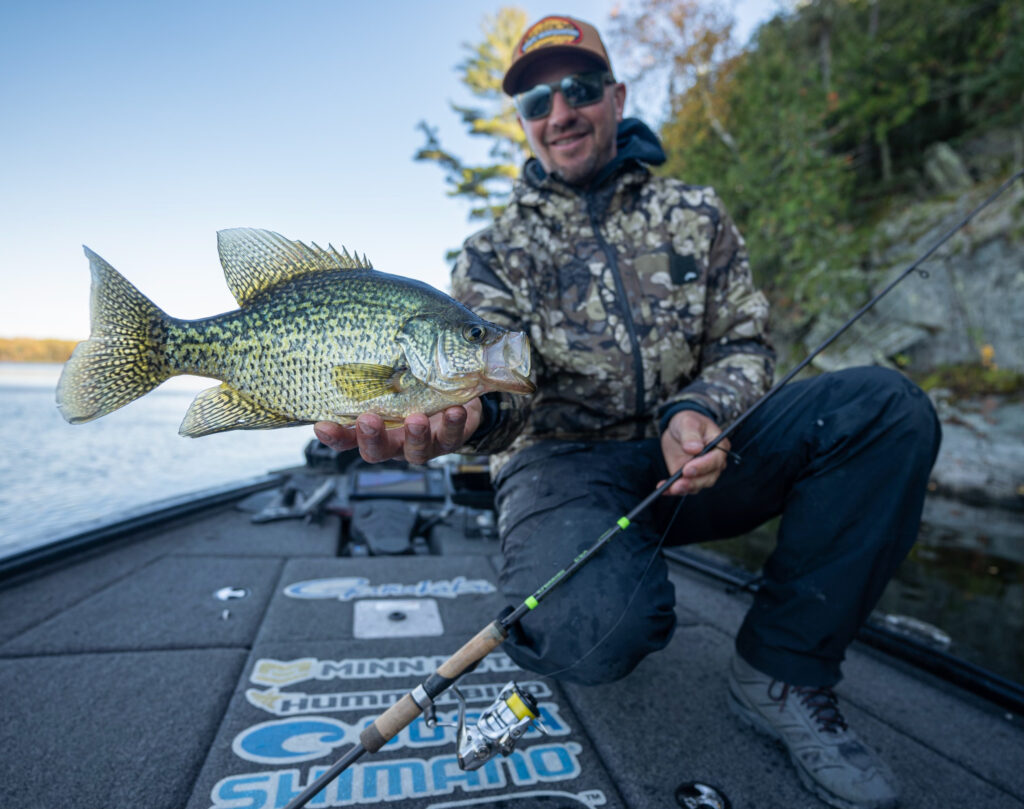
The nice days are starting to get fewer and far between but there is still some time for anglers to get out on the water before the 2024 open water season comes to an end. Most of the fish species that we have in our lakes are catchable and bite well until we start to freeze up, with the exception of lake trout, the only species with a closed season across the region starting October 1. Crappie become as predictable in the fall as they are anytime during the year and finding them now can set you up for a good season on the ice.
As a kid, we used to go crappie fishing at least a few times every fall and most the trips were good, but there were times when we struck out too. They are different than other species because by nature they like to school up, so usually you’re either going to find them and catch a bunch or miss them and not catch any.
Perhaps more than any other species, the use of electronics for finding crappies day in and day out is very useful. Often, they will school up into good size groups and they are often suspended at least a few feet above the bottom, making them easy to spot with traditional 2D sonar when you drive over them as well as with Side-Imaging or forward-facing sonar if you use either of those types of sonar. Not only is it important to find the fish, knowing where they are in the water column is a big deal because if they are five feet above bottom and you’re dropping your jig right to the bottom, you’re going to be fishing under them and probably not catch a whole lot.
When it comes to finding crappies in the fall, I mentioned them being predictable earlier. The easiest way to explain where I find them is to look in the deeper basins of the bays or lakes that they live in. On some waters, that is 20 feet deep, on others, you can find them all the way out in 40 feet. They tend to like being over those soft-bottomed basins where they can pick off bugs and invertebrates as they rise out of the bottom. Some of these types of areas are vast, bringing up the importance of electronics if you want to be efficient out there. I’ll drive around slowly looking for them on these flats and never drop a line until I actually find a school.
This is especially important in areas where you know they live, because these groups of fish will move around these basin areas throughout the season. Typically, if you find crappies during the later part of the fall, they are not going to be too far away once the ice forms. They’ll spend the entire winter in these basin areas.
Crappies are known to look up so once you’ve found a few fish, you want to try to keep your bait above them. This is a good rule to follow when you’re ice fishing or fishing for them in shallow water in the spring. I seldom use anything other than a 1/8-ounce jig tipped with a small plastic trailer. A lot of anglers use a jig and minnow, which work great as well but if you find them, they’ll bite the plastic baits just fine.
The big misconception a lot of anglers have with crappies is that they are super plentiful and fast growing. While they might grow quicker than some of our other species, those bigger fish take time to grow. In my experience, crappies are the easiest fish there is to clean out in our lakes because they congregate so much. There are dozens of good spots that I’ve fished over the years that we never catch them in anymore.
Crappies are great to eat and keeping a few is encouraged but know that if you go out there and take limits from an area over and over again, it doesn’t take long until there are none left. They also don’t do well when they are caught from deeper water. My experience has been that if you catch them from water deeper than 25 feet, they are not releasable. They might swim away but you’ll often see them float back up to the surface moments later.
Fall is prime time for crappie fishing across the Sunset Country Region and if you find a good spot now, it’ll probably be good throughout the ice season as well.