He scored two touchdowns in an unspectacular seven-year Canadian football career. He threw one pass, caught 12 and ran the ball for 457 yards in those seven years, or less than one-third of what Winnipeg’s Brady Oliveira will finish with when his season ends on Saturday.
Yet Karl Hilzinger remains the most inspirational football player I ever met, and not for anything that happened between the end zones. His is a story worth repeating.
Hilzinger played for Toronto Balmy Beach when the Beachers were still eligible to compete for the Grey Cup (honest!), then the Roughriders (Saskatchewan) and the Rough Riders (Ottawa). Nobody retired his number but they retired him, after just 52 games. Regarded as one of the best all-round athletes Montreal ever produced, Hilzinger was a competitive skier, an accomplished golfer and a swimsuit model at a time when almost all swimsuit models were women.
In 1956, he lost his dream of having a pro football career. Eight years later, he lost his legs.
Hilzinger was in a car accident. His red convertible that matched his engaging personality was being driven by a friend when it hit a power pole, electric wires across his right arm and his legs. He was declared clinically dead but came back to life at a Montreal hospital. Another friend, national team skier Peter Duncan, had been with Hilzinger 15 minutes before the accident.
“Against all expectations, Karl survived his injuries,” Duncan wrote three years ago in the Tremblant Express. “His right arm and his ribcage were severely burned and his legs had to be amputated above the knee. He underwent multiple surgical procedures and numerous skin grafts.”
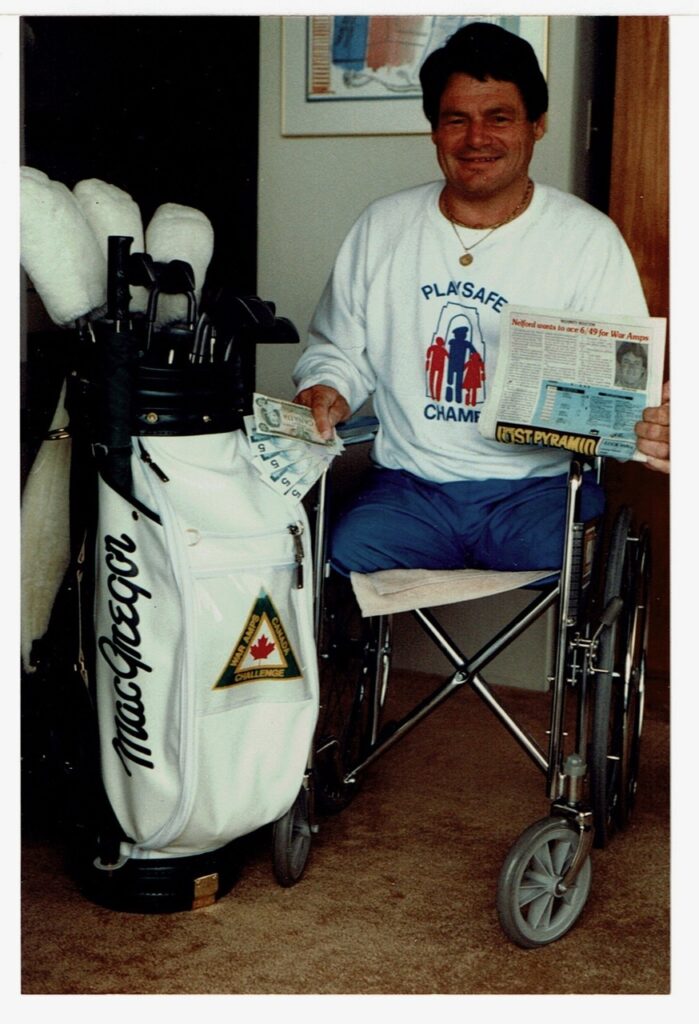
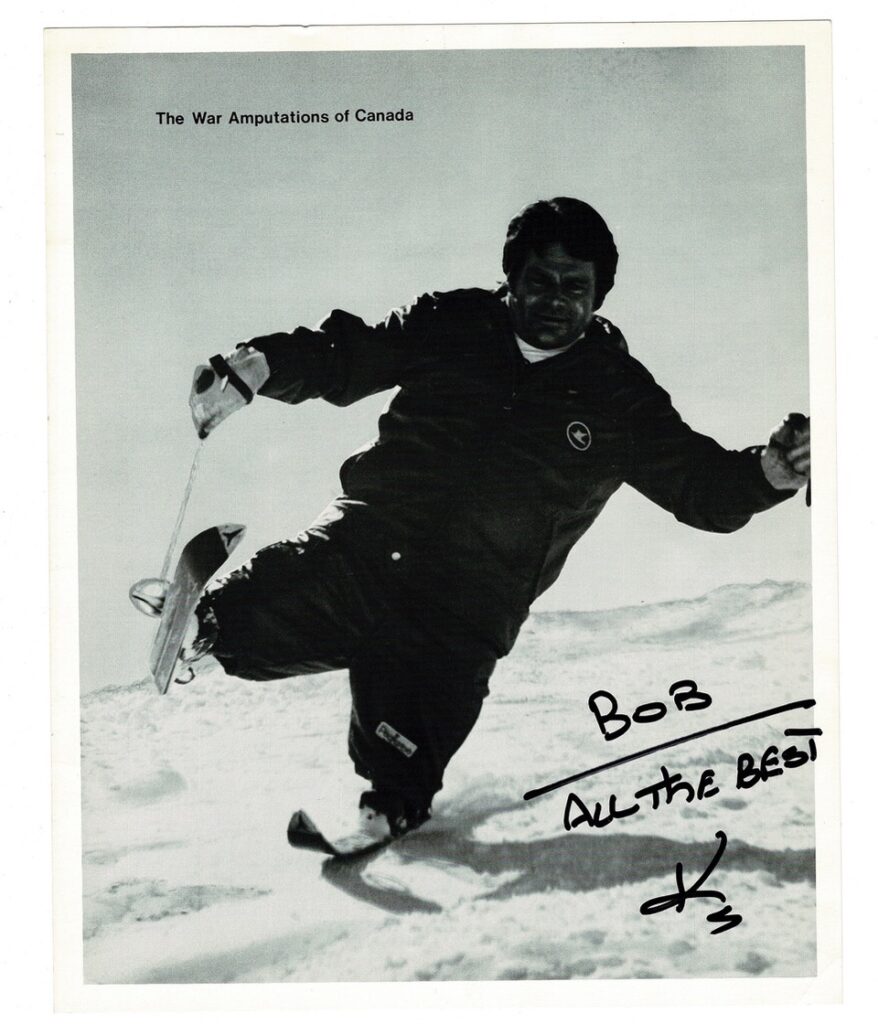
Fast forward eight more years, most of it in rehab for Hilzinger. Using prosthetics he designed, he re-appeared on ski hills and golf courses, minus his legs. He signed on with the War Amps of Canada and was the face of CHAMP (Child Amputees) for 12 years. The War Amps motto “It’s what remains that counts” inspired him, and he inspired so many physically-challenged Canadian kids.
Along with a lot of spectators, like me.
We met on an Alberta mountain, at Sunshine Village. I was there writing press releases for the sponsor of the Canadian Disabled Ski Championships. Karl was there being Karl, entertaining and motivating young skiers who watched this three-foot-tall dynamo zip down the slopes as if he were six feet tall and with legs.
The Paralympics were around but, like the “disabled” ski championships, they were still something of an afterthought that followed the main event, the “real” championships. Hilzinger was proof there was athletic life after death. He was the kind of person who made you feel, instantly, that you were his friend and for all-too-short a period of time, I was.
Hilzinger liked to go to Mexico. Before his accident, he qualified to dive off the cliffs in Acapulco, half a football field above the water. Even then, there was no challenge he wouldn’t face.
In 1988, Karl was driving down the West Coast to Mexico. There was another car accident, one wintry night, and this time he didn’t survive. His death was a footnote, and football didn’t really lose an inspiration.
But Canada did.