

Almost every day, I think of the late Toller Cranston, whom some experts say was the most revolutionary Canadian figure skater in history. Never having qualified as either an expert nor a figure skater, I’m not among them, but from a distance even to me it was clear that Cranston was extremely confidently opinionated, sometimes provocative and wildly artistic.
Why he remains a constant in our household is an unusual and hopefully interesting tale.
In 1988, I was managing editor of the Olympic Souvenir program for the Games in Calgary. It was decided that six of the magazine’s 232 pages would be devoted to Olympic sports art. Cranston, a figure skating bronze medalist at the ’76 Games and a painter all his adult life, was a natural. Through his agent, he agreed to paint “sportraits” of famous Olympic skating gold medalists: Sonja Henie and British ice dancers Jayne Torvill and Christopher Dean.
Did he need pictures of Henie and Torvill & Dean?
“No, I’ll be fine, thanks,” Toller said.
Getting his paintings done on time became a challenge.
“I’ve just ground to a halt,” he said one day on the phone, shortly after his “drop-dead” deadline.
It must be pointed out that nobody involved with the program was familiar with his work. All we knew was that he was a past Olympian and a a respected painter. That was good enough. The name value and association of having one Olympic skating medalist paint previous gold medalists was overwhelming. And you don’t tell a painter how to paint, do you?
Finally, his paintings arrived.
Jack Amster, the project’s general manager, happened to be visiting from New York. Also in the office was another sportrait artist we’d commissioned, Glen Green. The reactions to “the Cranstons” ranged from interesting to admonishing.
“We can’t use those,” declared the boss.
“This guy,” said Green, whose artistic style is realism, “is a fruitcake.”
And Toller was. The fruit was strawberries, a theme that runs through many of his works. His depictions of Sonja Henie and Torvill & Dean were beyond unexpected. Strawberries? Yet the detail in Cranston’s water colours, even to the uneducated, was impressive.
After much debate, it was agreed to use his paintings in the Olympic program.
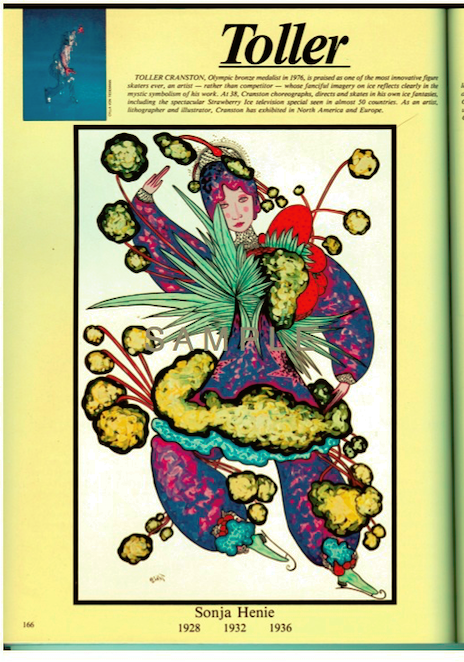
Many months after the Games, I was writing a TV Guide story about figure skating judges. Again, Toller was a natural. We had never met, and never did, but he remembered the paintings. He couldn’t have been more accommodating, also opinionated and provocative. He was a great interview.
Oh yes, the paintings.
The time came to distribute the program’s artwork.
“Who wants the Cranstons?” somebody asked, as if nobody would.
“I do,” said my wife, Nancy, the Olympic program’s research director, much to the astonishment of her husband.
Ever since, the Cranstons have hung on our dining room wall. We see them — enjoy them — every day…and we think of the man who created them.




