



What do Thanksgiving dinner, a social media group for fans of Star Trek: Deep Space Nine, a comic book convention in Vancouver, a PTA meeting and a liquidation sale at Build-a-Bear Workshop have in common?
Discussing politics can make each descend into something between an ECW cage match and a Slipknot live show in Des Moines.
Especially in recent years, discussing politics or expressing concern about policy can turn a peaceful day into an immersive Garbage Pail Kids: The Movie experience.
Why is that?
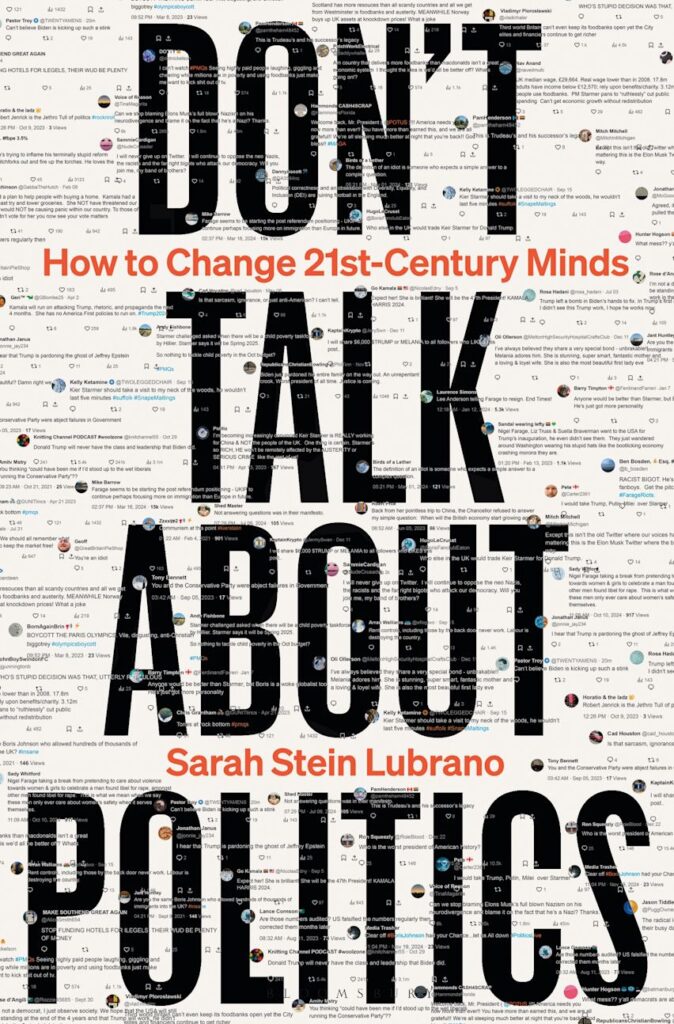
In 2025, Sarah Stein Lubrano released Don’t Talk About Politics: How to Change 21st Century Minds.
Joining other authors exploring the ubiquitous division and polarization of good people (such as Jonathan Haidt, George Lakoff, Robert Putnam and Ezra Klein), Sarah Stein Lubrano asks an important question: How can minds and perspectives be changed when the common options, such as dialogue, debate, discussion, and meetings of the minds often lead to further division, angst and polarization in our times?
Lubrano expresses that the foundations of Western liberal democracy (with its aforementioned avenues toward better arguments, ideas and facts) fall short of serving their purpose in our days of heated consequences to dialogue.
Ultimately, Lubrano shares that the defence of identities, the protection of social belonging, tribalism, and deeply rooted commitments to established beliefs outweigh more reasoned avenues of influence. As for changing minds, relationships matter more than discussion and arguments. Politics, in turn, is learned through action and participation rather than study. Finally, infrastructure matters more than we admit. Ideas matter, but ideas spread through relationships and social movements as opposed to debates.
In reflection and retrospect
As much as I agree with Lubrano’s perspective (and voice that is both informative and eloquent), I can’t help but acknowledge that there are holes that can become an expressway to similar destinations of relationships withering on the vine that we see today—where politics tastes like bitter wine.
It seems to fall into the trap of an either-or dynamic in which the way forward is focused on one road, while (albeit not explicitly) the other is lowered in importance and potential. I believe this framing of solutions can be a caustic seed planted in chaotic soil. Both (and more) are needed. Ideas without mileage are abstract theory. Action and movement without dynamic ideas can be aimless. Ideas and action without factual understanding can take us on a runaway train. When asked which road is correct—ideas and movement or dialogue and debate—I believe the answer is “Yes.”
Also, there may be an important distinction between focusing on politics rather than civics. In many cases with blurry lines, the first is about power and the second about principles.
In Wellstone’s wake
The late (and intensely missed) U.S. Senator Paul Wellstone genuinely believed that learning about ideas, civic participation, systems and effective theory and approaches was crucial—just as crucial as motivated involvement in civic life. He championed ordinary citizens becoming involved in electoral politics—with a focus on both theory and action, ideas and movement, debate and relationships.
In the aura of archetypes
Although the challenges of today are more readily observable and unique in their nature, pull the veneer back, and the truth behind it is revealed. Our individual and collective challenges are the same hurdles that our world has fumbled over like generational puzzle boxes for millennia.
Although the costs may be greater and the potential for damage is intensified, problems such as not listening to one another, dogmatism, fundamentalism, envy and various ideologies still steer matters. A rich foundation of cultural, symbolic, metaphorical, and metaphysical narratives from every corner of the human family has survived for the very reason that the uphill climb to peace and nobility is timeless. Perhaps it is by looking at the heart of our honoured and preserved stories that various solutions can be located.
Embrace uncertainty and contradiction
For most of my life, I thought the biggest problem in civic life was the politician who lies. However, I have come to believe it may be the politician who is certain.
No matter what side of a partisan issue one is on, none of us has the full picture or the complete vantage point. This is why paralyzed communication in the wake of division is truly a tragedy and why talking (and listening) with one another—not as enemies or opponents, but as people helping one another understand more fully—matters.
Perhaps ideas keep us open and fluid while beliefs solidify and petrify.
Through certainty and belief, the fluidity of ideas often gives way to ideological possession.
How do we know?
First, the aim is to change another’s mind and beliefs. With such solid certainty, the specific political belief is irrelevant when the approach and intent take on the metallic flavour of conversion. The destination of this dance is often reductionism, essentialism, and the blurring between fact and belief (where beliefs are presented as fact and fact downplayed as opinion).
Finally, certainty can easily become a zero-sum game. Once we become certain, discussion becomes performance rather than discovery. Yet knowledge is generated through dialogue, debate, and the collision of ideas—not through the defence of conclusions already presumed true.
Embracing uncertainty is humble and is precisely why the Oracle at Delphi saw Socrates as the wisest Athenian: understanding the very real limits of knowledge is the beginning of wisdom.
Our one-dimensional politics are not the end-all, be-all of who we are as complex, complicated, multidimensional individuals full of contradictions.
Contradiction does not imply lack of integrity.
It is never the way, but a way.
Talk (and walk) with Wellstone. Deep dive into the esoterica of myth in our multigenerational Groundhog Day. Embrace uncertainty.
How do we better our world? I don’t know. I don’t believe I have the answer… but I have a good idea.
What’s yours?
Bloomsbury Publishing, 288 pp, $20



