


To say we are living in interesting times feels like an understatement—one that would make Del Griffith (the lovable, overly talkative shower curtain ring salesman in the 1987 comedy Planes, Trains & Automobiles) nod in agreement.
To the south, political noise echoes and bleeds into markets. Globally, trade relationships strain under pressure. Economic policy is spoken about loudly and often, but not always with depth.
In that environment, I found myself drawn to the work of Mark Carney, notably his book Values:
Building a Better World for All. Not from a partisan standpoint, but out of curiosity. What kind of thinking does a career spent inside the machinery of global finance produce at a moment like this?
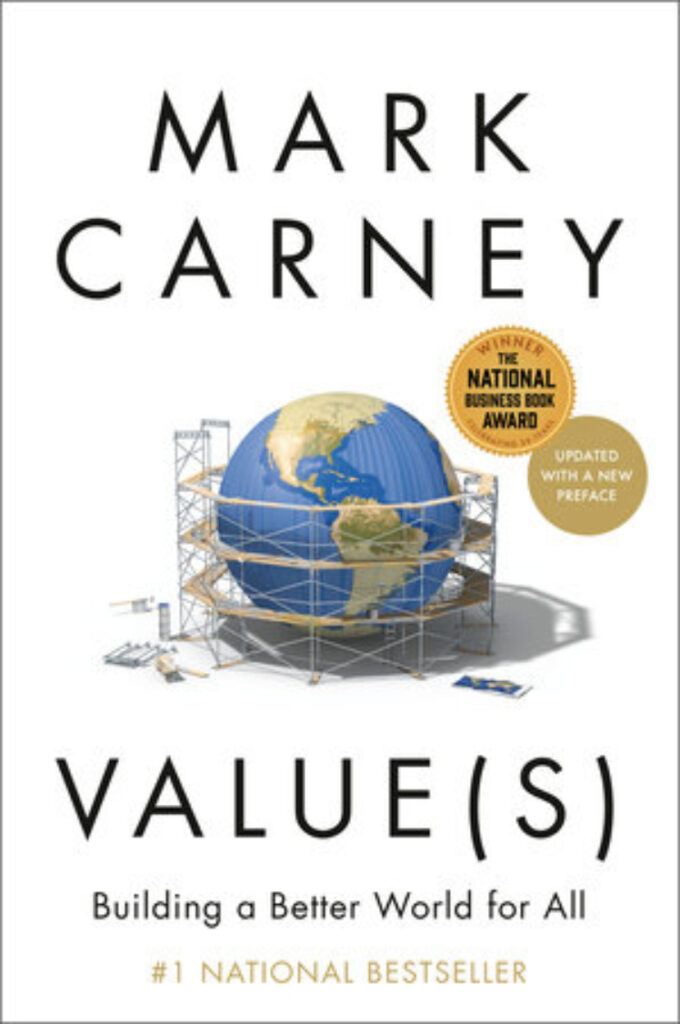
Carney’s central idea is deceptively simple. There is a difference between value and values.
Markets are highly effective at determining value. They price goods, allocate capital, and signal demand. But the things that allow societies to function—trust, fairness, environmental stability—are not always captured in those prices. They exist outside the ledger, even as they quietly underpin everything within it.
That gap matters. Greatly.
Because when something isn’t priced, it tends to be ignored.
This is not a failure of individuals. It is a feature of the system.
Markets are built to optimize what they can measure.
And what they can’t measure—clean air, institutional trust, social cohesion—often fades into the background until its absence becomes impossible to ignore.
Carney argues that many of the pressures we’re seeing today stem from that exact dynamic.
Financial crises emerge when risk is discounted in the pursuit of short-term returns. Inequality widens when capital compounds faster than labour can keep up. Climate change accelerates when environmental costs are treated as external to the system. Trust erodes when institutions begin to serve themselves more efficiently than they serve the public.
These are not separate issues. They are expressions of the same underlying problem: short-term optimization at the expense of long-term stability.
What makes this particularly interesting is that Carney does not reject markets. He doesn’t argue against capitalism. Instead, he treats markets as tools—powerful ones—but tools that require direction.
That direction comes from values.
It means pricing what has long been treated as external. It means aligning incentives with long-term outcomes rather than quarterly performance. It means strengthening institutions, so they are credible, transparent and independent enough to act beyond immediate pressures. And it means rethinking corporate purpose so that it reflects not just shareholders, but the broader ecosystem of stakeholders that make markets possible in the first place.
There’s a tendency to invoke Adam Smith whenever markets are discussed, often reduced to the idea of an “invisible hand” guiding outcomes. But Smith never argued for a system detached from moral grounding. His work assumed the presence of social norms, restraint, and a shared sense of responsibility. In many ways, Carney’s thinking is less a departure from Smith than a return to him.
So where does that leave us?
I haven’t fully made up my mind about Carney as a political figure. That’s not really the point here. What stands out is the shape of his thinking at a time when systems feel increasingly unstable.
When trade tensions rise and economic currents shift unpredictably, there is a certain value in having someone who understands how those systems actually function—not just in theory, but in practice. Someone who has navigated crises, who has seen how quickly confidence can evaporate, and how difficult it is to rebuild once it’s gone.
Politics often comes down to timing.
In stable periods, leadership can afford to be reactive. In volatile periods, it cannot. The margin for error narrows. Decisions carry longer shadows.
Moments like this tend to favour a particular kind of mindset—one that is less concerned with immediate wins and more focused on structural balance. One that recognizes that markets, left entirely to themselves, can drift in ways that ultimately undermine the very conditions they depend on.
In that sense, Carney’s relevance may not come from ideology, but from alignment with the moment itself.
When conditions are calm, values can be treated as secondary without immediate consequence. When conditions turn, their absence becomes visible.
We are in one of those turning points now.
Whether Carney is the right figure for it remains to be seen. But the framework he offers—one that insists markets serve society, not the other way around—feels less like theory and more like necessity.
And timing, more than anything, is what determines whether an idea remains abstract or becomes actionable.
Del Griffith would agree.
Signal, 528 pp., $28




