



Often, the unstated, the abstract and the silent are just as impactful as the stated, the clear and the articulated.
Nilofer Merchant explores this sentiment in her 2026 book Our Best Work: Break Free from the 24 Invisible Norms That Limit Us.
This may have a bit more length and substance than past written columns, but it is not without purpose. This book was like discovering gold, and I hope the review contributes to our region—not only for leaders, but musicians, artists and educators too.
Exploring the landscapes of leadership and workplaces, Merchant shares that the true hurdles to great work and meaningful impact do not come from the people listed on an organizational roster. Rather, the deepest obstacles are built from invisible and unstated norms embedded within our organizations themselves—often unseen without exploration.
It’s a fascinating analysis of organizational life that, by means of a polished mirror and a series of puzzles waiting to be solved, illuminates realities that many people sense but struggle to articulate. Merchant brings these invisible assumptions to the centre, examining them layer by layer, chapter by chapter, exposing their consequences and offering practical wisdom for moving beyond them.
- Trade comfort for change: Growth requires leaving familiar habits behind.
- Comfort can quietly become the enemy of progress. Organizations often cling to familiar routines because they feel safe, even when those routines no longer serve their purpose. Her advice is to create cultures that reward curiosity, experimentation, and continuous learning instead of simply preserving what has always been done.
- The one with the pain Isn’t the one with the problem: Individual struggles often reveal systemic and cultural flaws.
- When one employee struggles, the instinct is often to fix the individual. Merchant encourages leaders to ask whether that person’s difficulties are exposing weaknesses within the larger system. Instead of asking, “What’s wrong with them?” ask, “What is our organization teaching us through this experience?”
- Disrupting value: Redefine what our organization truly values.
- Organizations frequently reward behaviours that contradict their stated values. Merchant encourages leaders to examine what promotions, recognition, and incentives actually reinforce. If behaviours don’t match values, people will always follow the rewards rather than the mission statement.
- If you don’t ask, you don’t get: Create cultures where asking is expected, not risky.
- Many workplaces unintentionally discourage questions because asking can appear weak or uninformed. Merchant argues that curiosity should be viewed as a strength. Organizations become healthier when people feel safe requesting help, resources, feedback and new opportunities.
- You can’t sleep when you’re dead: Sustainable performance beats burnout.
- Exhaustion has become an unhealthy badge of honour in many workplaces. Merchant reminds readers that burnout eventually reduces creativity, judgment and effectiveness. Long-term success comes through balance, recovery and sustainable effort.
- Serve progress, not power: Advance the mission, not your status.
- Too much organizational energy is spent protecting hierarchy and influence. Merchant encourages leaders to focus less on personal status and more on advancing the shared mission. Progress should always outrank politics.
- There are limits to logic: Facts alone rarely drive meaningful change.
- Evidence is important, but people are equally motivated by emotion, relationships, and trust. Merchant reminds us that meaningful leadership requires both reason and humanity. Facts persuade the mind; stories and relationships often move the heart.
- Go out beyond absolutes: Replace either/or thinking with nuance.
- Many organizational problems are treated as simple choices when they are anything but simple. Merchant encourages readers to resist false dilemmas and search for more nuanced solutions that embrace complexity instead of avoiding it.
- End rank and yank: Stop ranking people against one another.
- Forced rankings create unnecessary competition and reduce collaboration. Merchant argues that organizations thrive when people are evaluated by growth, contribution and teamwork rather than by how they compare with their colleagues.
- Never fake it: Authenticity builds stronger organizations.
- Pretending to fit an artificial mould prevents people from contributing their best ideas. Merchant advocates for workplaces where authenticity is welcomed because genuine perspectives create stronger conversations and better decisions.
- Strategy and execution are one and the same: Learn while doing.
- Planning and implementation should never be separated. Merchant suggests that organizations learn their way forward through action, allowing strategy to evolve alongside experience instead of remaining fixed on paper.
- Trust the present, not the past: Don’t let yesterday’s success dictate tomorrow.
- Past victories can become invisible limitations when organizations assume yesterday’s solutions will solve tomorrow’s problems. Merchant encourages leaders to continually re-examine assumptions instead of relying on tradition alone.
- Don’t mistake paternalism for leadership: Empower people instead of protecting them.
- Leadership is not about shielding people from every challenge. Merchant argues that genuine leadership equips others to grow, solve problems and make meaningful decisions for themselves.
- Stop fighting for the emperor’s pleasure: Optimize for purpose, not pleasing authority.
- Many organizations become consumed with impressing those at the top. Merchant encourages leaders to redirect that energy toward serving customers, communities and the organization’s deeper purpose.
- Labels limit more than liberate: See people beyond categories.
- Labels simplify complex human beings and often narrow expectations. Merchant reminds readers to look beyond titles, demographics and assumptions in order to recognize the unique strengths every individual brings.
- You are not for sale: Your worth is greater than your personal brand.
- In an age obsessed with self-promotion, Merchant argues that a person’s value cannot be reduced to marketability. Character, contribution and integrity matter far more than carefully managed appearances.
- Cease and desist bad behaviour: Fix systems that reward the wrong actions.
- Poor behaviour usually survives because organizations unintentionally reward it. Merchant encourages leaders to redesign systems and incentives so that healthy behaviour becomes the easiest behaviour.
- New solutions need new questions: Innovation begins with better inquiry.
- Breakthrough thinking starts by asking different questions. Merchant encourages readers to challenge assumptions before rushing toward familiar answers.
- Stop making it all about you: Shift from ego to collective success.
- Organizations achieve more when success is shared rather than individualized. Merchant encourages leaders to replace personal recognition with collective accomplishment and mutual support.
- Forge A-teams by not fixating on A-players: Great teams outperform collections of stars.
- An exceptional team is more than a collection of exceptional individuals. Merchant argues that trust, complementary strengths, and collaboration consistently outperform isolated brilliance.
- You can’t bestow power: People claim agency—it cannot simply be granted.
- Empowerment is not something leaders hand to others. Merchant explains that people develop agency by exercising responsibility, making decisions and contributing meaningfully. The role of leadership is to remove barriers that prevent that growth.
- A hero harms us: Build resilient systems instead of heroic individuals.
- Organizations that rely on heroes often become fragile. Merchant argues that sustainable success comes from building systems that allow ordinary people to consistently do extraordinary work together.
- Work isn’t worthy of worship: Work should enrich life, not consume it.
- Meaningful work is valuable, but it should never replace family, health, or personal purpose. Merchant encourages readers to see work as one important part of a well-lived life rather than its entire definition.
- Change the metrics: Measure what truly creates long-term value.
- People naturally optimize whatever is measured. Merchant concludes by encouraging organizations to rethink their metrics so they reward learning, collaboration, resilience and lasting impact rather than only short-term results.
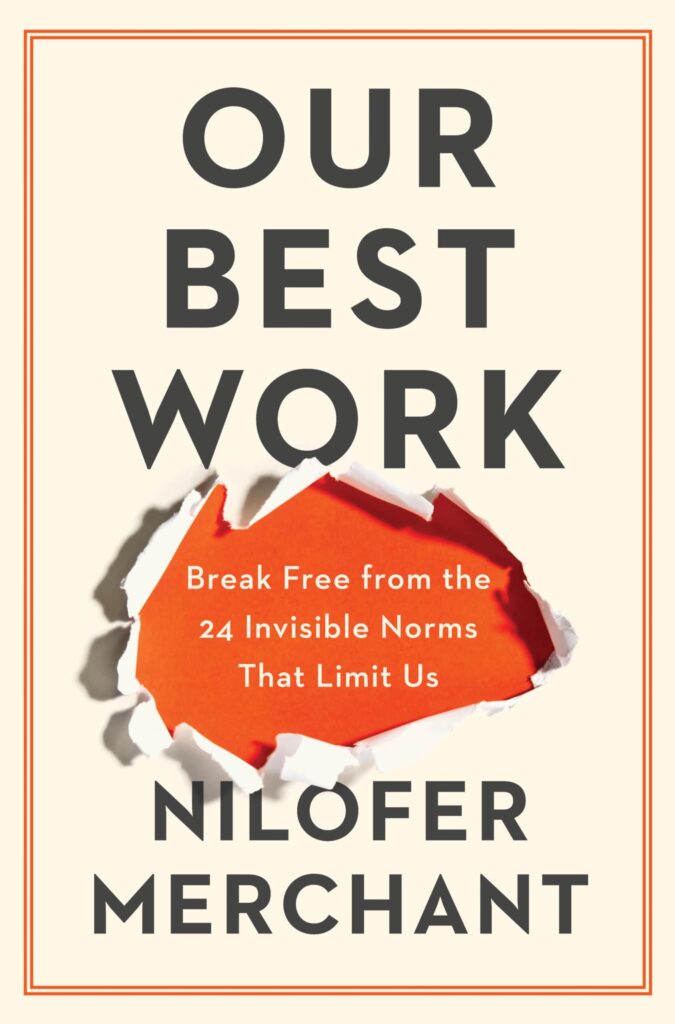
As you can see, the result is not simply a leadership book. Rather, it is an invitation to question many of the assumptions we rarely stop to examine.
Each point is difficult to dispute and solid with substance.
The only insight that keeps calling is that such lessons proposed by Merchant are valid outside of workplaces and organizations: If Merchant’s words and ideas were applied to bands composed of artists and musicians, to publishing companies with diverse-thinking writers, or to a meeting of minds discussing the future of leadership in capacity and succession—what would happen?
Crack a Dr. Pepper in a wine glass and please take a moment to reflect on each of the 24.
The sky is the limit, potential is present and promise awaits.
HarperCollins, 352 pp., $42




