


Has there ever been a more dynamic and wiser mentor than Master Splinter of the Teenage Mutant Ninja Turtles?
The ninjutsu-trained Turtles knew it, as did Shredder, Krang, and possibly every vigilante from Dimension X.
But what made him so sublime?
His dry humour? His cultured engagement with the immortal works of Renaissance artists such as Leonardo da Vinci, Raffaello Sanzio da Urbino, Michelangelo di Lodovico Buonarroti Simoni and Donato di Niccolò di Betto Bardi? His unshakable feud with a razor-edged supervillain with a voice way too similar to Uncle Phil from The Fresh Prince of Bel Air?
It may have been his managerial skills.
Ponder this for a moment.
Raising the heroes in a half shell (Turtle Power!), he didn’t teach them all in the same way. Rather, he paid close attention to their gifts and talents (as well as, just as critically, areas to build and strengthen) to give rise to the autonomy of the individual and the functional unity of his turtle team.
Whether by deliberate design or happy interpretive accident, read symbolically, the weapons appear almost perfectly chosen to counterbalance their personalities.
Take Raphael, for example. Raphael, the bombastic, headstrong turtle, is often the personification of a grenade that never stops exploding. He is given (and highly trained in) a pair of three-pronged sai. To cultivate restraint in one heavily defined by offence, it is ingenious to consider how a weapon particularly suited to blocking, trapping, controlling and countering could help balance his student by teaching restraint and defence.
Donatello, the highly technical genius of invention and innovation, is defined by his skills in technology, engineering, and machines. His teacher gifts him a wooden bo staff. To cultivate simplicity in one heavily defined by reliance on tech, it is ingenious to consider how this could help balance his student by giving him a weapon that trains him in simplicity and the natural rather than dependency on complexity.
Michelangelo, the young heart akin to Jeff Spicoli in Fast Times at Ridgemont High, is defined by a fun but scattered (and unfocused) personality. He is given a pair of nunchucks. To cultivate focus and to hold firm attention in one heavily defined by a frantic lack of seriousness, it is ingenious to consider how a weapon requiring focus, attention, and technical maturity could help balance his student. In fact, if he is the least bit careless, he could bruise himself.
Leonardo, the Zen-like peaceful student who values calm and balance, is gifted a pair of katana blades. For the student most defined by his penchant for peace and meditation, it is ingenious to consider how the most overtly lethal edged weapon of the four could help balance him (the other side of the Raphael coin) and help him understand it is better to be a warrior in a garden rather than a gardener in a war.
Invoking wisdom that establishes and embraces contradiction in order to conjure skill and creativity, Master Splinter may have become the world’s most skilled manager—even in cartoon and comic land.
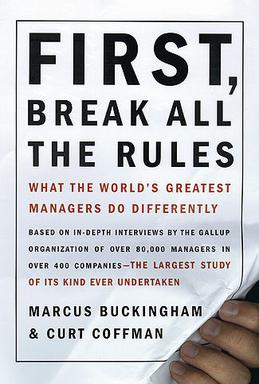
Originally published in 1999, Marcus Buckingham and Curt Coffman’s First, Break All the Rules: What the World’s Greatest Managers Do Differently is equally timeless, relevant to our times and counterintuitive.
Buckingham and Coffman propose that the most highly effective managers should reject conventional assumptions about how employees should be managed and instead manage according to their talents, gifts, autonomy, and avenues of growth.
Following a massive research base focusing on managers, employees, and high-performing workplaces, the authors share that:
- Select for talent rather than only experience or credentials. Skills can be learned. Knowledge may be taught. However, an individual’s recurring patterns of thought, perspective, feeling, and behaviour cannot be manufactured. These can reveal if a person naturally thinks and behaves in ways that sync up with a role.
- Define the outcomes they should strive towards, but allow the worker to determine how to accomplish and arrive at expectations.
- Rather than obsessing over weaknesses, place primary focus on strengths while also supporting growth.
- Treat people differently. Counterintuitive, right? Different employees are likely to have their own motivations, have different learning models, carry different talents, and respond to different types of recognition. Give rise to the individual.
- Organizations should consider creating multiple career pathways. Not every skilled employee may see moving into a manager (or similar promotion) role as desirable.
- Each role can be cultivated towards excellence.
- Leaders and managers carry different roles. One is concerned with vision, direction, and growth. Managers are closer to the employees. Managers should support individualized ways to support and grow an employee’s gifts.
A massive Gallup poll revealed that employee engagement is massively shaped by the immediate working environment, especially via the manager.
The spirit of Buckingham and Coffman’s writing expresses that the successful road for managers is to understand that employees (and people in general) have much greater potential to become dynamic, extraordinary versions of who they already are, as opposed to conventional ideas that are often practiced in professional development avenues.
I applaud these authors, as well as Master Splinter.
Ultimately, they are saying the same thing.
Giving rise to the individual makes the team more successful.
Successful ideas don’t necessarily come from doctrinaire, orthodox, or conventional ideas—but rather from what appears to be contrary.
The ghost of Carl Jung is present in Splinter’s approach, especially in terms of the process of integration (pulling together all aspects of identity), as well as confronting and integrating the shadow self (what could be misunderstood as weaknesses or challenges) to balance the individual and support wholeness.
The integrated individual and the balance that arises can surely benefit the team.
Even the modern Hermetic thought of The Kybalion fades into the conversation. Strengths and weaknesses are often treated as opposites. The Kybalion makes the case that there are no opposites, just different degrees of the same thing. Refining skills while igniting one’s gifts is not only possible but effective.
Perhaps in some alternative meeting of the minds, Master Splinter has assumed a pen name, moonlights as an author, and collaborates with others on roads to successful professional development.
It is irrelevant that the 1990s film live-action Master Splinter appeared to be a decoration in a Spirit Halloween store. If he can help overtake the Technodrome, he can surely overcome semi-outdated ideas and approaches.
Turtle Power.




