



When I was a child, I had experience with a religious cult
I’m not kidding.
During regular visitation with a family member in my younger years, I got my first bitter taste of indoctrination from a large group walking the edge between belief and extremism.
As intense as that experience was, and as deeply as it later connected to avenues of counselling, one unexpected ripple effect was the development of a kind of Spidey-sense: an ability to recognize indoctrination and cult thinking from a mile away.
As an adult, I have come to realize that cult thinking extends far beyond religious groups. It can surface in politics, culture, spirituality and more.
Among the many positive, healthy, open and inclusive gatherings where people express awe, work collectively toward civic goals, or preserve teachings meant to inspire, there are occasionally groups that seek to shut down questioning, extinguish doubt and ignore facts that contradict their preferred way of seeing the world. In such spaces, free will is treated less as a gift than as a hurdle.
That realization taught me something important: a cult is not defined by its name, structure, purpose, or size.
Rather, it is defined by its relationship to independent thought and independent identity—by the extent to which it reshapes identity, and whether belonging feels like a soft cotton case wrapped around an iron pill.
This brings us to this week’s book review.
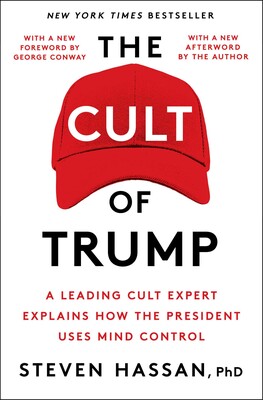
Beginning with a deliberately provocative title, The Cult of Trump: A Leading Cult Expert Explains How the President Uses Mind Control, Dr. Steven Hassan—a former member of the Unification Church and a scholar of coercive persuasion and cult psychology—argues that the political movement surrounding U.S. President Donald Trump can be understood not merely as partisan loyalty, but as a form of cultic influence. Blending memoir, clinical observation, and political analysis, Hassan lays out the dynamics of cult behavior, showing how religious, political, personality-based, business and even health-related cults often follow strikingly similar playbooks.
To organize his observations, Hassan uses his BITE model, which outlines four general categories of control: behaviour, information, thought and emotion. Each category is defined by techniques commonly found in highly controlling groups.
In the realm of behaviour control, the focus is on regulating actions and environment in order to shape identity. Techniques include controlling daily habits, creating rituals tied to the leader, using reward-and-punishment systems, fostering dependency on the group for meaning and direction and enforcing black-and-white rules about acceptable conduct. The effect is gradual: independent decision-making is replaced by group-aligned behaviour.
In the realm of information control, the goal is to govern what people see, hear and trust. This can include privileging in-group media, dismissing outside sources, discrediting critics, encouraging echo chambers and repeating approved narratives while excluding alternatives. The effect is a closed informational loop in which outside viewpoints are rejected before they are even considered.
In the realm of thought control, the aim is to shape how reality itself is interpreted. Techniques include slogans and loaded language that replace complexity with reflex, binary thinking that reduces the world to “us versus them” and thought-stopping phrases that shut down doubt or inquiry. Over time, doctrine becomes internalized as truth. The effect is a narrowing of critical thought and an increase in automatic, conditioned responses.
Lastly, in the realm of emotional control, the focus is on manipulating feelings in order to reinforce loyalty. This may involve fear induction, guilt, shame, love-bombing, validation, and the fusion of personal worth with devotion to a leader or movement. The result is emotional dependency, making separation from the group psychologically difficult.
From a bird’s-eye view, the persuasive methods described by Hassan reveal an interwoven emotional chess game. These include:
- Repetition, where messages are repeated until they feel true
- Charismatic authority, where the leader is presented as uniquely trustworthy or knowledgeable
- Us-versus-them framing, which deepens polarization and strengthens group cohesion
- Management of cognitive dissonance, where contradictions are rationalized in order to preserve belief
- Gradual escalation, in which small commitments deepen over time
- Social proof, where intense belief in others reinforces belief in oneself
Taken together, these methods form a system designed to narrow perception, reduce independent reasoning, heighten emotional dependency, and elevate group identity over personal judgment.
This is not to say that every supporter is fully controlled. Rather, Hassan argues that these mechanisms can operate to varying degrees across both small and large populations under the right conditions.
I do not know President Trump personally. I have not met him or attended one of his rallies, so I cannot speak to his character beyond the public brand and image. And if Hassan is correct in suggesting the presence of malignant narcissism, I cannot verify that.
What Hassan’s work does offer, however, is something genuinely useful: a framework.
If we know what patterns to look for—what strategies, signals, and structures tend to accompany indoctrination—then we can follow the evidence wherever it leads, including toward elected and civic leaders whose words may be beautiful while their methods tell another story. History repeatedly shows that there is always a connection between ends and means, and that substance eventually reveals whether the shell is sound.
So, what, then, is incumbent upon us?
If gathering, certainty, assurance and awe possess a gentle gravity that can make people feel welcomed and part of something greater, then we should also take heed of the important words of the late Christopher Hitchens: “Take the risk of thinking for yourself. Much more happiness, truth, beauty, and wisdom will come to you that way.”
The next book I will be spending time with this week (and which will be reviewed on April 8) is The Case Against Reality: Why Evolution Hid the Truth from Our Eyes by David Hoffman.
Free Press, 320 pp., $26.99
Robert Horton is an educator, author, orator and linguist. He is a member of Rainy River First Nations.




