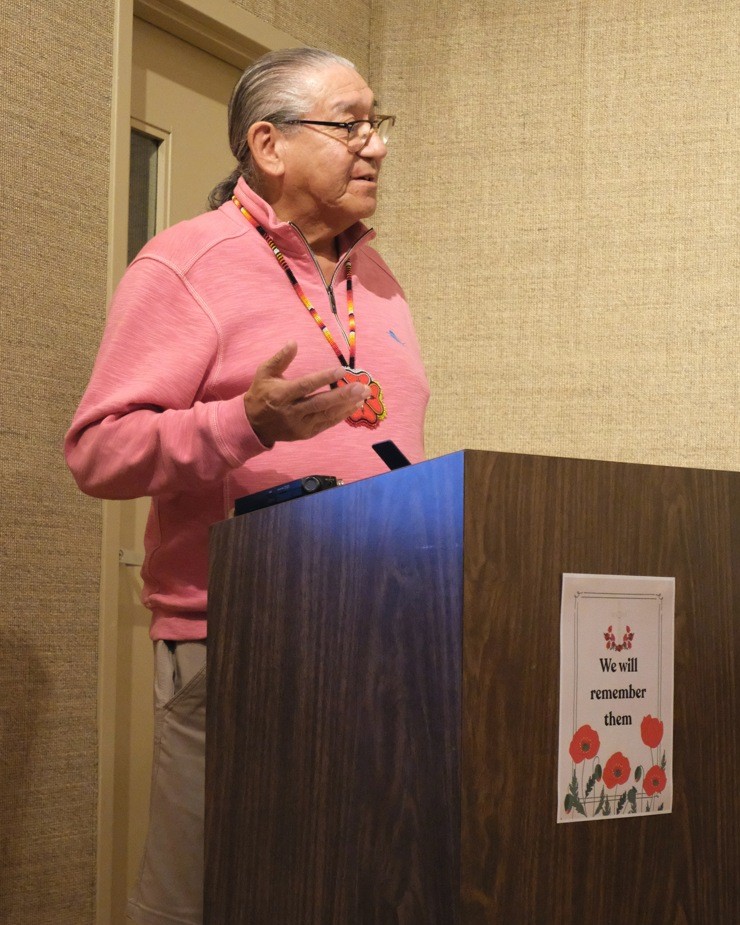
On the eve of Remembrance Day, veteran Armand Jourdain Sr. of Couchiching First Nation asked his audience to remember the people who never wore a uniform: the mothers, wives and children who waited at home.
About 26 people gathered at the Fort Frances Museum and Cultural Centre on Nov. 10 for “Echoes of Absence: The War at Home”, an evening built around the museum’s mini exhibition of the same name.
It opened with the audience singing “O Canada” and Jourdain reciting John McRae’s “In Flanders Fields”.
Most Remembrance Day services, Jourdain said, focus on those who served and those who did not come home. He wanted a different perspective: “a mother’s lament.”
“I was thinking what it must be like for a mom to carry a child, to love a child, and have that child not come home,” he said, pausing to gather himself.
The evening, about a year and a half in the making, was planned with museum curator Lisa Hughes and program and events coordinator Catrina Caira, who wrote the exhibition’s panels. Reading them aloud, Jourdain described a war that reached Fort Frances “in quieter ways,” turning kitchens, schoolyards, railways and docks into places of waiting and worry.
“Families learned to live suspended between fear and faith, knowing that no news was ever neutral,” one panel reads.
Another recalls a local woman told by letter that her husband had been killed in action, only to learn days later he was in fact wounded but alive — uncertainty that left scars long after the war ended.
Jourdain played “A Mother’s Prayer” by Ellis and Wince Coles, a song his mother listened to every Remembrance Day; his father served in the Second World War. The determination he saw in his mother after his father died, he said, he has seen only once since: in his wife, at their son’s bedside after a serious snowmobile accident.
“The determination that mothers have, that’s where true strength lies,” he said.
Jourdain was 19 when he joined the military on Jul. 3, 1975. He trained at Cornwallis, N. S., served with the Special Service Force at Canadian Forces Base Petawawa, and finished at Air Command headquarters in Winnipeg with military intelligence.
When he enlisted, his son was two years old and his daughter two weeks old. He did not see them again for nine months.
He and his father both received medals, Jourdain said, but the people most deserving of one “are my children, because they did without their dad for a long time.”
He then opened the podium to the audience, whose stories ranged from a great-grandfather who lost an eye at Vimy Ridge to a father who ran wartime mess halls, feeding soldiers before they shipped overseas and when they came home.
One woman found her father’s remembrance banner hanging beside that of her sister-in-law’s father, and sent her a photo with the caption: “our dads are hanging out together.”
Another attendee described a cousin’s PTSD after serving in Bosnia and Afghanistan as “a cost that we don’t look at.”
Some of the hardest accounts came from Jourdain’s own family. His son, Armand Jourdain Jr., a Treaty Three Police Service officer, told the audience that he is proud of his father’s service but has hesitated to stand for the national anthem. Those who served gave him that right, he said, “but they’ve also given me the right to sit, and that’s my own protest.”
“What Canada projects and what Canada actually is are two things,” he said.
Jourdain Sr.’s son-in-law, visibly emotional, called his grandfather, an Anishinaabe veteran of the Second World War, his hero. Asked once how he survived the war, his grandfather answered: “I survived because I went to residential school,” meaning, his grandson explained, that after the hardships he endured there, war could not frighten him.
When he came home, the grandson said, other veterans were given land and homes while he lost his Indian status and could not join the Legion.
“I love my grandfather,” he said. “I love what he did for his country, the sacrifices that he made.”
Until 1960, most First Nations people could vote federally only by giving up their Indian status. Post-war land and grants were in theory open to all veterans, but most Indigenous claims were denied.
The evening that opened with the anthem closed with Jourdain Sr. thanking everyone who had spoken and telling them that their freedom to do so was why he enlisted.
“When I joined the military it was for freedom, it was for democracy, it was so people can vote, so people can express their views and their opinions without retribution,” he said. “People spoke from their heart. They spoke from history, and that’s why I serve my country, because that’s what we do here in Canada.”