Beside the gently lapping waters of the Rainy River, a crowd of about two dozen gathered under a cloudless autumn sky to watch as Mayor Andrew Hallikas and Mayor-elect Brent Calder officially rededicated the Calder clan monument at Sorting Gap Marina.
The monument, which honours one of Fort Frances’ founding Métis families, was moved to the marina in October from Point Park, after the town lost its long court fight over ownership of the park’s land. Calder, a descendant of the family, spoke first about the move.
“I wanted to make sure that we’d have a spot where it would be recognized by tourists and people within the Town of Fort Frances,” he said.
“I think you’re going to find in the years to come this is probably a pretty good move,” he added.
The monument still carries a small bronze plaque, signed “The Calder Clan,” thanking the four Agency One First Nations “for the use of this land.”
Point Park, the monument’s original home, sits on former reserve land held jointly by the four First Nations of Agency One: Couchiching, Mitaanjigamiing, Naicatchewenin and Nigigoonsiminikaaning.
The town ran the park under a long-term lease that expired in 2009. In June 2025, after 27 years of litigation, Ontario Superior Court Justice J. S. Fregeau dismissed the town’s claims to the land. Council did not appeal and apologized to Agency One.
After the ruling, Calder said, Hallikas “called me up and said that we had a legal thing, we were supposed to move it.” They met and agreed the marina was “probably the best thing for the Calder clan, the Town of Fort Frances and Agency One.”
Hallikas opened his remarks with a nod to the weather.
“We couldn’t have a better day to rededicate this monument in its new place,” he said, calling the monument “an important reminder of the history of Fort Frances.”
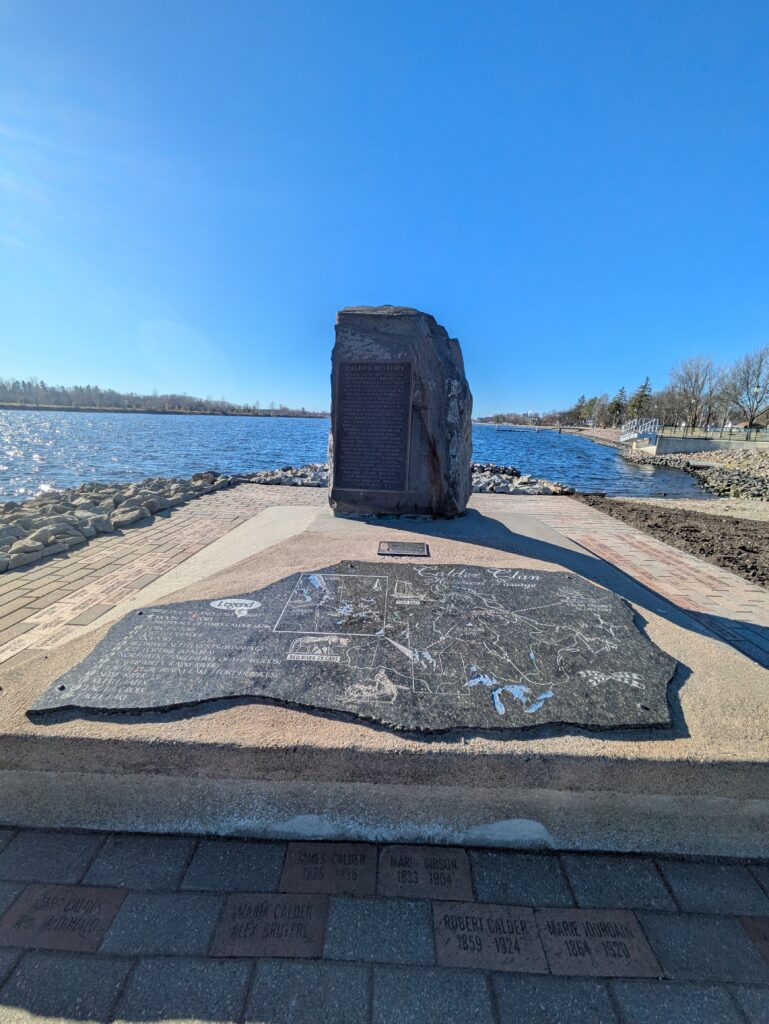
“We gather not only to unveil this monument in a new place, but to reaffirm our respect and admiration for a family whose story is deeply woven into the very fabric of Fort Frances,” Hallikas said as he performed the rededication.
The monument itself traces the family’s route from Orkney, Scotland, across Hudson Bay to Red River and Rainy Lake.
The accompanying plaque says the family migrated east from the Red River settlement in 1869, after the Red River Resistance led by Louis Riel, travelling by canoe and York boat. The men worked as fur traders and interpreters, “helping build understanding between peoples in a new and changing place,” Hallikas said, “while the Calder women played an extremely vital role as midwives and nurses, caring for families and neighbours when care was needed most.”
Around the base, the family tree spreads out underfoot. Front and centre are two engraved bricks for James Calder (1826-1896) and Maria Gibson (1833-1904), who married in 1846. The next row out holds their children and the people they married, and from there the bricks ripple outward, row after row and generation after generation, to the present day.
The tree is still growing. Calder noted that more bricks will be added next spring.
“The Calders over the years have been known to have a few kids here and there,” he joked.
Hallikas called the new site “so appropriate,” beside the permanent home of the historic tugboatHallett and the former Sorting Gap, where logs were sorted for the mill.
“Many of the Calders and their descendants, such as the Tuckers, the Georges and others, worked on or with the Hallett as it hauled booms of logs across Rainy Lake,” he said. “These logs ended up in the river right here.”
Calder told The Times afterward that he picked the spot himself, where three birch trees once stood, close to “that big boat” without taking up room needed for events such as the bass tournament. “I still wanted it to be a centrepiece for people that are out visiting this area,” he said.
“May this memorial stand as a lasting reminder of where we have come from, of the families who helped to build this community, and of our shared responsibility to honour that history—our history—with respect,” Hallikas said in closing.