

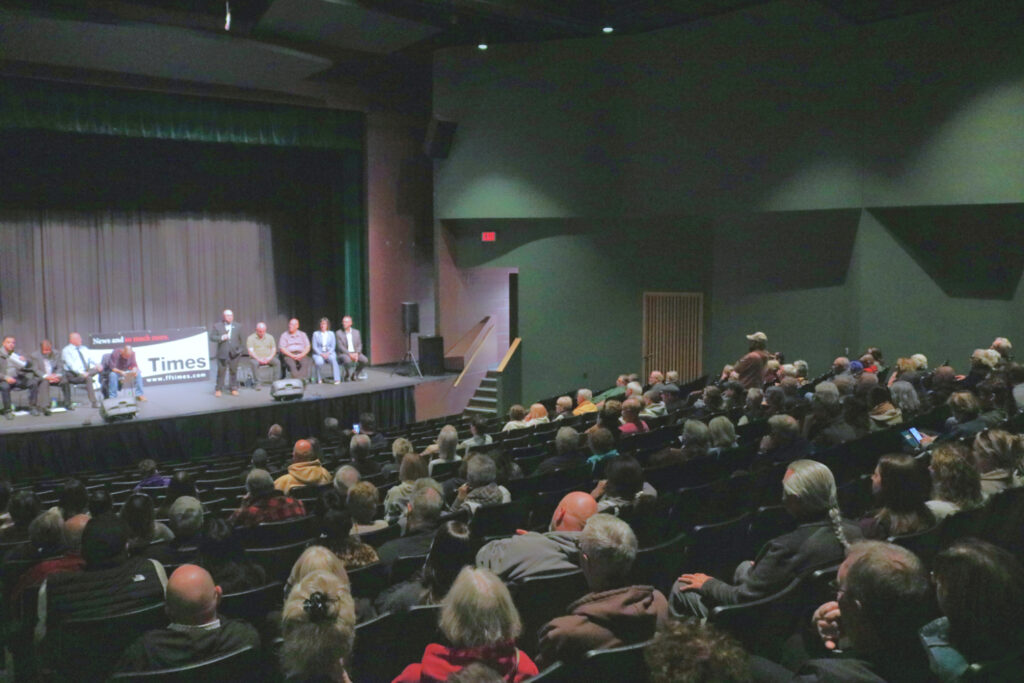
Local voters had the chance to hear directly from municipal candidates and put their questions on the table during an all-candidate town hall hosted by The Fort Frances Times and the Fort Frances Labour Council last Thursday evening.
Held at the Townshend Theatre, the event gave residents an opportunity to engage with both councillor and mayoral candidates ahead of November’s election. Questions from the audience focused on several key community issues, including the potential use of strong mayor powers, housing and economic development, and the future of public services, providing insight into candidates’ priorities and plans for the term ahead.
Strong mayor powers
First introduced by Ontario Premier Doug Ford’s administration, Strong mayor powers took effect on Nov. 22, 2022. They are a set of authorities granted to the head of a municipal council which allow for vetoing of budget amendments and bylaws, establishing or dissolving council committees and the appointment or dismissal of municipal staff.
However, the use of strong mayor powers typically needs to be in relation to provincial priorities of housing and infrastructure goals. A full breakdown of strong mayor powers, the rules surrounding them and a list of designated municipalities can be found online at www.ontario.ca.
Amongst the candidates for councillor seats, the majority expressed mixed feelings towards the concept, saying they believe it can be a useful tool, but one that requires discretion and should be used only in extreme cases, given the nature of potentially going against a majority decision.
Two councillor candidates, Nathan Galusha and incumbent Steven Maki, stated they are starkly opposed to the use of this authority.
“I’m against it,” Maki said. “I feel that you’re electing a council to make decisions as a group, and for one person to have veto power sounds authoritarian at the least. I’m not in favour of one person having the ability to dictate policy when we are all voted to make that decision.”
As for candidates for mayor—the individuals who would hypothetically be able to actually use the strong mayor powers—neither Brent Caulder nor John McTaggart ruled their use out completely.
“I believe in the democracy of you electing a council, I believe in the democracy of that council making decisions,” said McTaggart, who was serving as a member of council when the legislation allowing strong mayor powers was passed.
“I cannot stand here tonight and say I would never use them, but I would be awfully cautious with them. I am really concerned about them; I would be very careful.”
From Calder’s point of view, they are something he doesn’t hope to use but would if push comes to shove.
“I’m in favour of keeping strong mayor powers on there,” Caulder said. “I’m asking the next council to come prepared, and if they come prepared, I don’t think I would have to use that power.”
Economic development
Although future development opportunities are possible in Fort Frances—for both the housing and the industrial sectors—they still require action from the next term of council to accomplish.
Every candidate highlighted the need for economic development, discussing that they plan to work towards drawing in potentially interested commercial partners and find solutions for the drastic need for housing in the area.
When asked how he would promote the town to prospective investors and businesses, Caulder said Fort Frances already has one of the key resources many industries are looking for: power.
“Just about any industry that comes in, the major thing they need is power and, even without expanding right now, we’re only running the power commission at about 22 per cent,” Caulder said. “We have excess power as of right now.”
Caulder said attracting new investment will require a council willing to work with businesses and make timely decisions.
“At the end of the day, council has to start working with individuals when they come knocking on the door,” he said. “If it’s going to cost us $100,000 to do something, sometimes you’ve got to put money out to make money. You can’t be slamming the door in people’s faces.”
McTaggart, the opposing candidate for mayor, believes the key is in utilizing committees already established within the town’s administrative structure as well as a greater outreach method of spreading the word.
“The Municipal Accommodation Tax Committee, which is run through the Future Development Corp., they get half of the money that comes in from the taxes on hotel rooms; the other half goes to the town,” McTaggart said. “That committee is out working the community, and they’re looking for niche markets.”
“I think the other thing is that we need to go out and knock on doors, telling people what we have here. I talked earlier about the opportunities I see in industrial byproducts that we can piggyback on, and if we go and start knocking on doors and selling what we have—the cheap power, the land, and other benefits that are going to be here—I think we will find people that will come here and they will realize the gem that is this community.”
The housing challenge
However, attracting new industry is only one piece of the community development puzzle. A lack of available housing remains a significant challenge, limiting the town’s ability to welcome new residents who may be interested in local employment and business opportunities.
While several potential housing development sites are being considered, none has generated as much public debate as the property at Fifth Street East and Frenette Avenue, the former site of St. Michael’s School.
The property was purchased in 2021 by the District of Rainy River Services Board (DRRSB), one of the 10 District Social Services Administration Boards (DSSABs) in Ontario. Since then, it’s been the subject of complaints around “loss of green space.”
Councillor candidates were asked if they would work with DRRSB to find an alternative location for the housing development, which was met with mixed responses, given that the property is privately owned by the services board, which has the right to do as it pleases with it.
Candidates Anthony Andrusco, Gary Cousineau, Kaleb Firth, Nathan Galusha and Steve Maki said they would try to sit down with the board and discuss other options.
“My understanding is it’s privately owned,” Andrusco said. “I also understand that, you know, having four kids myself and them being very busy, it’s important to have that green space and a place where kids can go, and they can hang out, and have a sense of belonging.”
“I think if there’s any place in town that can work to have more green space, I think that it benefits our youth. I would be willing to see how that process would work.”
Mike Behan, Doug Brown, Kathy McKenzie and Bill Morrison Jr. said the housing need outweighs anything that would further hinder the process.
“My first concern is that it’s going to delay the project by searching for alternative sites; we’re going to be delaying the project even longer, and we need the housing yesterday,” Behan said. “My second concern is that if we move it to a new neighbourhood, the same arguments are going to be made. Same opposition, then nothing is going to get built.”
“It goes back to housing, and if you don’t put it there, where are you going to put it?” McKenzie said. “You’re going to get people mad no matter where you want to put it. We need housing. It has to go there.”
Behan and Morrison stated that they would have the discussion if the privately operating services board approached them first, rather than call them in to try and change their minds.
Public services
Councillor candidates were also asked by Library CEO Nadine Cousineau how they would prioritize community services such as the Fort Frances Public Library and the Fort Frances Museum.
All candidates agreed those services are important community assets. Behan said he would like to explore opportunities to increase library funding through support from senior levels of government.
“Forty per cent of our budget is taken up by what we call uncontrollable costs,” he said. “Whether it’s the OPP, the District of Rainy River Services Board, the Northwestern Health Unit or other mandated expenses.”
Behan noted that the provincial operating grant for public libraries has remained unchanged for decades.
“$19,000 might have seemed like a lot of money in 1995, but it’s not a lot of money in 2026,” he said. “We have to make sure we’re putting pressure on senior levels of government to do their share as well, so it doesn’t all fall on local taxpayers.”
Despite the candidates all expressing that they hold community services in high regard and wish to see them continue operating, Cousineau said she doesn’t believe her question was answered.
“It was clear the councillors support the public library, but they didn’t necessarily tell me where on their priority list it sits,” she said.
Overall, Cousineau believes the town hall was still a useful tool in making it clear who she should vote for come election day. “It definitely helped,” she said.
Polls for the Fort Frances municipal election open online on Oct. 17 at 10 a.m. and close on Oct. 26 at 8 p.m. Residents can confirm they have registered to vote by visiting www.registertovoteon.ca



