



Thunder Bay will play a major role in building the next generation of VIA Rail passenger cars following a more than $4.7-billion federal investment announced this morning that will inevitably have a spillover effect across the Rainy River District.
Speaking at a press conference in Thunder Bay, Prime Minister Mark Carney announced that VIA Rail will acquire and maintain 313 new passenger cars from Alstom Canada, with manufacturing taking place at Alstom facilities in Thunder Bay and La Pocatière, Que.
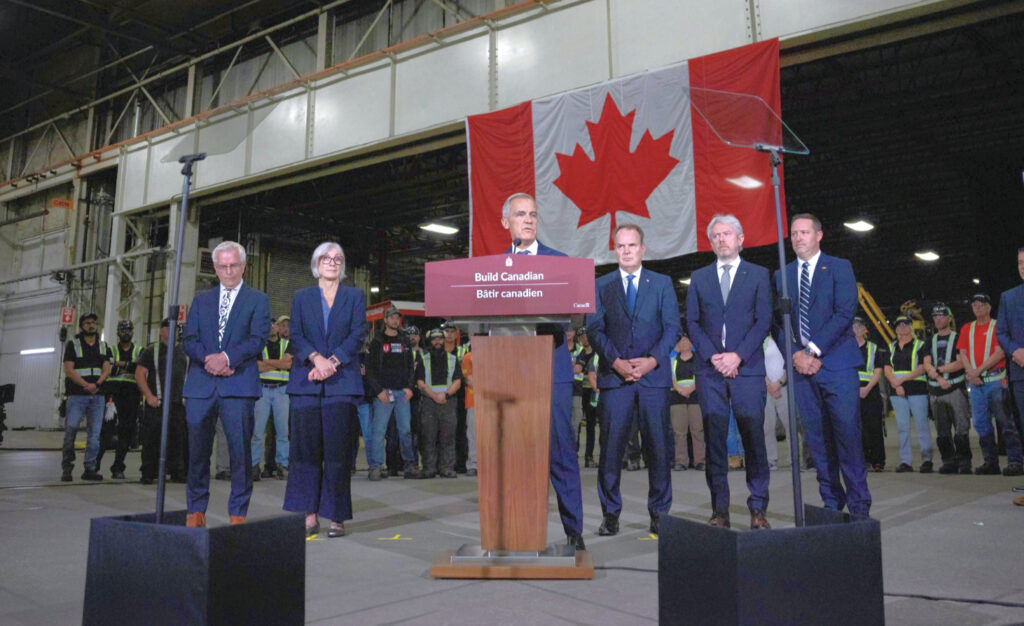
As the country navigates a bruising trade dispute with Washington, the federal government is calling the agreement the largest investment in VIA Rail’s history. “For the first time in four decades, VIA’s passenger cars will be built in Canada,” Carney said. “Cars once made in the United States, now made here at home.”
Ottawa estimates the project will support nearly 700 jobs across Ontario and Quebec and generate more than $1.6 billion in economic benefits. The announcement did not include any plans to restore passenger rail service to areas of Northern Ontario that have lost it over the past decades.
For Northwestern Ontario, the announcement provides another major source of work for Alstom’s Thunder Bay manufacturing plant. Transport Canada estimates the project will support approximately 615 full-time-equivalent jobs annually over four to eight years during the design, manufacturing and delivery period, followed by about 55 jobs annually over 15 years for technical support, spare parts and maintenance.
The department has not provided a separate figure for how many of those jobs will be based specifically in Thunder Bay, but an investment on this scale in Thunder Bay will almost certainly create spillover effects in Fort Frances because large capital projects generate regional labour demand, supply‑chain activity, and wage growth that don’t stop at city limits.
Thunder Bay is already facing worker shortages in trades, transportation, equipment operation, and construction, so hundreds of new jobs created by a major project would pull workers from across Northwestern Ontario—including Fort Frances— raising local employment, contracting opportunities, and household income.
Major industrial investments in Thunder Bay have historically supported surrounding communities through manufacturing, transportation, and construction supply chains, meaning district businesses, tradespeople and service providers would likely see increased demand as the regional economy accelerates.
“This investment is great news for Thunder Bay and for Northern Ontario,” said Patty Hajdu, Minister of Jobs and Families and Minister responsible for the Federal Economic Development Agency for Northern Ontario.
“Building the passenger rail cars in Canada means good-paying, skilled jobs for Canadians and new opportunities for local businesses that are part of the rail supply chain.”
The announcement follows calls from Thunder Bay officials and business groups for Ottawa to ensure VIA Rail’s new fleet would be built domestically. The Thunder Bay Chamber of Commerce and the Thunder Bay Community Economic Development Commission (CEDC) wrote to the Prime Minister in November 2025 urging the federal government to apply its Buy Canadian policy to the procurement.
“We are delighted to see the principles we advocated for reflected in Canada’s approach to major rail investments,” CEDC chief executive Jamie Taylor said. “For Thunder Bay, an investment of this scale will strengthen our manufacturing sector, generate significant economic activity and drive long-term growth across our community and region.”
The VIA contract adds to other major rail projects underway at the Thunder Bay plant. Earlier this year, Alstom secured a $2.3-billion agreement to supply 70 new six-car subway trains for the Toronto Transit Commission, with final assembly to take place in Thunder Bay.
The new VIA cars will be used on eight long-distance, regional and remote routes outside the Quebec City-Windsor corridor. More than 216,000 passengers used the services in 2025, including passengers travelling to Indigenous, rural and remote communities where other public transportation options can be limited.
The fleet—a mix of sleepers, dining cars, panorama cars and more—will replace VIA’s long-distance, regional and remote equipment, some of it more than 70 years old, on routes serving eight provinces. Today’s announcement also promised modern accessibility and reliability improvements.
VIA’s Toronto-to-Vancouver Canadian service is among the routes that will receive the new equipment. In Northwestern Ontario, that route travels through communities including Hornepayne, Longlac, Armstrong and Sioux Lookout.
The first of the new passenger cars are expected to enter service in 2031, with the entire fleet scheduled to be deployed by 2035.





