



International Overdose Awareness Day was observed by residents of Fort Frances and members of Rainy River First Nation during a healing walk through town on Monday, bringing the two communities together in mutual support.
International Overdose Awareness Day is recognized globally on Aug. 31 each year. Started in Australia in 2001, support from national agencies, charities and hospitals has seen it spread to North America and Europe as a way to get people talking about the steps to prevent drug overdose and encourage recovery programs.
The conversations Overdose Awareness Day is meant to initiate have become more relevant than ever to towns and cities across Canada in recent years. In 2025, the Government of Canada reported 5,608 deaths caused by opioid toxicity, 23,291 opioid-related emergency department visits to hospitals and 39,403 EMS responses to suspected opioid overdoses.
“Today, we are part of a global campaign to end overdose,” Fort Frances Mayor Andrew Hallikas said during the opening remarks of the walk. “With this walk, we want to highlight the concerning rise in overdose deaths. We want to encourage unity and collective action against overdose. Overdose knows no boundaries. Overdose affects us all, from grieving families to first responders to friends left behind. Today we are united in grief, and this empowers us together to transform loss into hope and action.”
The walk was coordinated by Weechi-it-te-win Family Services along with Rainy River First Nations. Starting at the Sorting Gap Marina, participants walked together, guided by hand drummers and escorted by Treaty 3 Police and OPP cruisers.
They made their way down Front Street, walking towards the United Native Friendship Centre, many holding signs with overdose awareness messages along the way.
Bill Morrison Jr., who does community relations at Weechi-it-te-win and is currently a Fort Frances town councillor, said the walk serves to spread awareness and to offer support to people in recovery or to those grieving the loss of people who never made it to that step.
“It’s nice when we all come together to one common goal, and today the goal was to bring awareness to Overdose Awareness Day,” Morrison said.
“This is also a walk to heal. We’ve had a lot of families that have lost members and friends. You see lots of people with signs that have lost someone. It’s heartbreaking that this is still going on. We’ve got to keep bringing awareness to this so we can somehow find a way to end it.”
Morrison said that support from both Treaty 3 Police and OPP is what is making awareness events like these possible, and that they have always come around to support and make sure things run safely.
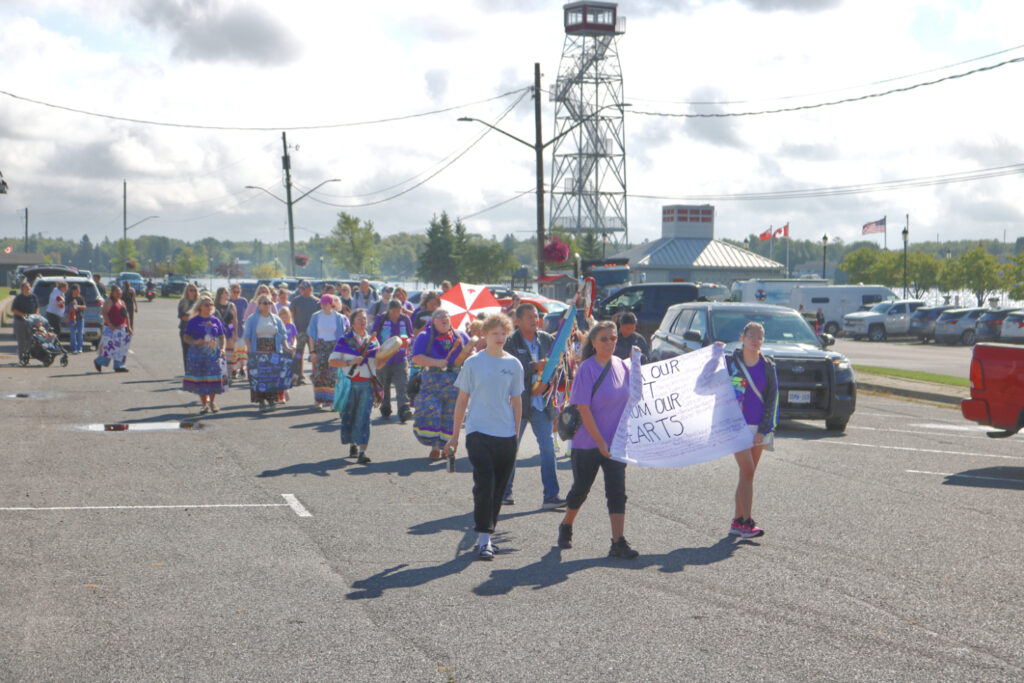
Monday, Aug. 31, saw dozens of people turn out to the Sorting Gap Marina for a healing walk held in recognition of the International Overdose Awareness Day. Walkers started at the Sorting Gap Marina, heading west down Front Street and ending at the United Native Friendship Centre, where a barbecue was held. Members from Rainy River First Nations, Gizhewaadiziwin Health Access Centre, the United Native Friendship Centre, Binesiwag Center for Wellness, Weechi-it-te-win Family Services,
Coeur Mining, Treaty Three Police Service and OPP participated to show support. – Liam Oliver Neilson photo
“I can’t say enough about the support we’ve had in OPP, the Treaty Three Police,” Morrison said. “Every time we have an event when all of our agencies work together, they’re always there for us, and they’re helping you see them block the traffic, just make sure everybody’s safe on the walk. They’re there to consult with us whenever we need them, and I just can’t say enough about how helpful they are to every single event we’ve had with them, and we just greatly appreciate their support.”
Treaty Three Police Staff Sgt. James Broughton said that although dealing with opioid use in First Nation communities is a constant battle, a recent shift towards stimulants is resulting in fewer overdoses in First Nations.
“We’ve been consistently struggling with opioid use for the last several years, but we’re seeing a shift from opioid use to crack cocaine, which is becoming more common,” Broughton said. “Oddly enough, crack cocaine is actually contributing to saving lives, which is a horrible comment in itself because crack cocaine is still awful.”
Although dealers tend to target vulnerable individuals in First Nations, Broughton said that following arrests made in southern Treaty 3 communities, there aren’t any current operations ongoing that police are aware of.
“We’ve seen individuals tied to gangs who have targeted First Nations vulnerable people who are addicts. They will come into the communities and basically set up shop, so to speak, and sell drugs,” he said.
“I’m pleased to tell you that nothing, to our knowledge, is going on in the south communities now. Those that we did learn about, we investigated, we conducted warrants and we shut down those operations. Those people were arrested and are before the courts currently.”





