



When I was in elementary school, there was a club.
This ominous club met on the lawn of L.O. Jacob Elementary School, under an oak tree that resembled a bear den.
They were the Geek Club.
Roll call: Gable. Beres. Midthun. Greenhoe. Lamers. Geslin.
My crew (Josh, Paul, Matt and I) were X-Club. Fanatics for the fandom. Movers and shakers of the Marvel Universe. That is, until our club went through a schism as notable as the Protestant Reformation. Now there was X-Club and X-Factor. We argued. We split. We healed.
But at the end of the day, the golden hue of the Geek Club hummed over the playground knoll.
Today, the names of those legends still never fade from memory into obscurity.
However, the truth remains. We wanted to be geeks.
We were geeks. Rebels. We just didn’t know it at the time. We were lost in Professor Xavier’s mansion.
To be a geek is an amazing thing. Ultimately, it is about walking to the beat of your own drum—these five taught me this before I could move on from Velcro shoes. I remember them well.
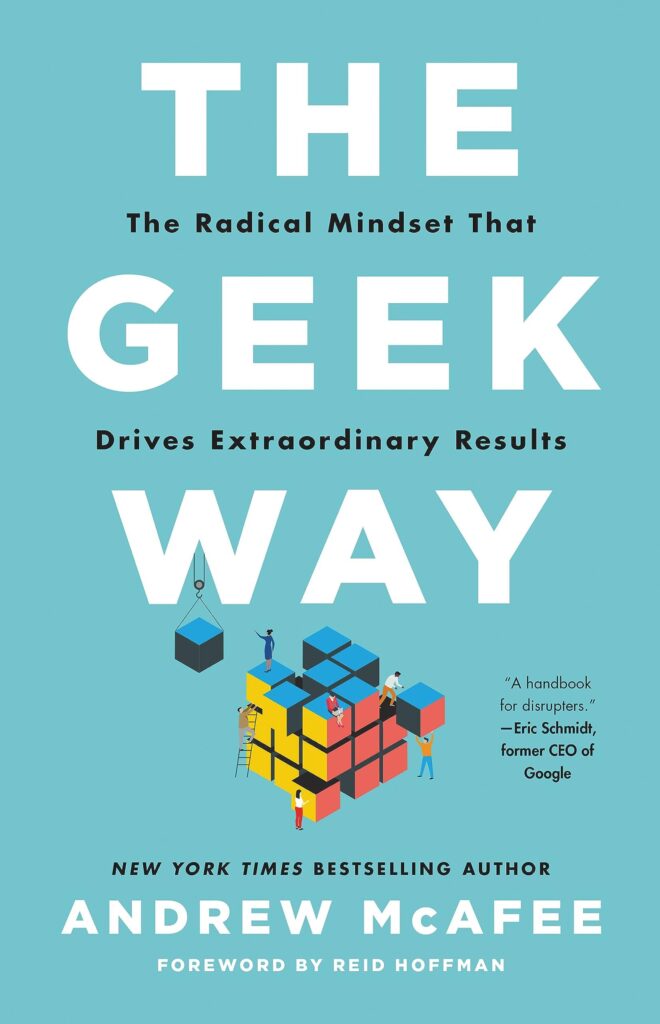
In 2023, Andrew McAfee authored and published The Geek Way: The Radical Mindset That Drives Extraordinary Results to help support organizations that wish to foster growth and success, but not in the conventional way. Through exploration and placing importance on creating systems that move against the grain in the greatest ways, organizations can resist bureaucratic lull, detached hierarchy, received wisdom, excessive planning and deference to authority.
How can this be successful? By means of geeks, of course.
Describing geeks as “obsessive mavericks,” McAfee identifies groups and individuals who become preoccupied with solving challenges—notably through unconventional approaches.
McAfee shares that unorthodox, against-the-grain, unconventional leadership can ultimately change the culture of an organization, pushing back against conventional management.
Rather than a worn, albeit comfortable, process of hierarchy, planning, approval, execution and evaluation, the Geek Way is defined by idea, experimentation, evidence, argument, iteration and learning.
Helpful in controlling uncertainty and fostering rapid learning, the Geek Way becomes a fast-moving, egalitarian, evidence-driven, argumentative and autonomous culture.
Rather than a director being noted for having the answer, the director can transform the role into that of a person responsible for creating a system capable of discovering the best answer.
A number of touchstones are set up like a walled garden where towering redwoods are pulled from the ground, replanted with stronger roots, and allowed to flourish:
- Don’t always defer automatically to expertise, as expertise can also produce the institutional orthodoxy of “we have always done it this way” or “that’s considered best practice.”
- Anti-authoritarian epistemology doesn’t mean anti-intellectualism.
- Debates and arguments, reasonable and purposeful, can have positive impacts.
- Evidence outranks hierarchy.
- Autonomy and one’s professional practice can get swamped and disempowered by processes of manager approval, director approval, finance approval, legal approval, and executive approval. Bureaucracy, purposefully restrained and constricted, can foster autonomy and empowerment.
- The benefits of giving people challenges (defined by a particular outcome) rather than directions can allow new creative energies to grow.
- While some bureaucracy is necessary, bureaucracy can be a disease that repeats and replicates itself.
- Shortening the distance between an idea and feedback is a positive step.
- Iteration beats perfection, as everything can be given the opportunity to progress.
- The value of speaking truth to power is an element that should be welcomed and fostered.
- Leaders must be capable of being corrected.
Considering these (and many more points), it becomes obvious that leaders can be the architects of cultures that embrace such positives and promise. After all, more than anything, organizational stagnation is an insidious enemy.
After spending time with McAfee’s work, I found myself wondering where the specific line lies between disrobing orthodoxy while culling convention and stripping too much of the substance that holds an organization together.
Ultimately, the only answer I can arrive at is—I’m not sure anyone knows until we try, experiment, and ask “why not?” in place of “why.”
I find his book remarkably valuable, even if simply for making the simple (yet profound) case that the greatest challenge of our organizations of any stripe is not failure or error—it is stagnation, the attempt to cling to (and replicate) the conventions of the past and the failure to look beyond the orthodoxies that can be as much an anchor as a wing.
As the Sacred Clown iteration of the Trickster reminds us, the new and novel ideas of any age can easily become a hindrance if one drops anchor within them.
The leader isn’t an oracle. The leader is the architect of a culture in which reality is allowed to win.
So, let’s hear it for the Geeks of days gone by, those who balance creativity with critique today, and those still yet to arrive.
Tip a zero-sugar Dr. Pepper from a wine glass, while marathoning Star Trek: Deep Space Nine and a playlist of Muse, in their honour.
Gable. Beres. Midthun. Greenhoe. Lamers.
Long live the Geek Club.



