


Mary Shelley was only 18 when she first conjured up the horrific image of a man-made man: an abomination, a smattering of human parts patched together in one’s feverish pursuit of scientific discovery. The titular protagonist of her work, Victor Frankenstein, bears no resemblance to the pop-cultural image of a grey-haired, maniacal mad scientist; instead, the source material features a promising young academic hardly older than the author herself, who is swiftly brought to ruin by his successful creation of artificial life.
Similarly, the greenish, wall-eyed ogre of a man that he creates is an unfair derivation of the creature featured in the text; in actuality, Frankenstein intended to create a body that would exceed the standards of human beauty, but his success left him with a deformed giant. Modern adaptations of Shelley’s concept might lead us to believe that Frankenstein is a horror novel, but the terror derived from this work will not be found in cheap scares. The eeriness of Frankenstein lies at the intersection of science fiction, ethics and the faults of human nature.
A popular interpretation of Frankenstein is that it serves as a cautionary tale about man’s incessant need to push forward against the bounds of human knowledge: the desire to go where no man has gone before.
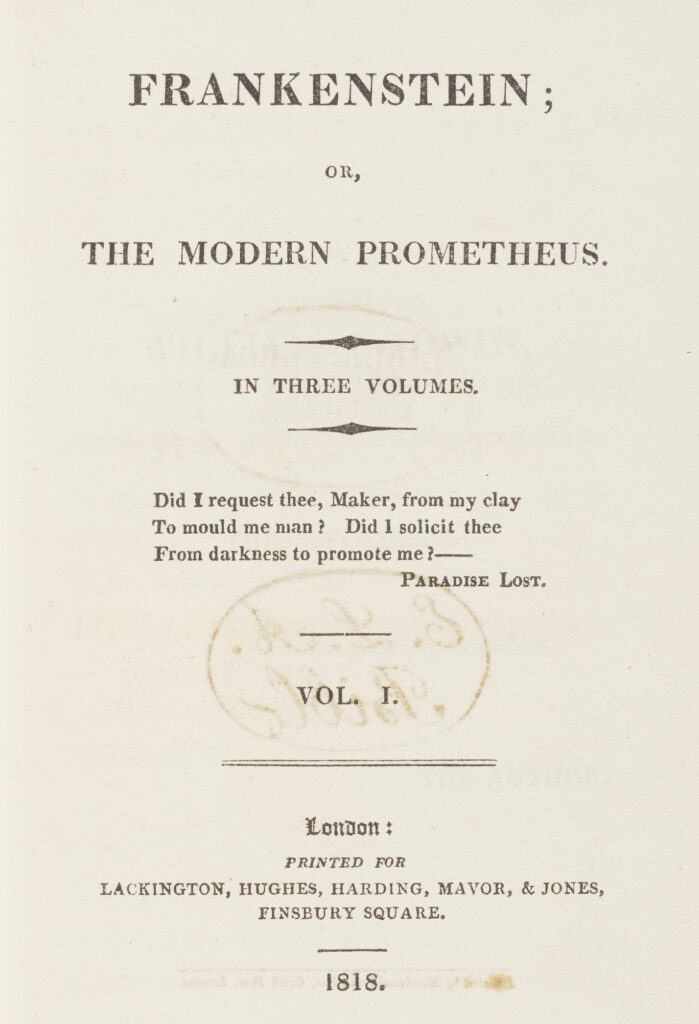
This message is embodied by the narrator, one Captain Robert Walton, a sailor who meets Victor Frankenstein in the Arctic during an expedition to reach the North Pole. Both men demonstrate ambitions to march into uncharted regions, either physically or scientifically, but although the ill and weakened Frankenstein encourages the sailor to complete his treacherous expedition, the image of what unbridled ambition has done to the young academic causes Walton to abandon the project and return to England.
It would seem as if there were a lesson well-learned in the sailor’s retelling of Frankenstein’s tragic tale. Learning to harness one’s unbridled ambition may be the most palatable lesson to be derived from the work; however, encountering an allusion to Frankenstein in another book inspired me to come back after many years and dig deeper into my thoughts on Shelley’s iconic science-fiction novel.
In Yuval Noah Harari’s non-fiction work, Sapiens, he writes that “this scientific mythology… at first sight… appears to warn us that if we try to play God and engineer life, we will be punished severely.” Harari continues, “We seek comfort in the fantasy that Dr. Frankenstein can create only terrible monsters” in his attempt to make an artificially superior human. “Any attempt to improve us will inevitably fail, because even if our bodies might be improved, you cannot touch the human spirit.”
I think Harari is misusing and extrapolating the lesson that Mary Shelley conveys in the novel. I don’t believe that the book is condemning those who push the limits of science, or that there lies inevitable failure and cosmic punishment behind the door of curiosity. Victor Frankenstein is punished not for creating the monster, but for abandoning it. The pain and torment he experiences is a direct consequence of his inability to take responsibility for the artificial life he has created.
Working for months on end in this endeavour of creation, Doctor Frankenstein intentionally suppresses his own ethical concerns regarding his project. He swallows the growing repulsion he feels toward the creature he is manufacturing, and it is not until his labours bear fruit and his creation first blinks to life that he fully comprehends the weight of what he has done.
He flees in horror from the grotesque figure that he has introduced to the world, and what emotion fills him when he returns to find the creature missing? Not anguish, but relief. He could “hardly believe that so great a fortune could have befallen” him, that the monster was out of sight and therefore no longer his responsibility. It goes without saying that this couldn’t be further from the truth.
The creature spends months adjusting to human society, but despite his efforts to acclimate, he is repeatedly rejected and persecuted for his grotesque appearance. His resentment towards his creator grows, and his sole motivation becomes vengeance. He consciously rejects the morals he has acquired through his observation of man and eagerly directs his violent temperament at the innocent people closest to Frankenstein. For this, the creature cannot be entirely blameless.
The doctor finds himself in an impossible situation, where neither killing the creature nor satisfying his demands seems to be the best course of action. The longer this inaction stews, the greater the consequences mount. Frankenstein seems unable to contend with the idea that the reality he desires, one in which the creature never existed, is an unproductive and fruitless ideal: he no longer lives in a pre-monster world.
If he had the foresight to anticipate the repercussions of a post-monster world, would he have pushed forward with his project regardless? Or is it simply a consequence of our innate human nature to always bite off more than we can chew?
Frankenstein discourse often asks the question: Who is really the monster? The vengeful science experiment who torments his creator, or the negligent scientist who disregards the ethical, or even paternal obligations that his creation demands? Perhaps we ought to point two fingers of blame, in that a monster has indeed created a monster. But should either of them truly be condemned for their actions? For their curiosity? For their injustices? Or for biting off too much and for suffering such painful, ethical tummy-aches?
By reducing Frankenstein to a tale of good and evil, we lose out on the richness of nuance. The topic of ethics, and in this case, the ethics of artificial intelligence, is inherently subjective; so approaching the issue with a die-hard loyalty to one side shaves away all of the rough edges, or all the complexities, that make discussion worthwhile. People like Harari can then slip this smooth, dull overview of Shelley’s work into the argument that works best for their narrative, and readers come away with a less complete idea of the ethical issue altogether.
I’ve evidently been mulling over my relationship with right and wrong as I read this book, and it was difficult for me not to pick sides and make a monster out of either character. Similarly, I have had a difficult time stepping away from my extreme stance on the growing use of artificial intelligence and considering all the nuanced perspectives associated with it.
Like Victor Frankenstein, I find comfort in the delusion that I live in a pre-monster world. When it comes to the future of education, I have convinced myself that being staunchly against AI will be sufficient in making sure any student of mine sees the value of using their own mind, doing the work and taking the path of most resistance. In my black-and-white, pre-monster world, complexity does not exist: to rely on AI is lazy, anti-social and uninspired, while condemning it is proper and noble.
Am I stupid? It’s beyond naive to think that children would willingly do something difficult when the easy way out is sitting right in front of them, and it’s even more blind to act as if them doing so is indicative of ignobility and laziness. How many cycles of curmudgeons have spit on the younger generation for their reliance on the internet, on typewriters, on microwaves, on the steam engine, on modern pharmaceuticals and gasoline without lead in it?
Back in my day, we didn’t have an omnipotent being on our cellphones that did our homework for us, but only if we did! If I hadn’t had such a visceral aversion to the use of ChatGPT, the last two years of my university career would’ve been a breeze.
That is in no way saying I would’ve been better off, and on the contrary, I still believe that would’ve been a complete detriment to my learning. But now I can better appreciate the nuances of why university students felt so compelled to use it. It doesn’t mean they were evil; it means they were using tools that had been provided to them more freely than I had.
I’m almost embarrassed to have had this subconscious ideal of a future of education that tucks artificial intelligence into the shadows. Who benefits from me sticking my head in the sand about the reality of AI? Not me, not my students, and not the institution of education. I too, like poor Frankenstein, find myself in an impossible situation where I cannot kill ChatGPT, nor allow it to become pervasive in education without there being severe consequences. Yet I feel as if it is the right thing to do to stop demonizing it and forcing it into the shadows and instead embrace the idea that artificial intelligence is a new reality.
How liberating it is to accept that an issue is complex, multifaceted and entirely subjective! I have identified a third entryway in the vestibule between good vs. evil, and it has opened up into an infinite hallway of doors and windows revealing a myriad of perspectives on the issue. Is it overwhelming? Do I want to go back into the vestibule? Sure! But sitting in the comfortable simplicity of “good vs. evil” means surrendering all the dynamic, exciting information that awaits me down that infinite hallway of nuance.
The question becomes, what is there to do about AI in education? I still wholeheartedly believe it is harmful for the process of critical thinking and curiosity, but it is an undeniably effective tool for researching and organizing information. The main takeaway of Frankenstein in this regard is the issue of responsibility. Are we, as educators, taking responsibility for the appropriate use of AI? Or are we continuing to act as if we live in a pre-monster world, where AI does not exist because it wasn’t around when we decided to be educators?
Responsibility might look like enforcing severe, irreparable consequences on students for taking the easy way out, but this once again relies on demonizing AI, and in doing so, will only encourage students to better hide their breaches of academic integrity rather than correct them. A better yet much more difficult approach to the issue is to accept AI as a reality of education and find ways to design lessons that anticipate or encourage the use of AI, while still rendering the use of it insufficient for the final product.
What does this look like? This could look like a return to physical media and tools interspersed with the use of AI for research. Let students use AI as much as they want to better grasp the lesson content, or to acquire all the knowledge they can and commit it to their greater understanding; however, when push comes to shove, the computers go away completely, and all they can rely on to succeed on that essay, that worksheet, or that lab is their brains alone. There cannot be an option to work on these things outside of the classroom; what is completed in that period is final.
Another implementation of AI in the classroom is to use AI in lessons and have students work backwards from there. “Here is a response from ChatGPT; here are the sources it has listed. Are these sources reliable sources of data? Where in this source is AI drawing its conclusions regarding point A, B, and C? Identify the parts of this AI-generated essay that feel flat, uninspired, or unconvincing. Do you agree with the points it is making? Why or why not? Add two points that you believe ChatGPT is missing in its argument. Spot the formatting difference between these two prompts and how it may have caused variation in their respective responses.”
This approach is by no means AI-proof or applicable across all disciplines, but you can see how questions like this make students engage with AI as a tool of learning rather than a replacement. Designing lessons in such a way can better prepare teachers in how they respond to inevitable AI use they find in their students’ work. Taking it out of the shadows and creating a conversation surrounding it will wean students away from the idea that they are getting away with something by using it on schoolwork.
Hopefully, such an approach will inspire them to make better-informed, mature decisions on how large a role they want AI to play in their education. If students and teachers can both recognize their obligations to understand the complexities of productive, ethical AI usage, it ceases to be an issue of good vs. evil, and we can progress forward in education rather than stagnate and yearn for our pre-monster world.
The young Mary Shelley aimed to create a creepy story to spook her husband and his friends during a vacation in Switzerland; what she conjured up over the next two years has since become a ubiquitous allegory on the dangers of irresponsibility, and a philosophical reflection on man’s compulsion to take on far more than he can handle.
The work evidently transcends its pop-cultural iconography of mad scientists and monsters and is in reality quite a beautiful and moving book about the faults of our species. Frankenstein’s creature gently acclimates to the world of man, discovering fire, language, love, music and literature.
He also uncovers the lesser traits of humanity, like betrayal, murder, cruelty and terror. His journey is set against beautiful landscapes in Western Europe, and Shelley unites the changes in weather and season to the changes in temperament of her characters, which I found to provoke almost a vicarious emotional response in the reader.
Frankenstein is a journey that undulates between peace and turmoil in a way that is positively human, and I come out of this book again, years after I read it in high school, with a much greater respect for the nuances of good and evil, action and consequence, and the ethics of artificial life that we fear will make monsters of us all.



