


When leaders and philosophers travelled to Delphi to seek guidance from the Oracle at the Temple of Apollo, they would regularly see three stylized inscriptions that welcomed all who approached from near and far.
“Know Thyself.”
“Nothing in Excess.”
“Surety Brings Ruin.”
Individually and together, they express coherent ethical visions that support themes of understanding one’s strengths and limitations, avoiding extremes, and cautioning against unwarranted confidence.
While diving into this week’s book, I was continually reminded of the temple’s inscriptions.
Know thyself
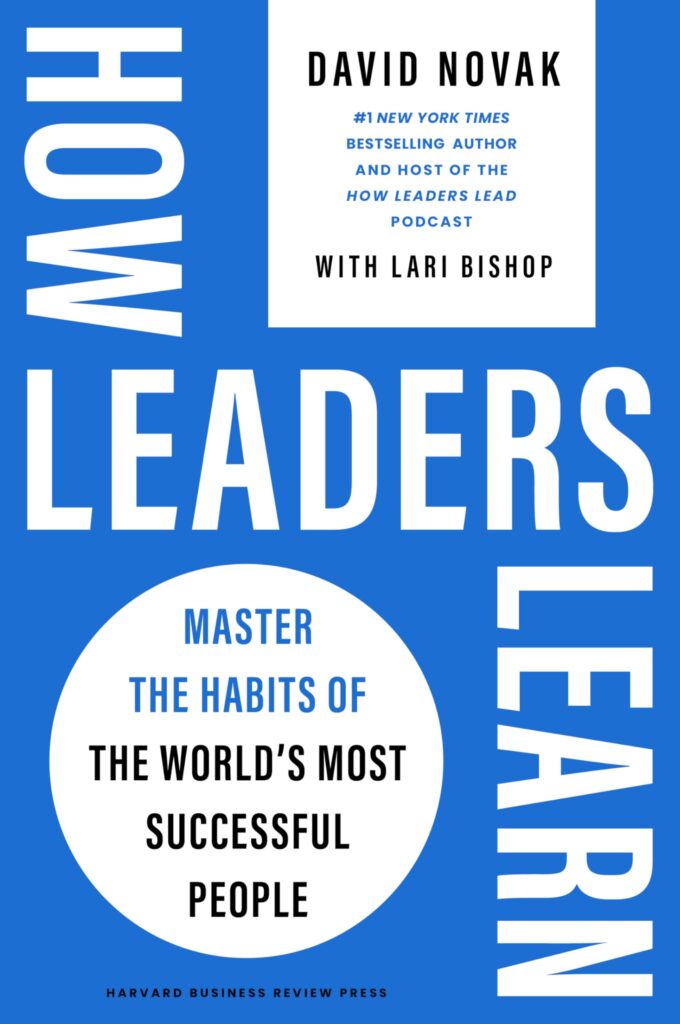
In 2024, Harvard Business Review Press published David Novak’s How Leaders Learn: Master the Habits of the World’s Most Successful People.
Novak blends his own experiences, insights from his career and interviews with successful leaders from business, sports, government, and military sectors.
Looking at what Novak (a former CEO) shares about how to successfully lead, it can be summed up in two ideas: know yourself and never stop learning. Novak expresses that leadership is not merely a function of intelligence, the lone result of opportunity or an accumulation of experiences. What makes the dynamic difference is when an individual embraces the avenue of eternal learning.
The forever curious
After personal reflection, study, and a myriad of interviews, Novak found that the distinguishing factor of effective leadership was leaders who remain eternally curious, lifelong learners who foster a love of learning in others (and cultivate an overarching culture of learning) and who engage in perpetual reflection.
Novak offers insights to accomplish these goals.
First, Novak shares that leadership begins with understanding and knowing yourself, as good judgment begins with self-awareness and reflection. Formative experiences, successes, failures, pivotal moments and mentors along the way are all part of this self-awareness.
Second, Novak makes the case that there is a difference between gathering information (knowledge without action) and learning, where learning involves asking questions, making observations, continually seeking new experiences, and testing ideas.
Third, there are habits that can be cultivated to embed curiosity as a discipline that defines leadership. The exploration of unfamiliar or unpopular viewpoints, reading broadly, spending time with others who think differently, and possessing the humility and openness to be wrong are all ways to keep eternal curiosity central to one’s daily life. This point struck me as very relevant to our times, when perpetual echo chambers (where a person is only aware of a personal opinion but is rarely introduced to alternatives), the oft-forgotten value of intellectual diversity, and the conflation of fact and opinion can each stifle substantial growth and the expansion of one’s horizons.
Fourth, learning from everyone at all levels of one’s organization is key to building a better understanding of the organization firsthand. As a CEO, Novak spent a substantial amount of time with employees who made pizzas and rode along during deliveries. The more insulated a leader becomes from the experiences of the team, the less effective that leader becomes.
Novak also shares that reframing setbacks and failures as opportunities to learn and improve, surrounding oneself with those who offer candid feedback and perspective (rather than yes-men), and establishing consistent processes within an organization are keys to achieving overall goals.
Finally (and perhaps the strongest key), Novak advocates for leaders creating cultures of learning that support individual development and organizational leadership. Celebrating thinking (rather than only results), rewarding curiosity, encouraging experimentation, and normalizing mistakes and setbacks as opportunities that lead to new pathways of success and improvement complete the temple Novak builds in stone and memory.
From the temple’s gate
I think Novak’s work is highly effective, very practical, and follows an approach that is both accessible and internally consistent.
Although there are not many new approaches unveiled, Novak provides a synthesis of countless keys to effective leadership drawn from disciplines often far removed from one another. This is the magic of this resource. It is built from experiences and insights gathered from distant professional and personal worlds while, at the same time, revealing the same gems of wisdom and approach.
The insights are highly anecdotal rather than data-driven, but I believe that is the intended charm and purpose of Novak’s approach.
As the oracle smiles
Closing Novak’s book to reflect upon it in the early morning hours, the spirit of the Delphic Maxims still warmed the room.
Beginning with an understanding of one’s own strengths, limitations, motivations, gifts and blind spots is often the first step toward wisdom.
Know thyself
Always remaining open to perspectives different from our own, not allowing the seats and titles we inhabit to place us into one-dimensional thought, and ensuring balance within our approach ensures growth and multidimensionality.
Nothing in excess
Ensuring that one’s curiosity is eternal, learning is forever, and one remains a lifelong learner and avid student of many things can protect us against certainties that become stagnant orthodoxies in place of wisdom and foresight.
Surety brings ruin
A highly recommended resource for budding leaders in every sense of the word.
Perhaps in a former life, Novak once sat at the feet of Pythia and carried the maxims from the temple’s walls within his heart, mind, and soul.
They are truly timeless, for the long arc of learning is also the long arc of understanding.
Harvard Business Review Press, 288 pp., $28




