



In 2024, historian and essayist Christine Rosen (who has written at great length about ethics and consequences of technological innovation) wrestled with a simple question:
“What happens to human life when more and more is experienced by means of screens and less and less is experienced directly?”
In her book The Extinction of Experience: Being Human in a Disembodied World, Rosen shares that while innovation can be a positive (and while technology isn’t a negative in itself), it often comes with a cost.
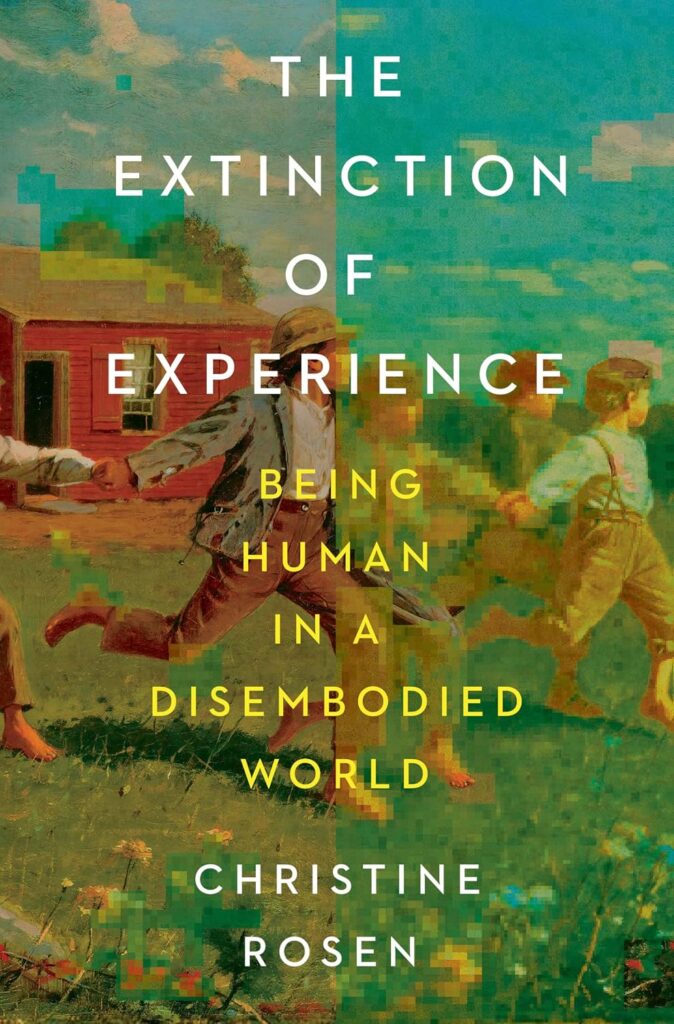
There are five central claims in her authored work:
- Technology competes for attention (with consequences such as shorter attention spans, limited reflection, less patience, and reduced capacity to engage with complex matters).
- Although solitude is where reflection, creativity, independent judgement, and self-understanding develop, time for solitude is easily filled with engagement with smartphones, news feeds, notifications, and streaming social media. This is the domain where dwindling reflection and increased reactivity is born.
- Increased technology-mediated exposure can take away from competence (even though information is maximized). Rich experience such as playing outside, community participation, laughing with peers, and understanding body language and nuance are often placed aside.
- Although technology can connect us over distance, true community is built through repeated physical encounters and being present (such as through school events, sports, volunteerism, religious communities, and gatherings in each town and city) in a shared reality.
- Although technology removes friction, it is often through friction where patience, resilience, problem-solving, and social skills are planted, watered, and grown. In this way, convenience can be a departure from a rich developmental path.
Being an Xennial (part of the microgeneration between Generation X and Millennials with memories defined by an analog childhood and digital adulthood), I acknowledge the change and very real consequences of when the concept of community moves from presence to convenience. There’s something that becomes gradually absent. I believe Rosen captures the concept and names the cost rather well.
Authored and published during the explosion of smartphones, virtual reality options, Zoom, and Microsoft Teams, it is a timely caution if one listens.
Although it can feel (at times) that the past is romanticized and the benefits of technology seem underplayed in Rosen’s writing, it is highly relevant and potentially reflective for those entrusted with civic and social leadership.
Seeing public spaces, parks, libraries, celebrations, waterfronts, and venues as glimmering oases that keep community alive (when convenience often pulls in the opposite direction) is a way to invest beyond infrastructure in what it means to be human.
Prioritizing citizen participation in civic affairs (beyond remaining at the spectator level) and helping to build understanding of processes, roles, and information has the potential to lessen things like low civic turnout, public cynicism, polarization, and Facebook arguments replacing true understanding through dialogue.
Festivals are foundational civic assets just like water mains and effective policy. They are places where concepts such as social trust, civic identity and community pride can bloom.
Relationships, traditions, shared stories and community continuity are all gears in a dynamic local identity.
Although Rosen’s book falls more towards diagnosing challenges rather than providing in-depth solutions, it does wake one up to sentiments once shared by philosopher Jean Baudrillard in Simulacra and Simulation.
If Rosen is proposing the question “What happens when direct experience is being replaced by mediated experience?”, Baudrillard went a step further.
“What happens when the representation becomes more important than reality itself?”
Like everything, there are positives and negatives to anything we explore.
Perhaps what it means to be human is to be able to wrestle with these questions and discover a delicate balance between the two.
Perhaps a healthy municipality is not merely a pin on a map, a place of service delivery or the crossing of coordinates, but a place where meaningful shared experiences occur.
If home is where the heart is, home truly contains the infrastructure of belonging.
What brings the human heart to life there may be the greatest investment of all.
WW Norton, 272 pp., $27.99




