



It is important that I begin this review with a miigwech, a thank you, and a merci—specifically, to those who contribute their time and focus to civic life in our town of Fort Frances. I suspect those who carry the responsibilities of mayoral and council roles in noble ways may not hear this as often as deserved.
Election time is right around the corner in our town. Between this week and when civic renewal occurs once again, I’ve decided to steer our weekly book reviews toward shimmering embers and ideas that orbit the topic of leadership. Civic ideas, rather than political treatises, will hold the gravity of these columns, as the former concerns principles and service while the latter concerns power.
Acts and impacts
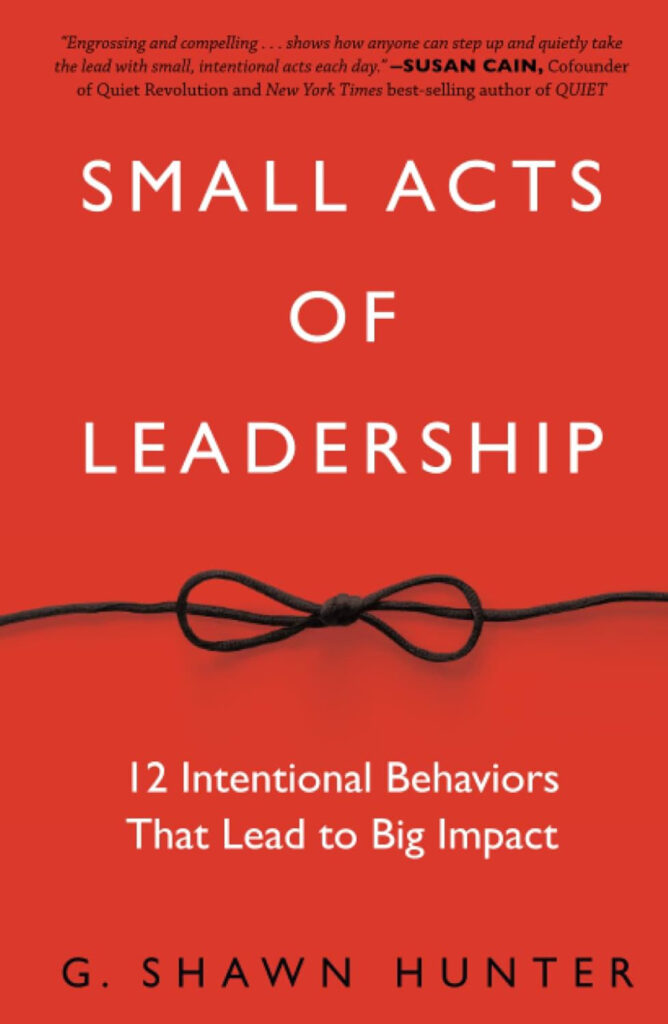
Published in 2016, Small Acts of Leadership: 12 Intentional Behaviours That Lead to Big Impacts by G. Shawn Hunter continues to prove its value (endlessly and without fail) each successive year. Ultimately, Hunter shares that effective leadership is not really about positions of authority, charismatic words, power plays or grand gestures. The true impacts come from the stacking up of very small (but repeated, consistent and continual) daily choices.
Although this may be counterintuitive, repetition of small choices creates more substantive and long-lasting impacts than large, occasional, climactic successes.
Using examples (not just anecdotes), Hunter shares the following 12 small acts that can be poured into situations, roles, and responsibilities—whatever or wherever they may be.
Believe in yourself
Leadership begins when decisions can begin before total certainty. Stepping out of self-doubt (while remaining open to learn as a counterweight) can build leaders. Those who cultivate self-belief are more likely to bring ideas, propose solutions, advocate more openly, and embrace difficulties.
Even when facing criticism, pressures, or controversial decisions, believing in your ability will allow you to better contribute to the well-being of your community.
Build confidence
We are not born confident. It is built by means of experience, preparation, and knowledge. Each challenge that you navigate will have a compounded effect, where future challenges can be more easily navigated.
Like all roles of responsibility (new and seasoned), we are all building ourselves with the more we learn, do, and with what we engage.
Embrace challenge
When navigating complex problems that stretch current capabilities, growth occurs. Preserving comfort while avoiding difficult matters prevents improvement.
Express gratitude
When we recognize municipal staff and what fellow leaders bring to the table, it reinforces positive behaviours that ripple outward. Those who feel appreciated are more likely to remain engaged, committed, and supportive.
Ignite curiosity
Curiosity leads to learning. Continual learning compounds positive and protective effects by helping us question our own assumptions, grow beyond orthodoxies of comfortable (albeit outdated) ideas in any topic area, and helps leaders confidently avoid getting trapped in ideology or ensnared in the opposite of intellectual humility.
Honour autonomy
Excessive control and micromanaging collapse another’s creativity, sparked initiative, or continual building of skills and accountability. We perform best when we are truly trusted to use our gifts, judgment and unique flavour of contribution.
Reach for authenticity
The late U.S. Senator Paul Wellstone once said: “Never separate the life you live from the words you speak.” This doesn’t mean perfection, nor does it invoke avoiding contradiction (as contradictions do not mean lack of integrity, but complexity). It simply means aligning actions with one’s values—not just in word, but in action. The more this is communicated by our walk (especially without the talk), the more effective the leadership.
Be fully present
Giving others full attention and active listening can reveal important insights that might be missed otherwise.
Inspire others
Connecting others to a larger purpose and an exciting vision worth striving for can demonstrate how their time and energy matter.
Clarify roles
Clear roles, responsibilities, expectations, and decision-making authority of all involved (including those at the forefront) help prevent confusion, frustration, and growing cynicism.
Defy convention
Question assumptions, explore new approaches and challenge “the way it has always been done.”
Know when to take a break
Reflection. Renewal. Recharge. Pressure without recovery reduces judgment, effectiveness and wellness.
I really enjoyed Hunter’s approach and analysis, as it fuses a few positive elements like a timeless alchemy. His chapters use examples rather than anecdotes. This moves insights beyond intention to effect.
It explores the soul of leadership deeper than title or avenue of involvement. This helps insights reach far beyond civic life into countless ways to bring leadership to life.
Above all
So, what is the point of this approach? Ultimately, synthesis.
It is a common mistake often born of entitlement-inflation and ego to imagine anyone can tell another how to do one’s job better than the person shouldering the experience and the responsibility themselves. This is akin to the spirit of someone being more certain what is best for another—better than they know for themselves.
This approach for this review (and others that will follow) is akin to reaching into our world of ideas, retrieving ideas and insights and making them available to those who may enjoy another arrow in their quiver of approaches.
I believe when we support noble leaders in noble ways, the choice manifests in the quality of our communities and, in turn, in the quality of our lives.
Good luck to everyone letting their names stand.
We got you.
Clearly, so does Hunter.




